

Sponsored by

Nobody quotes a fixed price for AI any more.
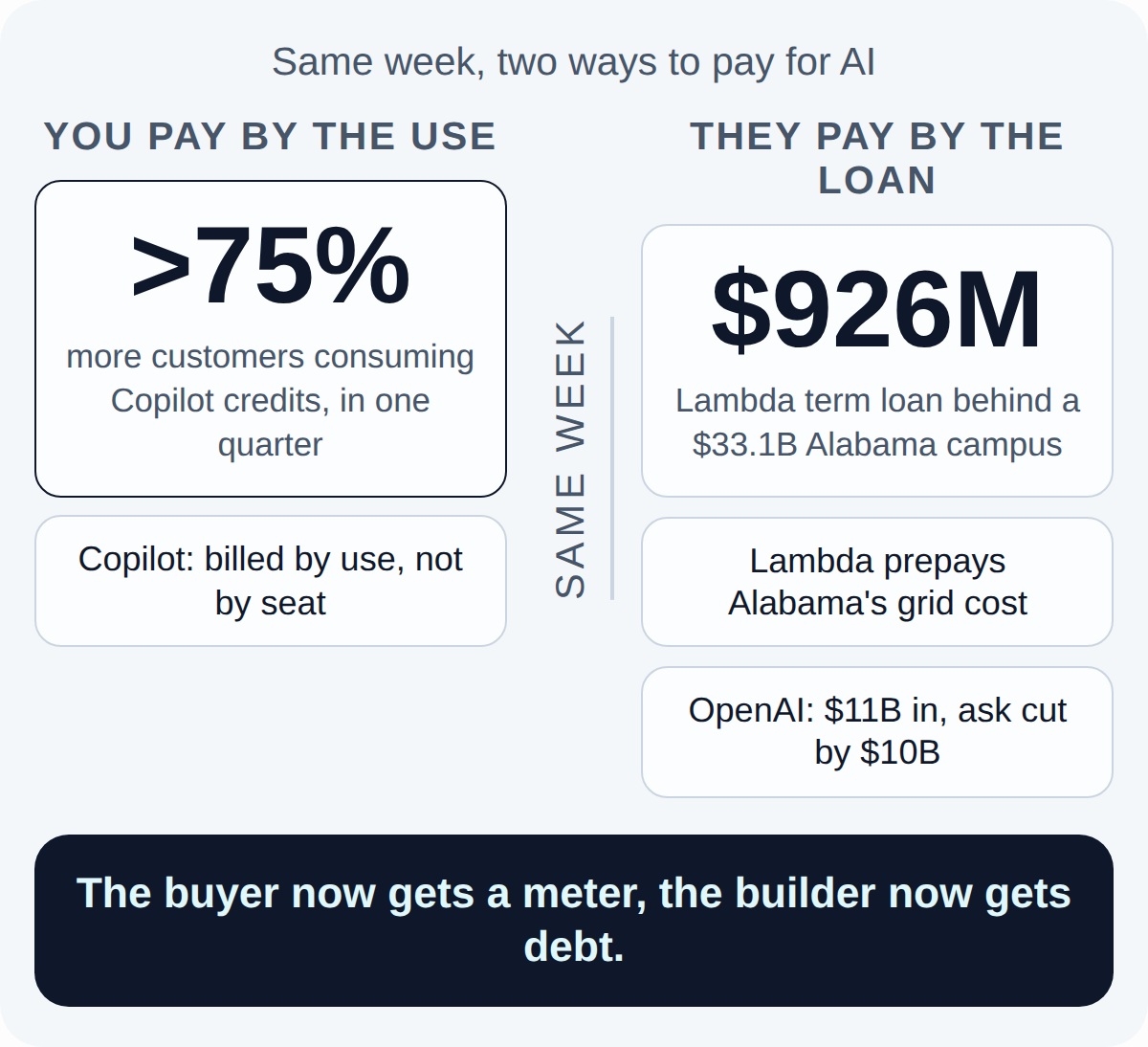
Three money items from the weekend, and not one of them carries a number you could drop into a budget line. Microsoft moved new Copilot buyers onto paying for what they use. Lambda is paying for a power grid in Alabama before it draws a watt, with borrowed money, and OpenAI closed part of a round it had already shrunk.
Advertisement
Finally, a Monday that doesn’t feel like one.

Imagine a Saturday where you're not catching up on the CRM you didn't touch all week.
HubSpot's new self-updating CRM doesn't wait for you to log back in. Friday's calls are already logged. The deal that needs a nudge Monday morning is already flagged. The automation you set up once keeps running without you thinking about it. None of it needed you over the weekend.
Customers are already seeing it pay off: 45% more deals closed. Finally, you start Monday caught up, not behind.
1. Microsoft turned the Copilot meter on by default
Usage-based billing is now enabled by default on new Microsoft 365 Copilot Business purchases, in a run through the Ignite 2026 licensing changes. You do not opt in to the meter, you opt out of it.
The same write-up reports that customers actively consuming credits grew more than 75% over the quarter, and that there is still no published seat count.
A distributor's monthly round-up of Microsoft changes had Flex Spend Plans going into testing on 2 November, alongside a 30-day Copilot Business trial. On 6 November two unrelated write-ups circled the same blind spot: the distance between licences bought and licences actually used, and how to find every AI subscription and API key inside a company.
I think the meter is the honest instrument and the dangerous one at once. A seat licence told you your worst case on the day you signed it. A credit pool tells you nothing until the invoice lands, and the people generating the consumption are rarely the people who defend the number in March. My expectation is that the first unpleasant surprise in most companies arrives as a true-up rather than as a price rise, and it arrives from a department nobody thought was a heavy user.
2. Lambda will pay for Alabama's grid before it draws a watt
Lambda is planning a $33.1 billion AI data centre campus in Lowndes County, Alabama. Alabama Power will supply the electricity, pending regulatory approval.
Lambda pays the full cost of the power and the grid infrastructure up front. It also announced a partnership with N-Drip to help local farmers conserve water.
The financing sits in the same announcement: a $1 billion senior secured fixed-rate deal and a $926 million senior secured term loan B. On 29 October a write-up on how AI is being funded had Lambda taking a $1.008 billion secured loan at a fixed 6.78% to pay for GPU deployments, and the same day Gartner put $3.5 trillion of AI infrastructure spending at risk by 2030.
Prepaying the utility is the cleverest line in this whole build, and it is not the line that worries me. Every ballot and every rate hearing this autumn has turned on who carries the grid cost, and Lambda has taken that argument off the table by writing the cheque. What it cannot write off is the interest: a campus funded at a fixed 6.78% has to earn its coupon every quarter, whether or not the tenants it was built for are still buying in 2029. I read the water partnership the same way, as the cost of keeping a county on side.
Advertisement
Why are so many brands shifting ad spend to CTV?

For marketers who want a presence in streaming, Roku is the obvious place to go. With 47% of all streaming time in the US, it has more reach than every competitor. Discover how Roku Ads Manager can spread your message across 100+ premium apps in a single, self-serve ad buy.
3. OpenAI has $11 billion in, after cutting the ask
OpenAI has closed $11 billion at a $1.25 trillion valuation. We ran the other half of this on 1 November, when the target came down by $10 billion to about $20 billion. So this is the first portion of the smaller round, not a new one.
Eleven of twenty, taken in portions, reads to me as investors pricing the round the way a lender would: in tranches, against milestones, with the right to look again. That is a healthier market than a single closing at a number set in the summer, and it is also the shape of an industry that has stopped being able to quote itself a flat price. I would read the conditions attached to the next large AI round before reading its headline valuation.
Names to watch
Seen this week by Ins7ghts, our research platform: a knowledge graph of the data and AI news we read every day.
- Konstl · Geneva software that cuts a building's energy use
Cost control. Technis acquired it on 6 November to strengthen how it optimises building energy consumption.
Companies that later raised money had been in the news about twice as often in the quarter before. Worth a second look in three months.
Advertisement
22 ChatGPT Agents Built for Every Marketing Job

Most marketers use ChatGPT to do general research and then call it an AI strategy. The ones outperforming them are deploying specialized agents built for specific jobs.
We put together 22 plug-and-play ChatGPT marketing agents that handle the work eating your week, each with built-in instructions and structured outputs ready to go in under 5 minutes.
Subscribe to Marketing Against the Grain and get all 22 free.
Inside you'll find:
Competitive intelligence agent that visits competitor websites and builds detailed comparison matrices automatically
Customer feedback analyzer that ranks improvement opportunities by business impact
Social listening specialist that monitors brand mentions and flags reputation risks before they escalate
Campaign optimization agents that handle attribution analysis and surface what is actually driving results
Your competitors are already running agents like these.
Get 22 ChatGPT Marketing Agents free when you subscribe to Marketing Against the Grain today.
Also today
- Anthropic is aiming to list on Nasdaq before Thanksgiving, seeking $80 billion to $100 billion at a targeted $1.25 trillion to $1.75 trillion. (2 min read)
- Harvey, the legal AI company, is in early IPO talks with Latham & Watkins after a jump to a $15.5 billion valuation. (4 min read)
- CD&R and GTCR are working on a $40 billion take-private bid for Global Payments. (3 min read)
Week AheadThe long stop date that moved
Diginex has been buying Resulticks, a customer engagement platform, in an all-share deal its shareholders approved on 13 October. On Friday it pushed the long stop date out to 19 November and convened an extraordinary general meeting. A long stop date is the day an agreed deal lapses if it has not closed, and this one decides who owns a platform other companies run their customer messaging on.
Which supplier commitment in your stack has a date on it that nobody put in a calendar?
My call: by 30 November 2026 Diginex completes its purchase of Resulticks on the 19 November date it has just set itself.
If you signed an AI contract this year where the price you agreed is still the price you pay, hit reply and tell me.
Yves
Tomorrow, What Shifted: three things that actually moved last week, and the thread between them.
Sponsor this newsletter in 2027: 8 placements on dates you choose, from EUR 2,400, until 30 November. Book: 7wdata.be/sponsor-2027
Ins7ghts Daily is published by 7wData.