

Sponsored by

The agent answers, a person still carries it.
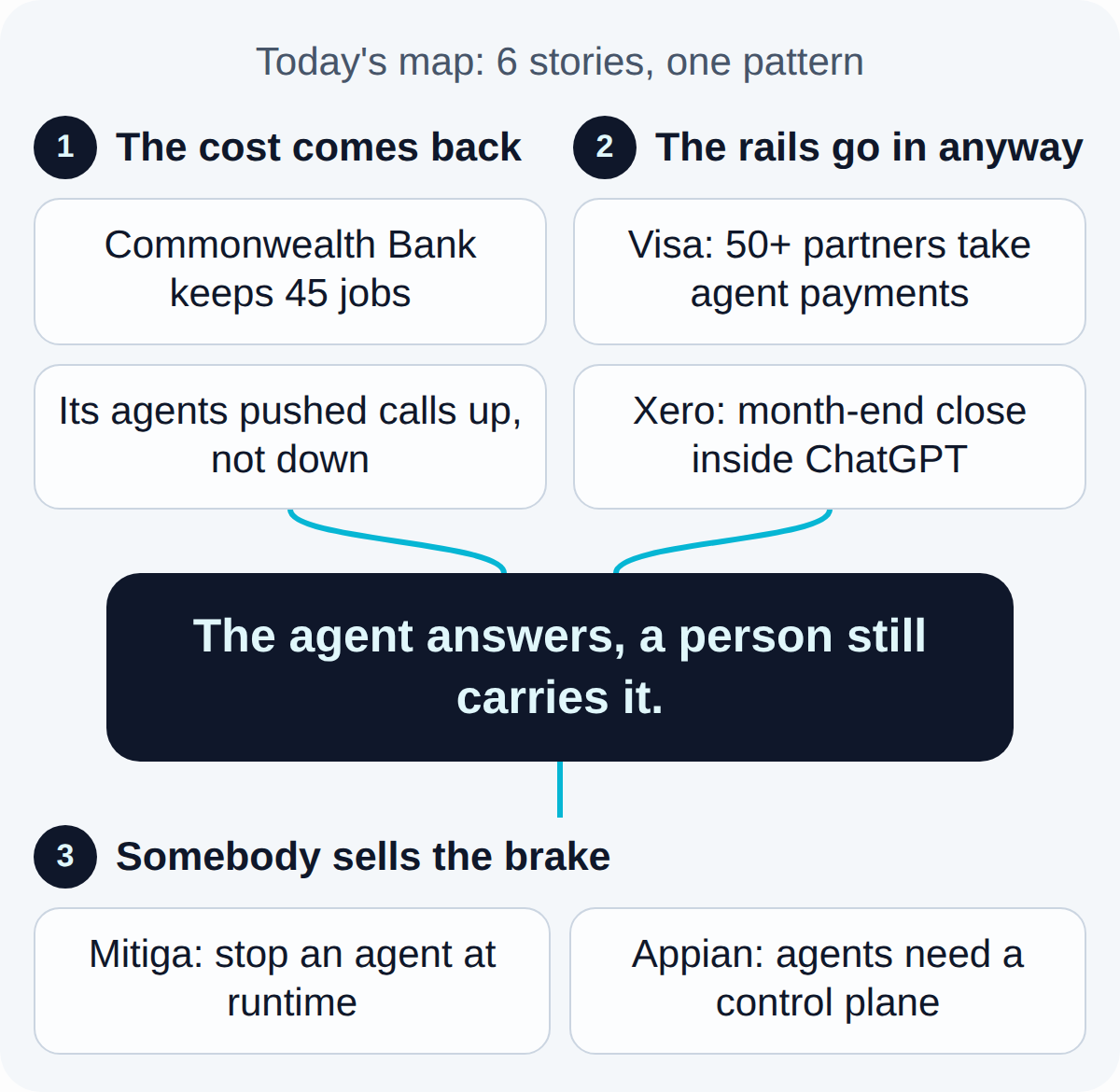
Three things from the last two days sit on the same moment: an AI acts, and then a customer or an auditor comes back to a human being. One bank found that out by counting its phone calls. A card network and an accounting platform are building for it deliberately.
Advertisement
A CRM so smart, it updates itself.

HubSpot's CRM is so smart, it now updates itself. Calls get logged and summarized the moment they end. New leads get researched and a first outreach drafted, automatically. Deals move forward on their own, with next steps flagged before you have to ask.
Even the one repetitive task you've been meaning to fix can now run itself, no code required. Customers using it are already seeing the difference.
This isn't the CRM you have to work hard to figure out. It's the one already working before you log in.
1. Commonwealth Bank kept 45 jobs it had planned to cut
Australia's Commonwealth Bank put AI agents in front of customers and then reversed plans to cut 45 customer-service staff, because the rollout led to a surge in user calls.
The calls went up, so the 45 people stayed.
The same piece puts Meta's Muse at 10 million users across the United States and Canada within about six weeks of launch, so adoption is not the problem here.
On 23 October Uber had rolled ChatGPT Work out to all 30,000 of its employees, which is the same bet pointed inward, where an unfinished task lands on a colleague instead of on a switchboard.
I read the reversal as a counting problem before it is an AI problem. A call that arrives because the agent could not finish the job is a cost, and almost nobody has that number wired to the same dashboard as the saving, so the saving gets reported months before the bill does. Before signing off on any headcount figure attached to an agent, I would count inbound contacts for a full month and make that the baseline nobody is allowed to quietly forget.
Playbook · Teach Claude to tell bought from bid

"Fox Plans To Acquire Roku": two AI models read that article, one said bid, the other said agreed. The playbook shows how to tell whether an acquisition is completed, agreed or only a bid.
Advertisement
Agencies & manufacturers: your workflows have a new buyer

Does your team run on Slack, SOPs and documented processes? AI labs pay for that history to train their models.
Bezel (YC W25) matches US and Canadian companies with 30+ employees to the right lab.
Deals start at $100k and are fully anonymized with no PII shared.
2. Visa signed up more than 50 partners for payments an agent starts
Visa expanded its Agentic Ready programme across Asia Pacific and moved it into acceptance, the merchant end of the chain. More than 50 payment and merchant entities are signed up: acquirers, payment service providers, gateways and selected merchants, all preparing to take a Visa transaction that an agent begins rather than a person.
Four days before that, the Cloud Security Alliance published a note on where the loss lands when an agent's payment wallet goes wrong, with the card networks named as partners inside the frontier labs' own wallets.
What holds my attention is not the 50 partners, it is the dispute. When an agent buys the wrong thing at the wrong price, the chargeback becomes a provenance question: can anybody produce what the agent was told, by whom, and at what moment. The acceptance side is being wired this quarter and the evidence side is still a research note, so the opening fight in agentic commerce lands on who holds the record, not on fraud detection.
3. Xero put the month-end close inside ChatGPT
Xero expanded its OpenAI integration with ChatGPT for Accounting. Accountants and bookkeepers can start a month-end close review, a client portfolio review and quarterly review preparation inside the chat window instead of inside the ledger.
Microsoft had been moving the same way: on 30 October it added accounting capabilities to Copilot, with finance skills in Excel.
A close is a dated, signed thing that has to be reconstructable two years later for an auditor who was not in the room. A chat transcript is not that, unless somebody has already decided where it is stored, for how long, and who can pull it out. I would ask Xero and OpenAI one question before letting this near a real close: who retains the conversation, and can the client export it. Explainability is cheap to promise at a product launch and expensive to produce in an audit.
A security vendor and a software boss described the same missing layer
Nobody put these two together. On 19 November Mitiga launched AI Agent Security, runtime detection and control for the agents already working inside cloud, SaaS and identity systems on credentials the company issued itself. The same day, at Appian Europe, chief executive Matt Calkins told the room that weird AI needs an enterprise control plane. One is a press release, the other a keynote, and neither mentions the other. Read together they describe the same hole: the agent is inside the business, on the business's own credentials, and the place where somebody can stop it halfway through an action does not exist in the stack today.
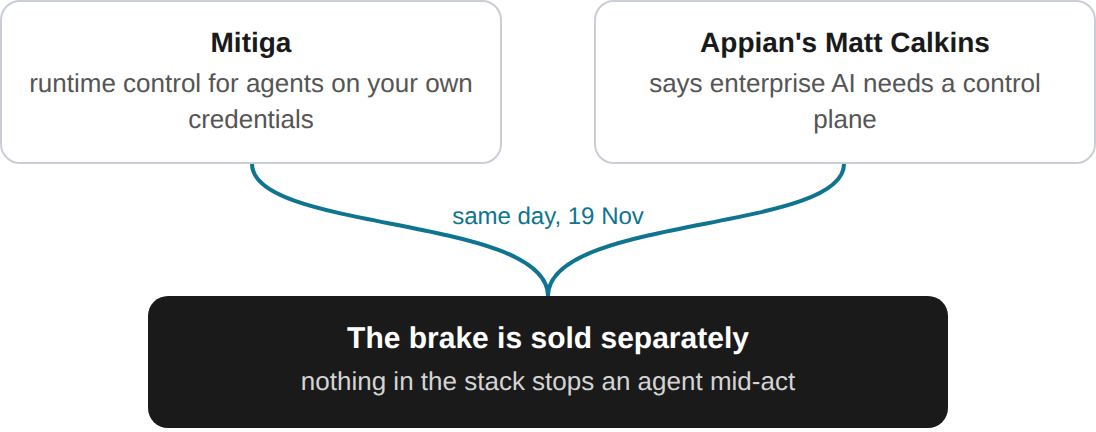
If the person carries it, the person needs a brake, and right now the brake is sold separately.
Today's context on 7wData
- AstraZeneca renews Tempus AI oncology deal with $200 million commitment AstraZeneca has committed $200 million in fees to Tempus AI over five years, under an oncology renewal signed on 16 November 2026 that takes effect on 1 January 2027, Tempus AI's SEC filing shows.
- Isomorphic Labs raises $5 billion Series C co-led by Greenoaks and Sequoia Isomorphic Labs, the AI drug discovery company that spun out of Google DeepMind, has raised $5 billion in a Series C co-led by Greenoaks and Sequoia Capital, C&EN reported on 18 November.
- Korea Venture Investment picks Shinhan and Timeworks for $20.4 million commitment Korea Venture Investment has committed $20.4 million (₩30 billion) to two fund managers, a Shinhan joint fund and Timeworks Investment, whose overseas expansion funds still have to be formed within three months.
Advertisement
Don’t lose overseas candidates while setting up a local entity.

Found the right person, but no entity in their country? Remote’s Employer of Record (EOR) lets you hire without setting up a local entity. We become the legal employer, with an average onboarding time of 3 days, handling employment contracts, benefits and payroll taxes in line with local requirements.
Also today
- President Trump said the United States is against globalist regulation of AI in any form. (2 min read)
- Scale moved into hospital operations with five purpose-built AI agents. (7 min read)
- Alteryx introduced VURA, a governance layer aimed at trust in AI outputs. (4 min read)
The Long ReadYou cannot hold a launch window in your hands
I always bought my records physically. The sleeve was in my own hands, I could put the record on a deck and listen to it before paying, and the choice was mine. Very few disappointments came out of that.
Yesterday Google signed Blue Origin for the first heavy-lift launch of Project Suncatcher, its plan to run AI systems in orbit. The capacity in that announcement cannot be put on a deck and listened to, and neither can most of what sits in an AI roadmap now.
Which of the capacity numbers in your AI roadmap rest on something you have actually seen working?
My call: by 31 December 2027, no heavy-lift Project Suncatcher launch will have flown.
If you have put an agent in front of customers and found that the work moved somewhere else instead of going away, hit reply and tell me where it went.
Yves
Sundays are for Week Ahead: what is already on the calendar for the coming week.
Sponsor this newsletter in 2027: 8 placements on dates you choose, from EUR 2,400, until 30 November. Book: 7wdata.be/sponsor-2027
Ins7ghts Daily is published by 7wData.