

In partnership with

Today's buyers wanted the company, not the contract.
Three purchases landed inside a day and not one of them is about a model. A government put money on a share register, a software company bought a defence engineering team, and a help-desk vendor bought its third IT operations business of the year. Every one of those could have been signed as a contract, and nobody signed one.
Advertisement
Your company data could be worth $100k–$3 million

There's a new channel of revenue that has just been unlocked for companies with over 20 people that have been around longer than a year.
Few know it, but AI labs now let you monetize your company’s operational data, and they're spending $15 billion this year on it to train the next frontier of LLMs. Your workflows, documentation, processes, and internal convos like Slack are extremely valuable and they're paying anywhere from $100k to $3 million for it per company.
Before you ask, all the data is anonymized and cleaned before it's sent to a Lab. Bezel (Y combinator backed) helps find a data partner that is the best fit for you.
1. Canada bought shares in its own AI supplier
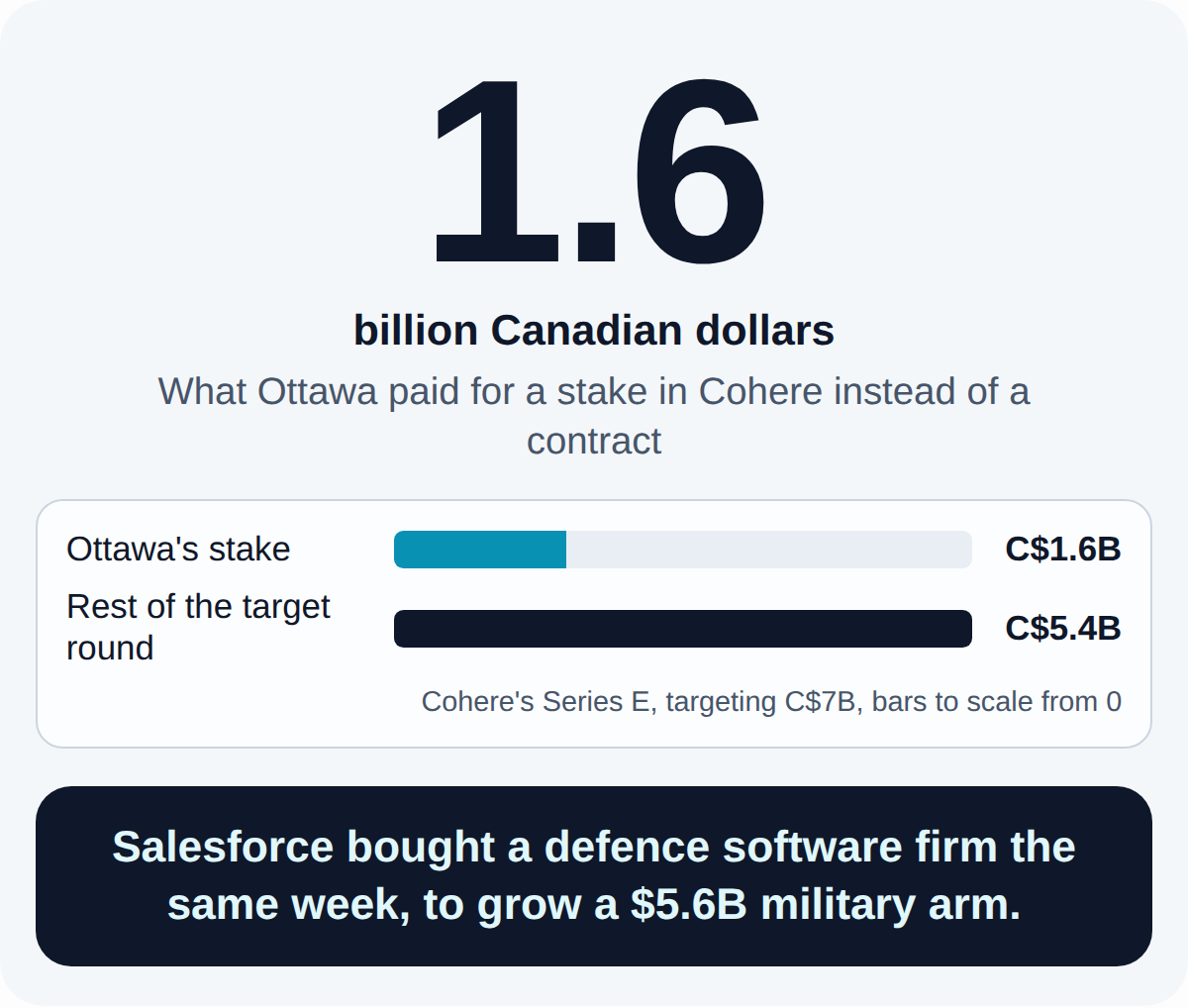
Canada announced a C$1.6 billion equity investment in Cohere, the Toronto model company. The Globe and Mail and the Wall Street Journal both read it as what it is: the federal government on the share register.
It sits inside a Series E targeting C$7 billion at a C$35.7 billion valuation. The same write-up carries the part that will matter longer.
Cohere also signed a memorandum of understanding with the Government of Canada to put its technology across the public sector.
The company has spent October rearranging itself around exactly this kind of buyer. On 5 October it signed a merger agreement with German developer Aleph Alpha, keeping the Cohere name; on 6 October PwC announced a global alliance with it, starting in Canada; on 16 October it said it would buy Aisle, a Czech vulnerability remediation startup. Yesterday Ursula von der Leyen named the German merger in a keynote on EU and Canada relations.
I think Ottawa bought the wrong half of what it was after. A shareholding gives you a claim on the upside and a seat near the cap table; it does not decide where a model runs, who else can query it, or what happens to the training data of a department that files through it. Those are the questions a sovereignty argument is actually made of, and they live in the memorandum, not in the equity. The stake is what got the press release. If I ran a Canadian department I would ask for the memorandum first, because that is the one that gets quoted back at me.
2. Salesforce bought its way into defence software
Salesforce agreed to acquire Rune Technologies, a defence software startup, and will fold it into Missionforce, the military business the write-up puts at $5.6 billion. No price came with the announcement.
A day earlier it agreed to buy Loops for an estimated $30 million, an Israeli AI analytics company going into Tableau, with closing expected in early November.
An analytics team one day and a defence engineering team the next is not a spree. It reads to me like a company that would rather own the way into a room than be introduced. The part that interests me is the accountability bill that comes with the second one. A defence customer writes down who answers for a wrong output, in a way no CRM renewal has ever had to, and that obligation now sits inside a company whose other customers have never been asked the question. I would read Missionforce's terms of service long before I watched its demo.
Advertisement
Postgres analytics slowing down? Skip the second database. TimescaleDB extends Postgres so dashboards stay fast on live data. No pipeline, no migration. $1000 to start on Tiger Cloud. Get $1000 Credit
3. Freshworks bought the thing that counts what AI staff are running
This is a help-desk company assembling an audit trail out of other people's products. Robusta, an incident intelligence engine, is its third IT operations deal of 2026. The set, as the coverage lists it:
- Robusta, incident intelligence
- Torii, which tracks software and AI usage, under a definitive agreement
- FireHydrant, incident management, completed for about $88.7 million in cash
- Device42, IT asset management, agreed at $230 million
Cooley advised on Robusta on 28 October and on the Torii agreement on 12 October. By 20 October a market read of the Torii deal was already filing it under AI spend governance rather than service desk features.
Four companies to answer one question: what is running here and what does it cost. So the answer got expensive enough that buying it beat building it, and what that really measures is how little most IT estates can currently see of their own AI usage. The catch sits underneath: four acquired products carry four data models, so the inventory one of them produces and the bill another one produces do not have to agree. That disagreement is the thing worth testing before a renewal, not the dashboard.
Advertisement
Replace your traditional insurance broker.

WithCoverage replaces your company’s traditional insurance broker with AI-enabled insurance experts and attorneys. We bring 40+ competing carriers, flat fees instead of commissions, and one platform for policies, claims, and COIs.
Join 1,000+ businesses like GoPuff, Polymarket, and Opendoor.
Start with a free, confidential policy review to identify savings and better protect your business.
Also today
- Microsoft's Azure revenue grew 48% to $33.2 billion, with quarterly capital spending of $45.2 billion, below expectations. (10 min read)
- Anthropic launched a consulting arm. (8 min read)
- Archera raised a $15 million Series C for cloud cost protection, taking its total to $38.3 million. (50 min read)
The ScoreboardSix calls and a three-month-old miss
Six calls went out in the last seven days and all six are still standing, which says more about the horizons we set than about any hit rate. The board also counts the one older call that came due this week.
0 right 1 wrong 0 not a real call 6 still open
The one that did settle is older. On 30 July we said another large technology company would cut its AI model lineup down to a single named frontier bet inside 90 days. That window shut on 28 October with nobody doing it, and in the same week OpenAI added a fourth name to its GPT-6 family. Wrong, and wrong in the opposite direction to the one we guessed.
Which of your own forecasts from July would you still sign today?
If you bought a company this year for something you could have put in a contract, hit reply and tell me.
Yves
Tomorrow, The Long Read: one theme through the whole week, from three sources.
Reach data and AI leaders in this inbox: book a placement.
Ins7ghts Daily is published by 7wData.