

In partnership with


 So, What Actually Happened?
Thursday, and the thing I keep stumbling over is how long yesterday's contracts were. A data-centre operator disclosed that a hyperscaler took 210 megawatts on a fifteen-year term, roughly $5.2 billion of contracted revenue before a single workload runs on it. Google committed to buy 890 megawatts of nuclear output. An international group put nearly $2 billion into building the data that disease models will eventually train on. We scanned 190,000 articles this week so you don't have to. Then the same morning a money desk reported that corporate efficiency gains are still stuck despite all of it. Fifteen years of capacity, bought against a return nobody can measure yet. The only thing that got shorter yesterday was the lock-in, and that came from a regulator.
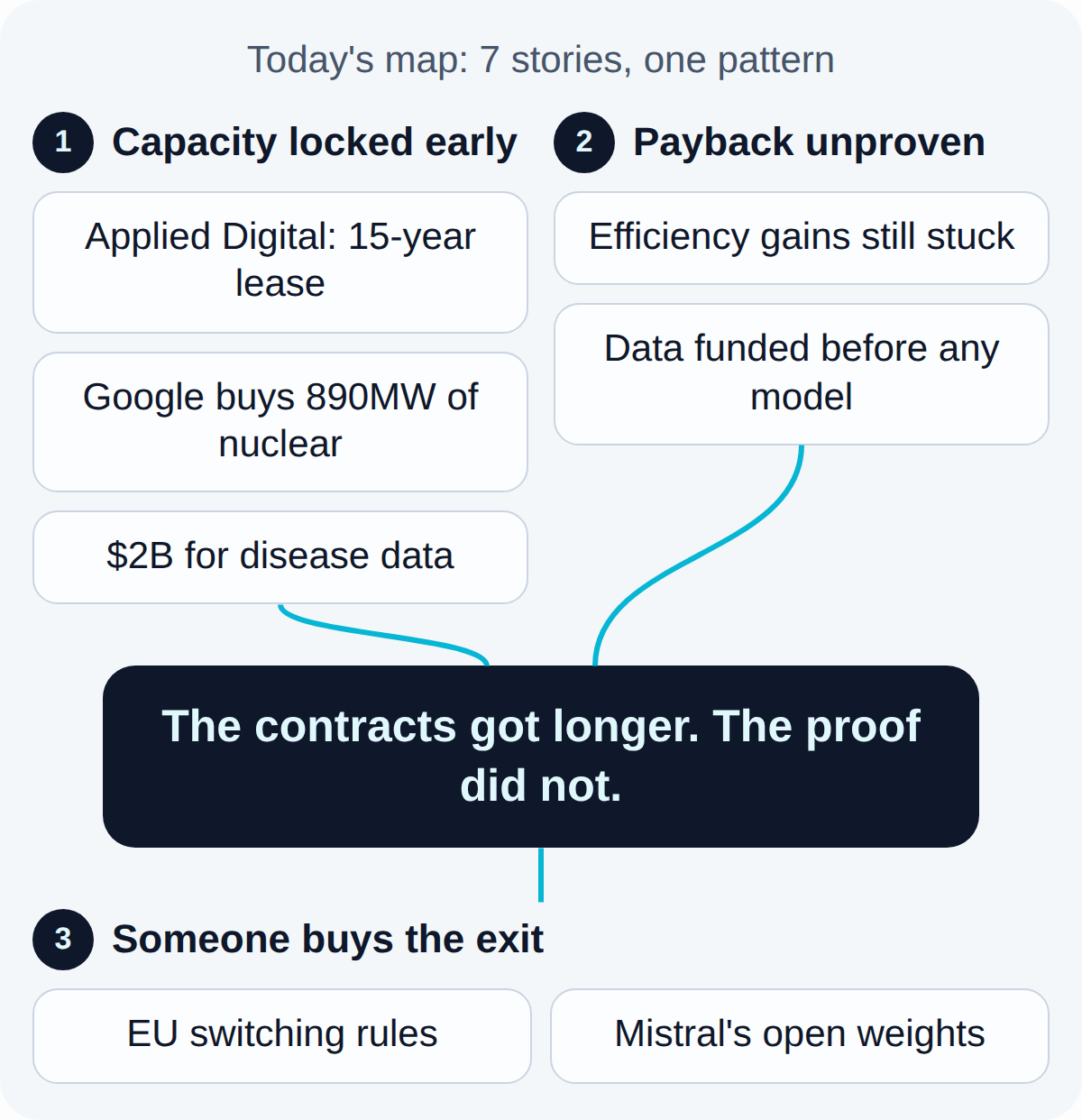
The Bottom Line: The contracts got longer. The proof did not, and your exit is now the only short-dated thing you own.
Advertisement
What if AI made us prove we’re creative?

This year AI shook up creative strategy. Most teams are still working like it didn't.
Ari Murray, Chief Digital Officer at Salt and Stone sits down with Bryan Harvey, Head of Brand at Hightouch, for an honest conversation about what's breaking on creative teams right now, how the roles are changing, and what a day looks like when creatives spend it on ideas, concepts, and craft while agents handle the manual execution.
Leave with new insights from 3 experts in the field and 5 prompts to instantly improve your creative output.
 The Tracks That Matter
1. Somebody Just Signed A Fifteen-Year Lease On Your AI Budget
Applied Digital's quarterly release carries a line most readers will skip: a tier-one hyperscaler took 210 megawatts at Delta Forge 2 on a fifteen-year term, about $5.2 billion of base-term contracted revenue. Fifteen years. Your longest software contract is probably three. Same window, Google agreed to buy 890 megawatts of nuclear output from Constellation, which is not really a procurement decision. It is a bet that the load it powers still exists in 2041. Capacity is being bought on infrastructure timelines and resold to you on annual ones. That gap is where your price comes from, and it never appears in the quote.
Here's what works: Ask your AI vendor how long their own capacity is committed for. If theirs is fifteen years and yours is one, you know who absorbs a demand miss.
2. Brussels Wrote The Exit Clause You Forgot To Negotiate
New guidance under the EU Data Act sets export and switching rules for SaaS: what a provider must hand back, in which format, how fast. Read it next to a law-firm note on how data and AI rules are reshaping M&A risk and it stops being a compliance chore. Switching cost has been the quiet term in every AI contract signed this year, because nobody could put a number on it. Once a regulator defines the floor for export and notice, the number becomes knowable, and a knowable number is a negotiable one. European buyers get this by default. Everybody else gets it by asking, and any vendor selling into Europe now has to be able to say yes.
Here's what works: Pull your three largest AI contracts and find the export clause. If there is none, ask for the EU Data Act language verbatim.
3. Nearly $2 Billion Went Into Disease Data, Not Disease Models
An international, cross-sector collaboration committed nearly $2 billion to foundational data for models that predict and treat disease. Not a model. Not a lab. The training material. That is the least glamorous line item in AI and the one with the longest payback, because somebody has to assemble, label and license decades of patient records before anything useful trains on them. The same shape shows up smaller: Australia's health department has now put $32.8 million into modernising its data on Google Cloud. Both are decade-length bets that the bottleneck is the input, not the architecture. If you have been waiting for evidence that data groundwork gets funded on its own merits, here it is.
Here's what works: Price your data readiness as a multi-year programme, not a project. Anything scoped in quarters gets re-scoped every quarter.
Quick hits:
- Europe shipped a trillion-parameter open model. Mistral released Large 4 at 1.05 trillion parameters with open weights, so a European buyer can host frontier-scale capability without a US or Chinese dependency written into the contract.
- Washington is taking compute as payment. The administration will receive $100 million in compute credits for an AI science push, which makes compute a currency governments accept rather than only a cost they budget.
- Seeing your own network is worth $2 billion. Elliott and Siris are exploring a Gigamon sale above $2 billion, a price that only makes sense if knowing what crosses your wires just became strategic again.
Advertisement
Blu Dot surpasses 2,000% ROAS with self-serve CTV ads

Blu Dot used Roku Ads Manager to drive incredible results for its furniture sales event. Its strategy hinged on custom audiences and retargeting, where intent was strongest.
“Roku has been a top performer,” said Blu Dot’s Claire Folkestad. “We have seen…CPMs lower than any other CTV partner we've worked with.”
Your Turn
Which of today's three reads matters most to your work?
 Signal vs. Noise
🟢 Signal: data security. It took more grip on everything else moving yesterday than any other subject we track, and it did that while the chatter about it dropped by a fifth. The real-world backing landed the same day: China made cybersecurity incident reporting strict and fast, and attackers were caught running fake ChatGPT, Gemini and Claude ad portals to harvest credentials. Most coverage is still parked on model releases.
🔴 Noise: ”agentic AI” as a phrase. It was named everywhere yesterday and lost more of its hold on what is actually moving than almost anything on the board. Watch what replaced it inside the same articles: connector lists, permission scopes, spend caps. The phrase is fading because the work finally got specific enough to have an owner and an invoice.
 From the 190K
We scanned 190,000 articles this week. Here's what no one's talking about:
Three names turned up in our reading for the first time yesterday, and all three sell the same product: AI capacity you can commit to without signing with the big three.
Each one lands on a different desk. The French startup press covers Rivercell launching with $25 million to build data platforms for drug discovery. A developer-tools blog announces Opper AI partnering with Greenference for low-cost, EU-hosted inference. A compliance-tech wire reports Behavox committing $8 million of GPU spend to Civo, a British cloud, for sovereign UK processing. Nobody files those three together.
Read them on one morning and they are a single trade. Every buyer signing a long AI commitment is also buying a dependency, and these three sell the version of that dependency you can point at on a map and walk away from. Rivercell sells the data groundwork. Greenference sells the inference. Behavox is the buyer, voting with $8 million. That is a market forming around the right to leave, well before anyone agrees on a name for it.
On Friday, check whether any of your AI capacity sits outside your three largest vendors. If the answer is none, your switching clause is theoretical.
Advertisement
Build or buy your support agent? Both skip the number.

Buying or building your customer service agent both carry a cost the pitch skips: maintenance if you build, flexibility if you buy. Running Agents in Customer Work is four conversations on agentic AI in customer ops, this one on build vs. buy. Register now, four Tuesdays, 10 a.m. PT.
 By The Numbers
- A hyperscaler took 210 megawatts on a fifteen-year lease worth about $5.2 billion — one capacity commitment dated out to roughly 2041, signed before the workloads exist.
- Google committed to buy 890 megawatts of nuclear output — the power behind AI is now bought on utility timelines, not cloud ones.
- Nearly $2 billion committed to foundational data for disease models — training material funded as infrastructure instead of as a research grant.
- Mistral's Large 4 ships at 1.05 trillion parameters with open weights — frontier-scale capability a regulated buyer can run inside their own walls.
- Elliott and Siris are exploring a Gigamon sale above $2 billion — what network visibility is worth once agents start generating the traffic.
- See what's rising across AI and data this week →
 Deep Dive: You Press A Thousand Records Before The First Play
Pressing a record is a decision you make before you know anything. A thousand copies, paid up front, weeks before a needle touches one of them on a real dancefloor. Nobody presses a thousand because they are certain. They press because the plant has a queue, and if you wait until you are certain, you are nine months behind the people who did not.
The queue is the reason
That is the only sane reading of yesterday. A fifteen-year lease and an 890-megawatt nuclear commitment are not confidence, they are queue management. Interconnects, shells and transformers run on multi-year lead times. The commitment is early because the supply chain forces it to be early, not because anybody's demand curve got clearer overnight.
The proof keeps not arriving
Meanwhile the return is still missing. A money desk spent yesterday on the same uncomfortable finding: corporate efficiency gains are stuck while AI spending climbs. That is not an argument to stop. It is a reason to notice that the people signing the longest contracts and the people expected to show the payback are not sitting in the same meeting.
The hedge is the exit, not the forecast
Which makes portability the live term. You cannot forecast your way out of a fifteen-year supply curve, but you can refuse to be the only party in the deal with a one-year horizon. Europe's switching rules, open-weight models you can host yourself, regional inference: all the same instrument. Not cheaper. Reversible.
What Actually Works
- Ask for the counterparty's term: before signing, find out how long your vendor's own capacity is locked. The mismatch tells you who eats a bad quarter.
- Buy reversibility before discount: a 15% saving on a platform you cannot leave costs more than list price on one you can.
- Fund data as a programme: input quality has a multi-year payback, and quarterly scoping kills it. Budget it the way the $2 billion disease-data group did.
- Run one workload outside your top three vendors: a second supplier you actually operate beats a clause you have never tested.
You can always press a thousand records. Just make sure you can still sell the crate.
 What's Coming
Contracted Revenue Becomes The Number You Get Asked About
A $5.2 billion base-term figure on one lease is the new way infrastructure gets valued. Expect it on every capacity vendor's next call, and expect your procurement team to be asked how much of that number has your name on it.
Switching Clauses Move Into Diligence
A law-firm note on how data and AI rules reshape M&A risk is the tell. Within two quarters, ”can this stack be exported” stops being an IT question and becomes a valuation input, because an acquirer who cannot move the data cannot model the synergy.
Regional Inference Turns Into A Line Item
Mistral's case for sovereign AI only matters if somebody buys it. Expect at least two large European enterprises to split inference between a hyperscaler and a regional host before year-end, filed as resilience and priced like insurance.
 For Your Team
Friday's meeting prompt: ”What is the longest commitment any of our AI vendors has made on our behalf, and what is the longest one we have made to them?”
Share-worthy stat: One hyperscaler just took 210 megawatts on a fifteen-year lease, roughly $5.2 billion of contracted revenue, for capacity that gets resold on annual contracts. The supply side is betting on 2041. The buy side renews in March.
Go deeper: Track where AI capacity and data spending are moving →
 The Track of the Day
”Sovereign AI is only as strong as the data foundation beneath it.”
Dr. Abed Benaichouche, Open Innovation AI, announcing a sovereign infrastructure partnership with NetApp
Swap ”sovereign” for your own company name and the sentence still holds. The foundation is the part you cannot rent by the month.
We scanned 190,000 articles this week so you don't have to. Data Pains → Business Gains.
Published: October 8, 2026 | Curated by Yves Mulkers @ Ins7ghts
1,300+ articles scanned. 7 stories selected. Our AI distills the noise into signal—in seconds. Get early access →
Know someone who'd find this useful? Share your unique referral link →
Want Your Own AI Intelligence Briefing?
Our platform analyzes 1,000+ sources daily and delivers personalized insights in seconds.
Join the Waitlist →Founding members: Lifetime discount • Priority access • Shape the product