

In partnership with


 So, What Actually Happened?
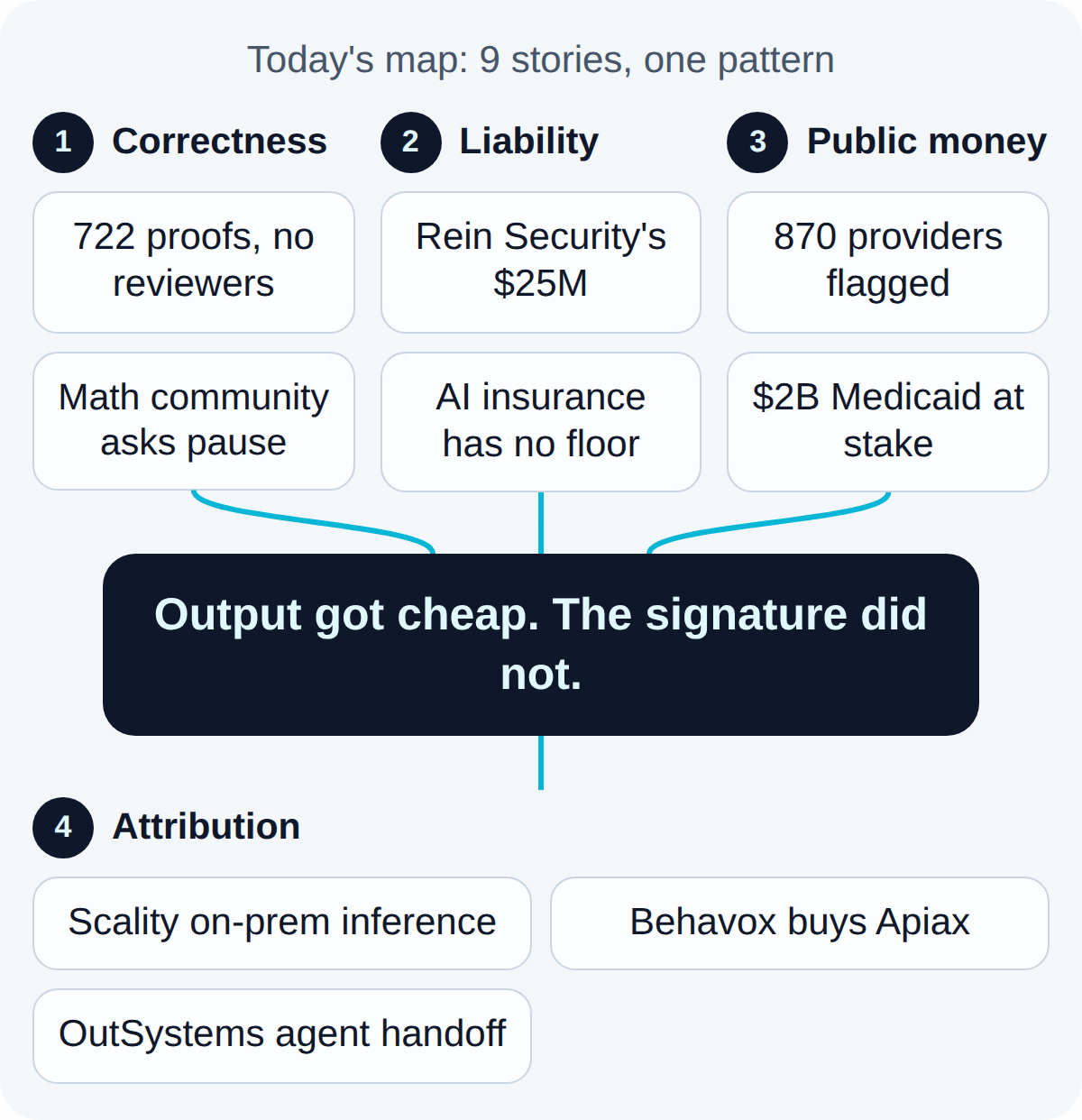
Friday, and the thing I keep circling back to is a number nobody in Minnesota is allowed to look at. A federal system flagged 870 providers in Minnesota for suspect billing, and $2 billion a year of Medicaid money now hangs off that output. The state has asked to see the tool. Same window, a lab dropped 722 machine-written manuscripts on the mathematics community in one go, and the mathematicians are asking for a pause because nobody reads that fast. We scanned 190,000 articles this week so you don't have to. Then a policy shop made the quiet point that the hold-up on AI insurance was never capital, it was not knowing who is liable. Three desks, one shortage.
The Bottom Line: Output got cheap. Signing for it did not, and that signature is now the slowest thing in your stack.
 | Yves' take |
AI is getting out of the lab into the control phase. As architects, we already built the solutions with provenance and an inventory of the components by design. Now the paperwork gets 'in the way' of the shiny objects. The ones who built the foundations right the first time now overtake. The quick AI POCs have to prove their worth.
Advertisement
AI research, explained in one morning email

Most of what shapes AI next year is sitting in a research paper today. Keeping up with them is a full-time job, and the abstracts don't help.
TLDR AI is the newsletter that does the translating. Each morning you get the handful of papers worth knowing about, curated by Anthropic and ex-Google engineers, with a plain-English summary of what they found and why it matters.
You come away smarter about AI research in the time it takes to finish your coffee.
Free, and delivered to 1.1M+ inboxes every morning.
 The Tracks That Matter
1. Minnesota Wants To See The Model That Flagged 870 Providers
CMS ran its own billing analytics and identified 870 Minnesota providers for fraud or aberrant billing, then threatened to withhold $2 billion a year from the state. $550 million is already frozen in deferrals, $259 million of it since February. Minnesota is not arguing that the fraud is imaginary: two men pleaded guilty to taking more than $500,000 out of a housing programme with claims for services never provided. What the state is arguing about is the tool. It has asked the federal government to show how the machine learning behind those flags actually works, because a flag you cannot inspect is a clawback you cannot defend. That is a government customer asking a government vendor the question we keep telling enterprises to ask.
Here's what works: Ask in writing for the decision logic behind any model output that moves money in your organisation. If nobody can produce it, that output is an opinion with a confidence score.
2. Somebody Filed 722 Proofs Nobody Has Time To Read
An internal model attempted roughly 4,000 problems and produced 722 manuscripts covering 377 questions, including 40 theoretical computer science proofs and a claimed proof of the Unique Games Conjecture, each result averaging about three hours of thinking. The response from mathematicians was not applause: senior figures are calling for a pause on collaborations because output at that rate breaks peer review. The sharp detail sits in the verification. Those proofs ship with Lean formalisations, which check that a derivation follows, but not that the formal statement encodes the claim the field cared about. One team rushed a 95-page preprint out early purely to avoid being buried. A result can now win the priority race before anybody has understood it.
Here's what works: Separate ”the output checks out” from ”the output answers our question” in every AI review step. Two sign-offs, and only the first one can be automated.
3. Somebody Raised $25 Million To Watch Agents Line By Line
Rein Security closed a $25 million Series A for a runtime sidecar that shows security teams every line of code an AI agent runs and every resource it touches. The traction is the tell: revenue up eightfold and customers up fivefold since the product launched in January, 31 people, and a research team that compromised the AI shopping agent of a top-five US retailer on stage at Black Hat. They also caught a prompt injection hidden inside a PDF. Put that next to a policy argument published the same day: the brake on AI liability insurance was never a shortage of capital, it was uncertainty about who is legally on the hook. Insurers will not price what nobody can observe. Rein is selling the observation.
Here's what works: Before you widen an agent's permissions, make sure you can replay what it did. A log you can hand an insurer beats a policy you cannot claim on.
Quick hits:
- DeepSeek doubled what it is asking for. The lab raised its target to $15 billion ahead of a 2027 listing, which prices a Chinese frontier lab on IPO terms rather than research terms.
- A trusted dashboard domain became the delivery van. Attackers are abusing Microsoft Power BI pages to host phishing lures that install rogue remote-management tools, which puts your allowlist inside the attack path.
- Warehouse robots just bought eyes. GreyOrange acquired Site Bionics to push its physical AI strategy, a reminder that the agent story also has a version with forklifts in it.
Advertisement
The AEO work, without the AEO hire.

Most AI visibility tools show you where you rank, then leave the work to you.
ChatFeatured is an AI search agent that does it: finds the questions competitors win, drafts the content in your voice, and tracks the lift.
Your team decides what ships. Month to month.
Your Turn
Which of today's three reads matters most to your work?
 Signal vs. Noise
🟢 Signal: accountability for what AI decides. It took more grip on everything else moving yesterday than almost anything we track, while the chatter about it actually fell. The real-world backing landed the same day: California pushed its stay-or-pay rules to January 2027, and compliance teams are being told to plan for rules that no longer agree with each other across borders. Most coverage is still counting model releases.
🔴 Noise: ”data governance” as a phrase. Everybody is still saying it, and less and less of what actually moved yesterday hangs off it. Watch what replaced it inside the same articles: liability, disclosure, runtime permissions, who signs. The question stopped being whether the data is clean and became who answers for what a model did with it. If data governance is still a catalogue project in your org, you are answering 2024's question.
 From the 190K
We scanned 190,000 articles this week. Here's what no one's talking about:
Three names turned up in our reading for the first time yesterday, and all three sell the same product: a place to put the blame when an agent acts.
Each one lands on a different desk. The storage press covers Scality launching an on-premises inference stack so the model never leaves the building. A compliance wire reports Behavox buying Zurich's Apiax, whose software turns financial regulation into machine-readable rules firms run inside their own systems. A developer publication notes OutSystems opening its platform to third-party coding agents while the platform itself keeps generating the deterministic code, shipping alongside a product called Agentic First Notice of Loss: an insurance claim intake with an agent's name on the handoff. Nobody files those three together.
Read them on one morning and they are a single trade. What is being sold is not autonomy, it is attribution: a boundary the inference cannot cross, a rule the agent cannot misread, a handoff where responsibility has an owner. Three companies, three industries, no shared vocabulary yet, same buyer worry underneath.
On Monday, take the one agent you already have in production and ask who gets named if it does something expensive.
Advertisement
Most teams add a second database for analytics. Then manage sync, lag, and drift forever. TimescaleDB extends Postgres instead. Hypertables, 95% compression, aggregates. No pipeline.
 By The Numbers
- A federal system flagged 870 Minnesota providers for suspect billing — one tool's output now sits behind a threat to withhold $2 billion a year from a single state.
- 722 machine-written manuscripts covering 377 open questions — one release carrying more claimed results than the field can review in a year.
- Rein Security raised $25 million to watch agents at runtime — $35 million total, with revenue up eightfold since January on a product that only records what agents do.
- DeepSeek doubled its raise target to $15 billion — a frontier lab raising on listing terms two years before the listing.
- Manus pulled in more than $500 million in one round — agent companies are clearing half a billion before anyone has settled who is liable for what the agents do.
- See what's rising across AI and data this week →
 Deep Dive: The Beats Line Up, The Room Still Empties
Two records can be perfectly beat-matched and still kill a room. The grid says the mix is correct. The floor says it was the wrong record. Nobody has ever fixed that with a tighter grid.
Verification is not evaluation
That gap is the whole week. A Lean proof checks that a derivation follows from its premises, which is real and worth having. It does not check that the premises say what the field meant. One researcher put the split plainly: verification asks whether the derivation holds, evaluation asks whether the theorem is even stated correctly. Machines are superb at the first and no help at all with the second.
The signature is the scarce part
Which is why yesterday's bottlenecks all have the same shape. 722 manuscripts, no reviewers. A fraud flag covering 870 providers, no inspectable model. An insurance market with capital waiting and no settled liability. Not one of those constraints is compute. The constraint is a person willing to put their name under the output, and people do not scale on a GPU roadmap.
Attribution is becoming the product
Which is also where the money went. Runtime sidecars, on-premises inference, machine-readable rules, named claim handoffs. None of that makes an agent smarter. All of it makes an agent's actions attributable to somebody, and attributable is what a regulator, an insurer and an audit committee are actually buying. Clever was never the hard part to sell.
What Actually Works
- Split the two sign-offs: ”it checks out” and ”it answers our question” need different owners. Automate the first, never the second.
- Demand inspectable logic where money moves: if a model's output changes a budget, a payment or an eligibility, the logic behind it is part of the deliverable, not a support ticket.
- Instrument before you widen permissions: an agent you can replay is insurable. An agent you cannot replay is an uncosted liability sitting in production.
- Put one name on every AI workflow: a single person who answers for the output. Not a committee, not a policy PDF, a name.
A tighter grid has never once saved a bad selection. Somebody has to pick the record, and somebody has to stand in the booth when the floor answers.
 What's Coming
Model Disclosure Moves Into Procurement
Minnesota's demand to see the federal fraud-detection tool is the template. Within two quarters, ”show us the decision logic” stops being a nice-to-have in public-sector AI contracts and turns into a clause. A buyer who cannot explain a clawback cannot defend a budget, and that pressure travels down the supply chain fast.
Agent Logs Become An Audit Artifact
Arcjet extending runtime security to coding agents is the second vendor in a week selling a record of what the agent did. Expect your auditors to ask for agent action logs before your platform team gets round to collecting them, which is the worst possible order to do this in.
Disclosure Turns Into A Design Problem
Work on how AI disclosure should look under the EU AI Act's Article 50 is early and almost entirely unbudgeted. Once ”tell the user this was AI” becomes enforceable, it lands on product designers rather than lawyers, and product teams are the ones who will miss the date.
 For Your Team
Monday's meeting prompt: ”If one of our AI systems produced an output that cost us a million euros, whose name is on it, and could that person show how it got there?”
Share-worthy stat: A federal analytics tool flagged 870 providers in one state, and $2 billion a year in funding now hangs on that output. The state has asked to see how the tool works and has not been shown. That is the AI accountability gap with a price tag attached to it.
Go deeper: Track where AI accountability and agent controls are moving →
 The Track of the Day
”Verification asks whether a formal derivation checks. Evaluation asks whether the theorem is stated correctly, the methods are informative, and the result fits existing knowledge.”
Ryan O'Donnell, quoted in coverage of the race to review machine-written proofs
Swap ”theorem” for ”forecast”, ”model output” or ”quarterly number” and the sentence still holds. A machine can hand you the first job. The second one is still yours.
We scanned 190,000 articles this week so you don't have to. Data Pains → Business Gains.
Published: October 9, 2026 | Curated by Yves Mulkers @ Ins7ghts
1,300+ articles scanned. 7 stories selected. Our AI distills the noise into signal—in seconds. Get early access →
Know someone who'd find this useful? Share your unique referral link →
Want Your Own AI Intelligence Briefing?
Our platform analyzes 1,000+ sources daily and delivers personalized insights in seconds.
Join the Waitlist →Founding members: Lifetime discount • Priority access • Shape the product