

In partnership with


 So, What Actually Happened?
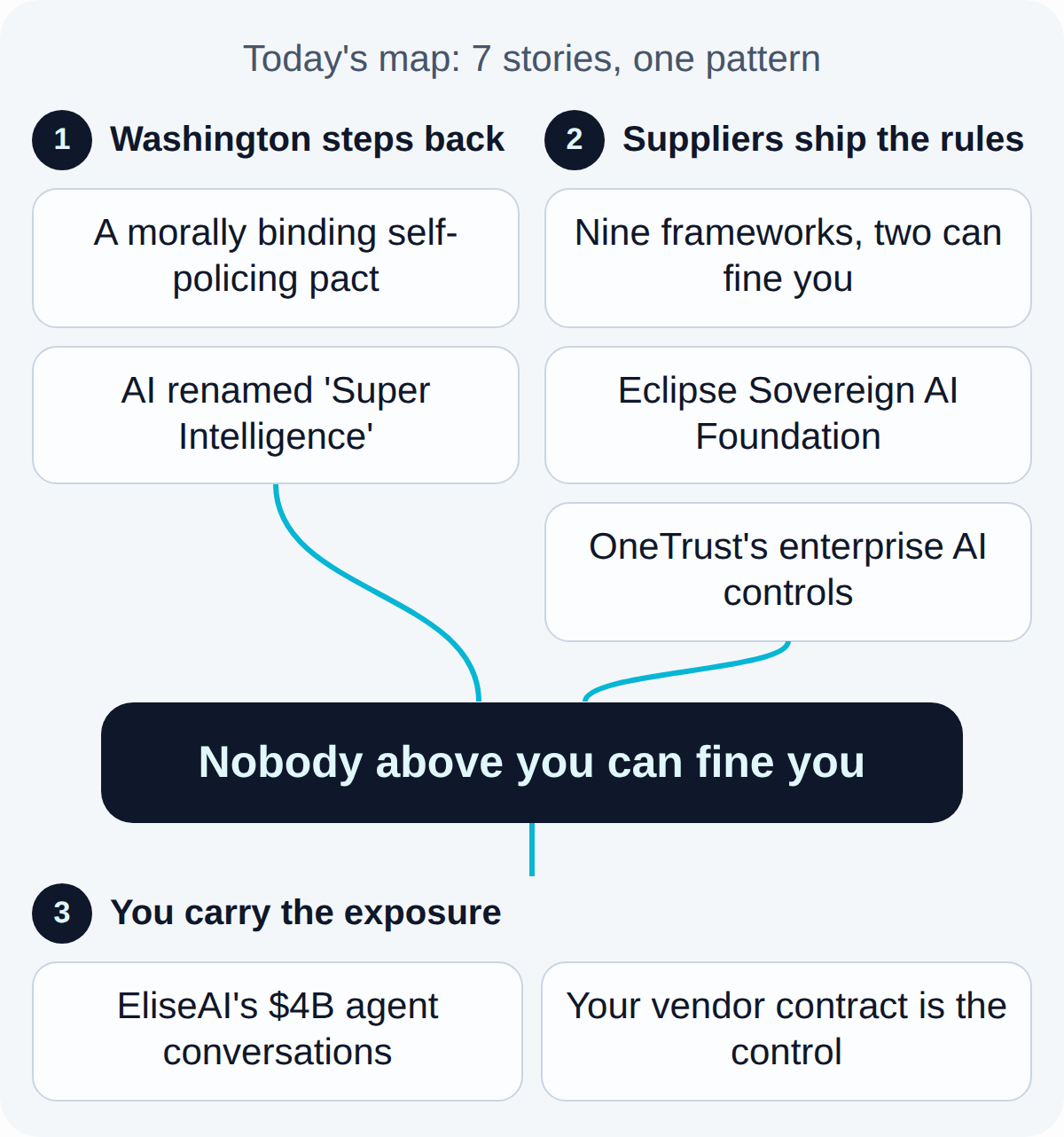
Thursday, and I keep circling back to who is actually holding the pen. At the White House the president and the major AI companies signed a ”morally binding” agreement to self-police, which is a phrase I had to read twice, and then he announced the US would rename AI ”Super Intelligence” because it is much bigger than the Internet. We scanned 190,000 articles this week so you don't have to. In the same two days somebody counted the AI governance frameworks now in circulation and found only two of nine can levy a fine, the Eclipse Foundation stood up a vendor-neutral body for open-source AI governance, and EliseAI raised $350 million at a $4 billion valuation on agents that talk to tenants and patients. Nobody in that sequence is waiting for a regulator.
The Bottom Line: Voluntary at the top means the only AI control you can actually enforce is the one you wrote into a supplier contract yourself.
 | Yves' take |
AI control is being written into supplier contracts. I hope the suppliers' agentic AI agents (I couldn't help using many buzzwords) read these contracts to keep you safe.
Advertisement
Webinar Series: Running Agents in Customer Work

Every AI vendor reports a resolution rate. No two calculate it the same way, and none of them tell you whether the replies were actually good.
Running Agents in Customer Work is four 30-minute sessions for the leaders who have to make agentic AI work in support, success, and ops. Session 4 gets into how to score quality at volume without reading every transcript, and the questions to ask a vendor about what their resolution math leaves out.
Four Tuesdays, Oct. 13 through Nov. 3, 10 a.m. PT. Register today, one sign-up covers all four.
 The Tracks That Matter
1. Washington Picked Self-Policing And Called It Morally Binding
The president and the heads of the major AI companies signed a commitment to police themselves, paired with an executive order, and reporters were told the field would be officially renamed. Strip the branding and read what the instrument is: a voluntary undertaking, signed by the parties it governs, with no penalty attached. That matters less for the labs than for everyone downstream of them. When your supplier's duty is moral and yours is contractual, the enforceable obligation sits with the company that deployed the agent, not the one that trained it. Most US coverage read it as a win for the industry. From a buyer's seat it is a transfer of risk, and the transfer went in one direction.
Here's what works: Ask legal which of your AI vendor commitments are contractual and which are published principles. Only the first kind survives an incident.
2. Nine AI Governance Frameworks, Two Can Actually Fine You
Somebody finally counted. A tally of the nine frameworks now in general circulation found that only two carry the power to levy a fine. The other seven are guidance, maturity models and principles, all of them wearing the same vocabulary. Supply kept growing anyway: Gartner published a hype cycle for AI governance technologies, and the OECD mapped how HAIP 2.0 lines up with the EU AI Act. Useful work, and also more documents nobody can be penalised under. Frameworks are multiplying faster than enforcement is, and that gap lands on you: when the board asks which standard you are held to, the honest answer today is whichever one your auditor happens to prefer.
Here's what works: Pick one framework, name it in writing, and map your controls to it. An audit against one named standard beats partial compliance with nine.
3. EliseAI Raised $350 Million To Let Agents Talk To Tenants
EliseAI closed $350 million at a $4 billion valuation, with Andreessen Horowitz and Bessemer leading and the Ontario Teachers' Pension Plan in the round. The product is agents handling leasing enquiries, maintenance requests and patient scheduling, which means every one of those conversations runs straight through fair-housing and patient-privacy rules. A pension fund underwriting that is a bet the compliance question is settled enough to scale. It is not the vendor's exposure when an agent says the wrong thing to an applicant. It is the property manager's and the clinic's. Operators spent the month buying agentic leasing tools on exactly that assumption.
Here's what works: For every agent that speaks to a customer, write down which regulation its conversation touches and who signs off. That list is your real AI policy.
Quick hits:
- A frontier model just moved inside chip design. Synopsys and OpenAI announced GPT-Synopsys, a multi-year deal that puts a frontier model into the chip-design toolchain, so the software deciding what your silicon can do now carries a model dependency you do not control.
- An AI public-safety company is going private. SoundThinking agreed to be acquired by Transom Capital, which is what tends to happen when a listed AI business stops wanting to explain its numbers every quarter.
- The people building it are asking for brakes. Researchers at OpenAI and Google DeepMind raised concerns about the race to self-improving systems, which reads differently in the week the commitments above became voluntary.
Advertisement
Deals are won when you're not in the room. Aligned gives every deal a shared space where buyers stay engaged and AI flags risk the moment it appears. Win the moments you're not there for. Start Using Aligned Free
Your Turn
Which of today's three reads do you think is wrong?
One tap. No wrong answers.
 Signal vs. Noise
🟢 Signal: governance that ships as a product. The controls that actually moved this week are things you install and staff: OneTrust shipped AI governance features for enterprise scale, and the IAPP published an executive skills framework naming who owns the function. A control in the execution path can block a step. A principle cannot. Most coverage filed both under compliance news instead of procurement.
🔴 Noise: ”data governance” as the heading. It was the most-written-about term in the industry this week and also the one losing its hold fastest, while the question buyers actually ask moved to what the agent is allowed to do. Teams still auditing tables and lineage are answering a 2024 question. The retail read on collecting data versus knowing anything makes the same point from the Nike and Lululemon side.
 From the 190K
We scanned 190,000 articles this week. Here's what no one's talking about:
The Eclipse Foundation shipped three named open-source pieces for evaluating and boxing in AI agents (PanEval, Enclave and LMOS), and US Immigration and Customs Enforcement asked vendors for a ”Secure Technology Environment for Large Language Agents”, responses due October 16.
Read alone, the first is an open-source announcement and the second is a procurement notice. Read on the same morning they describe one product: not a smarter agent, a box you can put one in and prove afterwards what it did. The Eclipse body brought 17 organisations to a vendor-neutral table to build exactly that, and the ICE request is a government buyer writing the specification for it in public. Notice who is doing it: a foundation and a procurement office. Not the labs, not the regulators.
What changes Friday: find out whether your agent platform can be evaluated and sandboxed by something you control, or only by the vendor's own dashboard. One of those two survives an audit.
Advertisement
Events, embeddings, analytics: three databases for one app? TimescaleDB does all three in Postgres. Hypertables, pgvector, continuous aggregates. One system, no pipeline. $1000 to start. Get $1000 Credit
 By The Numbers
- EliseAI raised $350 million at a $4 billion valuation — Andreessen Horowitz and Bessemer led, with the Ontario Teachers' Pension Plan in the round.
- Only two of the nine AI governance frameworks can levy a fine — the other seven are guidance, and all nine use the same vocabulary.
- The Eclipse Foundation's sovereign AI body launched with 17 member organisations — vendor-neutral, open source, aimed at evaluation rather than model building.
- Agentic search grew 200% as purchase journeys started inside AI chats — Salesforce's own commerce data, which makes an agent the first touchpoint instead of your site.
- Only 33% of utilities rate their asset management as advanced — an IFS survey, in the sector being asked to power all of this.
- See what's rising across AI and data this week →
 Deep Dive: The Rulebook Your Supplier Wrote
A data programme I worked on was tendered in parts, and every part went to a different consulting firm. The architect came from one of them. The build went to a consortium of smaller firms who were also competing with each other, and who wanted their own people in on time and material. Nobody was governing that programme. Everybody was selling into it.
Voluntary is a transfer, not a vacuum
When the obligation at the top is moral, it does not evaporate. It slides down to whoever can be audited, sued or fined, and that is the company with the deployment, the customer list and the insurance policy. A signed understanding between labs and a government is a document about them. The bill arrives with you.
A framework you cannot be fined under is a brochure
Nine in circulation, two with teeth. The other seven are still worth reading and still useful for structuring work, but they cannot settle an argument. When two of your vendors each cite a different one, you have not aligned on anything. You have agreed to use the same words.
The one lever that is genuinely yours
Procurement. Unglamorous, and the only place in this stack where you set a penalty instead of receiving one. Exportable logs, a named evaluation method, a sandbox you control, a defined incident clock. Those bind because you wrote them into a contract somebody wanted to sign.
What Actually Works
- Name one standard: pick the framework you will be audited against and map controls to it. One named standard beats thin coverage of nine.
- Make the log a purchase condition: exportable, readable by you, retained for a period you set. A vendor dashboard is not evidence you can produce.
- List your regulated conversations: every agent talking to a customer, tenant, patient or applicant, and the rule that conversation touches.
- Separate principles from clauses: mark which supplier commitments are contractual. Only those matter at two in the morning.
Every club has a noise limit on the wall. The ones that stay open are the ones where the limiter is wired into the amplifier, not printed on a sign.
 What's Coming
The Agent Sandbox Becomes A Procurement Spec
ICE's request for a secure environment for language agents closes October 16. Government requests get copied, and this one asks for containment, evaluation and audit rather than capability. Expect those same requirements in enterprise agent RFPs by the new year.
Framework Claims Start Getting Challenged
Now that the governance tooling market has a map, ”we comply with X” becomes checkable against a named category. The first arguments will be about which parts of a framework a product actually covers, and vendors who picked the vaguest one will discover why that was a mistake.
Vertical Agents Meet Their First Regulator
With $4 billion of valuation now sitting on agents that talk to tenants and patients, the first fair-housing or patient-privacy complaint about an agent conversation is a question of when. The deploying operator will be the respondent, not the model vendor.
 For Your Team
Friday's meeting prompt: ”If the strongest commitment our AI suppliers have made is voluntary, which of our own controls could actually stop a bad agent action, and who has the authority to pull it?”
Share-worthy stat: Nine AI governance frameworks are in circulation and only two of them can levy a fine. Which means every AI vendor on earth can truthfully say they follow one.
Go deeper: Track where AI governance and AI money are actually moving →
 The Track of the Day
”Only two of the nine can actually fine you.”
On the 2026 enforceability test for AI governance
Nine frameworks, two with teeth, and a morally binding handshake in Washington. Pick the one that can actually stop the music.
We scanned 190,000 articles this week so you don't have to. Data Pains → Business Gains.
Published: October 1, 2026 | Curated by Yves Mulkers @ Ins7ghts
1,300+ articles scanned. 7 stories selected. Our AI distills the noise into signal—in seconds. Get early access →
Know someone who'd find this useful? Share your unique referral link →
Want Your Own AI Intelligence Briefing?
Our platform analyzes 1,000+ sources daily and delivers personalized insights in seconds.
Join the Waitlist →Founding members: Lifetime discount • Priority access • Shape the product