

In partnership with

Whoever holds the copy decides.
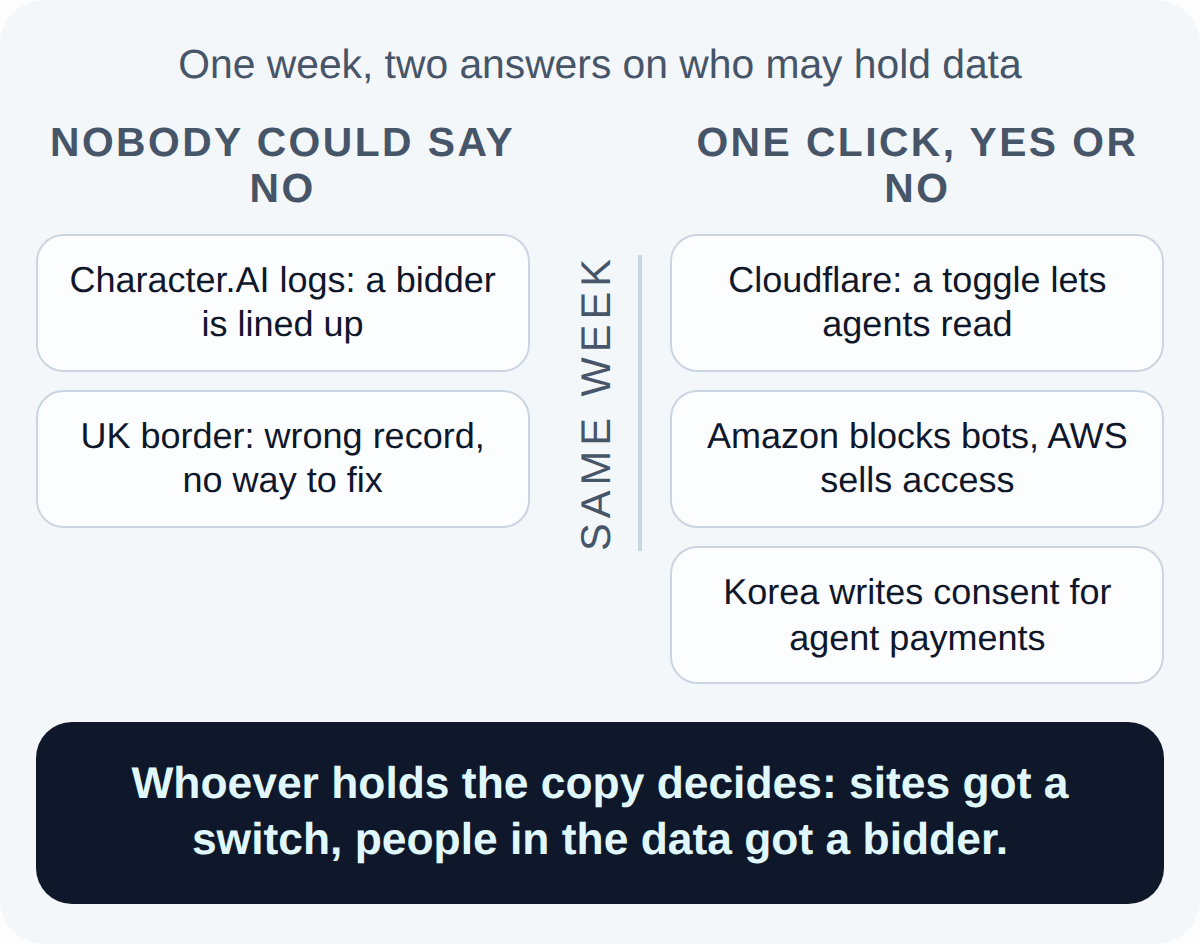
Three things from yesterday with nothing in common, except that in each one a copy of somebody's data sat where its owner could not reach it. A bankruptcy court is being asked who may buy a chatbot's conversations. Britain's data regulator told the Home Office its border system had no way to find a wrong record. Cloudflare turned “let AI agents read this site” into a setting.
Advertisement
Your follow-ups are only as good as your meeting notes

When the notes get a client's name wrong or a number off by a zero, the follow-up goes out wrong too. Or someone hand-fixes it first. Mostly right is still wrong.
Wispr Flow Notetaker uses your dictionary and calendar, so names, numbers, product names, and acronyms come out spelled right. It pops up when your meeting starts and captures Zoom, Google Meet, Teams, and Slack huddles with one click, no bot joining the call.
Weeks later, ask one question across every meeting you've had and get the answer with citations. Try Notetaker free on Windows and Mac.
1. Character.AI's chat logs went on the asset list
Character Technologies, the company behind Character.AI, filed for Chapter 11 earlier this month. It has now picked Smirks and Pangs Acquisition LLC as the initial bidder for its business and assets, and multiple US states are objecting to one line in that inventory: the user chat logs.
The bidder's name was not chosen with this cargo in mind.
A law firm had already read the filing as a privacy case on 12 November, before any buyer was named. On 18 November another one drew the same line from 23andMe's collapse, where the genetic records of millions of people also turned into an asset somebody bid on.
What decides this is the asset list, not the privacy policy. Nobody wrote down, at the moment an account was opened, that the conversations were unsellable, so a court gets to decide whether they are. I expect the answer to be yes with conditions attached, because that is how the genetics case went, and conditions last exactly as long as the buyer does. The clause I want in writing from any AI vendor holding our text is not the training clause everybody argues about. It is the insolvency clause: who owns the store if you stop existing.
2. A border system had no way to find its own mistakes
The UK's data regulator reprimanded the Home Office over Helios, its border control platform. The finding is not about a model or a score. Helios held inaccurate personal data and had no working process to spot it or fix it, which breaches the accuracy duty in UK GDPR.
People were wrongly detained on records the department could not correct.
The regulator also faulted the Home Office for not telling the people affected what had gone wrong, which left them unable to see the cause of their own complaint.
Nine days before that reprimand, the same regulator published what it expects of AI systems handling personal data in advertising. The guidance landed on 17 November. The reprimand landed on 26 November, against a government department.
A reprimand carries no fine, and departments outlive reprimands. The line I keep rereading is the absence of a detection process. Not a biased model, not a bad match score: no route from “this record is wrong” back to the record. Every data project I have watched go bad had that same hole, and it stays invisible in a demo, because in a demo the data is right. Signing off work shaped like Helios, I would test the correction path before I looked at a single accuracy figure.
Advertisement
Watch on demand: Tabs + PwC break down how finance teams are operationalizing usage-based pricing — without the manual overhead.
3. Cloudflare made agent access a switch
Cloudflare shipped three things for the agents reading the web:
- Search for Agents, a toggle that builds an AI Search index for a site and makes it findable by agents.
- AI Search, a managed service for indexing your own data and putting search inside your applications and agents.
- Markdown for Agents, which converts HTML pages into a light text format agents can read without the page furniture.
Two days earlier the company had proposed an identity framework for agent access, so the switch arrives next to a way of knowing who flipped through the door. Others are answering the same question in opposite directions: on 21 November AWS added agentic buying to its marketplace while Amazon blocked shopping bots on the retail side, and yesterday a write-up on how crawlers are learning to pass as human described the web closing against them anyway.
One toggle is a strange place to put a decision this size. Switch it on and agents read your pages cleanly and quote them back; leave it off and they read them badly, because they read them either way. That makes this a choice between being quoted accurately by somebody who owes you nothing and being quoted carelessly by the same party. My guess is that the half you actually want, the report of which agent took what, ships later and carries a price, and that is where the provenance ends up living.
A payment regulator and an app store both ruled on what an AI may do
Nobody put these two together. On the same day, Korea's Financial Services Commission set out plans for “AI agent payments”, where an agent compares products and executes the transaction for you, carried on standard payment plumbing with a consent model written for it, and Apple pulled MiniMax's chatbot from the App Store over child safety concerns. One is a rulebook for money, the other a removal from a shelf.
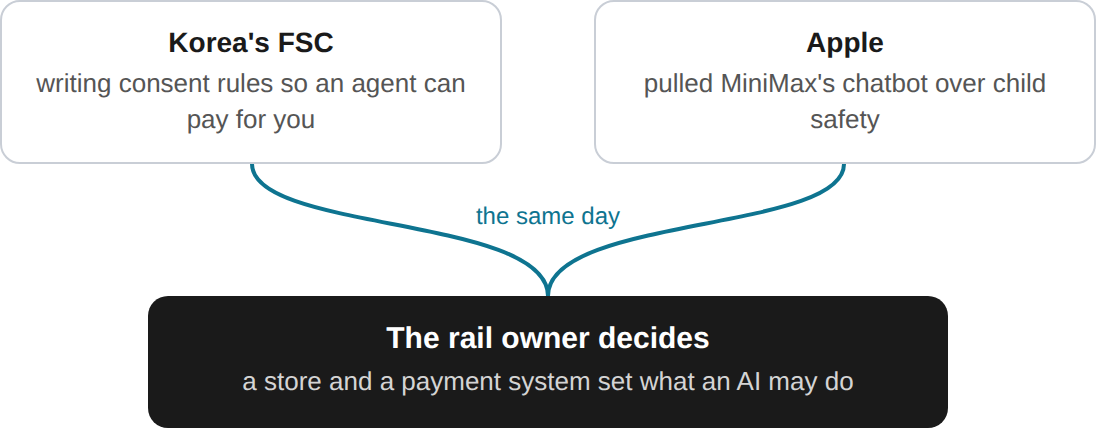
So the decisions are landing with whoever owns the rails: a payment system and a store, each setting what an AI may do with other people's accounts and attention.
Today's context on 7wData
- Salesforce bought Contentful and Publicis plans to buy LiveRamp: where does that leave Adobe? Salesforce completed its purchase of Contentful on 1 September 2026 and Publicis Groupe decided in May 2026 to buy LiveRamp for about US$2.2 billion; neither source names Adobe as a party.
- Are Anthropic and Accenture each investing $1 billion in AI assessments? Anthropic's amended IPO filing says it and Accenture each anticipate investing at least $1 billion over five years in independent AI reviewers, but the terms are not finalized.
- Salesforce agrees to buy Cresta for AI voice agents Salesforce has signed a definitive agreement to acquire Cresta, the maker of AI voice agents for customer service, with no price given and the close expected in the first quarter of Salesforce's fiscal year 2028.
Advertisement
"How did you hear about us?" “ChatGPT.”

Buyers ask ChatGPT who to hire, then contact the companies it names. ChatFeatured shows where AI recommends you and where it leaves you out, then writes and publishes the content that gets you cited; all while reporting AI traffic and the leads it brings.
Also today
- Microsoft said attackers in China and North Korea are using the ARTEX AI tool to break into technology systems worldwide. (2 min read)
- Documents, email and chat have overtaken traditional data quality as the top AI governance problem, with metadata tagging separating the organisations getting results from the ones that are not. (2 min read)
- ElevenLabs is reportedly raising at a $33 billion valuation. (3 min read)
The ScoreboardThe eighth call that was never a call
Forty of our calls have now passed their deadline, and the board shows every one of them.
0 right 32 wrong 8 not a real call 0 still open
One came due since the last board. On 26 May we wrote that “what is our AI maturity, really” would become a board-level question within two quarters. Yesterday was the deadline and there was nothing to look up: no company had to act, no document had to appear, no number had to move. Not a real call, the eighth of the forty to go that way. That is a worse result than being wrong, because a wrong call at least tells you what we expected.
Which of your own predictions for this year could a stranger check without asking you what you meant?
If you have a clause with an AI vendor that says who holds your data when the vendor stops existing, hit reply and tell me.
Yves
Tomorrow, The Long Read: one theme through the whole week, from three sources.
Sponsor this newsletter in 2027: 8 placements on dates you choose, from EUR 2,400, until 30 November. Book: 7wdata.be/sponsor-2027
Ins7ghts Daily is published by 7wData.