



 So, What Actually Happened?
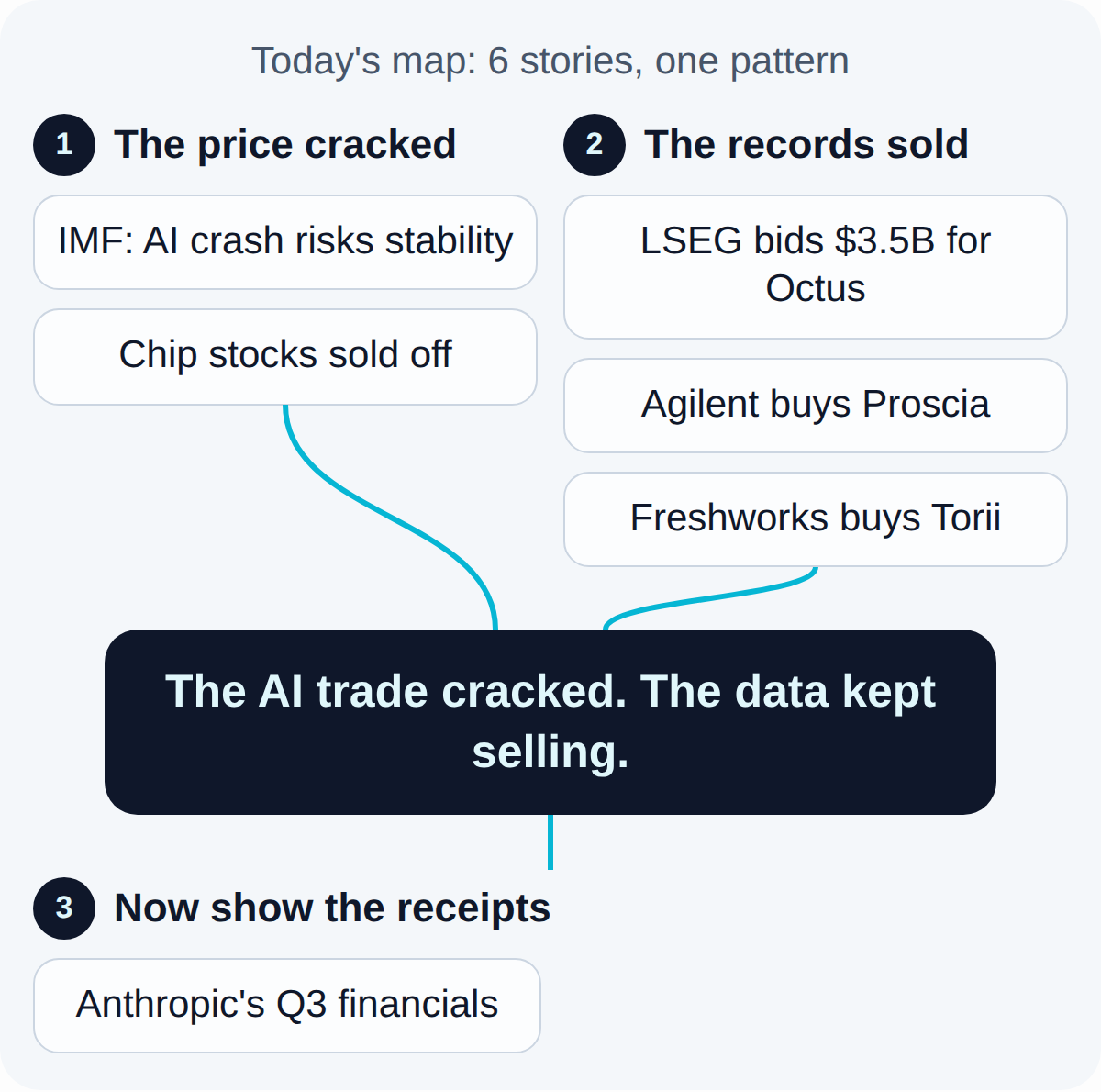
Wednesday morning, and what I keep turning over is that two opposite things happened on the same Tuesday. The IMF put the risk of an AI share crash on its financial stability list, next to government borrowing and cyberattacks, and chip stocks sold off in the same session. So that is the fear side, loudly, from the institution finance ministries actually read. Then I looked at what cleared, and none of it was a model. LSEG is in talks for Octus at about $3.5 billion, a group whose whole job is tracking who owes what. Agilent is buying a digital pathology company for up to $270 million. We scanned 190,000 articles this week so you don't have to. The money still moving is not buying cleverness. It is buying somebody's written record of what happened, and that is a completely different bet.
The Bottom Line: When the trade gets scary, the receipts get bought.
 | Yves' take |
Interest rates are starting to define the cost of your AI solution. Every investment in future AI is built on borrowed money. Is this what causes the AI crash? I can't avoid thinking this heads the same direction a lot of countries are in. They can't get their budgets under control. The money they borrowed became too expensive, and the debt only piles up.
Advertisement

Data sovereignty and compliance keep your most valuable data on-prem, but your Databricks strategy shouldn't stop there. Join MinIO's live webinar on Oct 22 at 10 AM PDT to see how AIStor Table Sharing uses the OpenSharing protocol to analyze on-prem data in place, with zero copies or pipelines.

 The Tracks That Matter
1. The IMF Filed AI Next To Sovereign Debt
The IMF's financial stability work now puts the threat of an AI-driven share crash in the same frame as rising bond yields, government borrowing and cyberattacks, and its own briefing names the combination of stretched valuations and debt rather than AI alone. Same session, semiconductor stocks sold off and the trade desks started writing that the AI trade is cracking. What makes this different from the usual bubble column is the mechanism. The worry is not that AI disappoints. It is that the build-out is increasingly bought with borrowed money, so a disappointment travels through credit, not just through share prices. That is why this lands on your desk and not only on a fund manager's.
Here's what works: Ask your CFO which AI commitments are multi-year contractual spend. That is debt wearing a vendor badge.
2. LSEG Is Paying $3.5 Billion For Who Owes What
LSEG is in talks to buy Octus from Permira for roughly $3.5 billion. Octus tracks distressed debt and credit: who owes what, to whom, and how badly it is going. Put that next to the IMF warning filed the same day and the timing stops reading as coincidence. When the worry is debt and AI valuations together, the first asset to get bid was not a model lab. It was the ledger. A second account confirms the same $3.5 billion range, about thirteen times what an AI pathology company fetched in the same 24 hours. Nobody is buying Octus for its algorithms. They are buying two decades of somebody writing down what happened in credit markets, which is the one thing a model cannot generate.
Here's what works: Name the one dataset your AI story depends on that you do not own. That is your renewal risk, and somebody else is pricing it.
3. Agilent Bought The Slides, Not The Model
Agilent agreed to acquire Proscia for up to $270 million, folding digital pathology into a business that sells laboratory instruments. Its own announcement calls the target AI-enabled digital pathology and scientific intelligence, and the giveaway is which half of the sentence is the asset. Agilent already makes the machines that produce the slides. What it did not have was the annotated archive of those slides and the labs that trust the reading. A pathologist signs the diagnosis; a benchmark does not. Same shape as the LSEG deal, arriving through a lab door instead of a trading floor. In the week the model trade wobbled, two buyers in two unrelated industries both paid for the layer underneath the model.
Here's what works: Before your next AI pilot, ask who already holds the labelled history in your field. If it is not you, that is your partner or your acquirer.
Quick hits:
- Somebody now keeps the record of your AI bill. Freshworks agreed to acquire Torii, extending Freshservice into software management and AI spend governance, which turns ”what are we actually paying for AI” from a spreadsheet nobody owns into a product category with a vendor.
- The data centre fight reached federal ground. AI data centres are coming for federal land with residents saying they were kept in the dark, now inside a governors' race, which makes site approval an election question rather than a procurement one.
- A model closed a problem that had been open since 1970. AI settled a 56-year-old mathematical question, and it is the honest counterweight to everything above: the capability keeps compounding even while the financing gets priced like it might not.
Advertisement
Leave Granola and get up to 12 months free of Wispr Flow Notetaker + Dictation

If you have paid time left on an individual Granola plan, we'll match it with a Wispr Flow subscription that includes Notetaker and dictation, and add bonus time, up to 12 months total. Sign in or create a Wispr account and submit proof of your plan to check eligibility.
Your Turn
Which of today's three reads matters most to your work?
 Signal vs. Noise
🟢 Signal: data governance as a named job. Data governance gained ground on everything else moving this week while plain ”governance” lost it badly. That split is the whole story: buyers stopped shopping for a policy and started paying for control of one specific dataset. The three deals above are the same move with a cheque attached, and most coverage is still writing about frameworks.
🔴 Noise: the phrase ”agentic AI”. It pulled heavy coverage again this week while both its volume and its hold on everything else fell hard. Agents have not stopped working. The label has stopped carrying information, which is why the buyers in this edition spent their money on records instead.
 From the 190K
We scanned 190,000 articles this week. Here's what no one's talking about:
Jungle AI, Clueso and Haven all surfaced for the first time this week, and all three raised money to write down something nobody was writing down.
Read separately they are three unrelated trade items. A Dutch startup desk covers Jungle AI teaching machines to flag when something is going wrong, which is a record of machine behaviour that previously lived in an engineer's head. An AI trade site writes up Clueso's $10 million Series A to turn how a company actually does its work into video, which is a record of process nobody documented. A deal database notes Haven's $15 million pre-seed for a personal digital twin, which is a record of a person. Industrial, software, consumer. Nobody in those three rooms reads the other two, and not one of them uses the word ”record”.
Put them on one morning beside a $3.5 billion bid for a credit ledger and the smallest cheques of the week turn out to be making the same bet as the largest one. On Thursday, pick one thing your team knows and writes down nowhere, and ask what it would be worth if it were written down.
Advertisement
50 Excel Hacks That Make Spreadsheets Work For You

Most Excel users waste hours on tasks that take experts minutes. The difference is not talent. It is knowing the right shortcuts.
These 50 Excel hacks from Kenji Explains cover the functions, formulas, and workflows that make spreadsheets work for you instead of against you.
Each one comes with step-by-step instructions and ready-to-use templates. Subscribe to Marketing Against the Grain and get all 50 free.
Here's what you'll get:
Time-saving shortcuts that eliminate the most common formula frustrations
Interface essentials most users never discover on their own
Game-changing functions for data analysis, automation, and visualization
Guided practice template so you can apply every hack immediately
The people who are fast in Excel are not smarter. They just stopped fighting the tool.
Get 50 Excel Hacks free when you subscribe to Marketing Against the Grain today.
 By The Numbers
- LSEG in talks to buy Octus for about $3.5 billion — a credit and distressed-debt data group, bid on the same day the IMF filed AI next to debt risk.
- Agilent to buy Proscia for up to $270 million — digital pathology, bought by the company that already sells the instruments making the slides.
- Apollo led a $35 billion financing for Broadcom's AI chip platform, beside a $25 billion SpaceX debt raise — the build-out is running on borrowed money, which is precisely the channel the IMF flagged.
- Ubitium raised $14 million — for a universal processor aimed at physical AI, with Runa Capital, OpenOcean and KBC Focus Fund in.
- Healthcare analytics is forecast to reach $166.65 billion by 2030 — a 24.6% compound growth rate, which is the demand curve sitting under the Proscia deal.
- See what's rising across AI and data this week →
 Deep Dive: Whoever Holds The Master Tape
A label can press the same record a million times and each pressing costs almost nothing. The master tape is where the value sits, because every pressing comes out of it and you cannot make a new one once the session is over. Pressings are infinite. Masters are not. That is the whole economics of a catalogue, and this week it showed up in AI.
The price cracked before the product did
Nothing broke technically this week. A model solved a problem mathematicians had left open since 1970. What moved was the price: the IMF put an AI share crash beside sovereign debt, and chip stocks fell the same day. Capability up, confidence down, in the same 24 hours.
The cheques that cleared went to masters
Look at what buyers actually signed. A credit ledger at $3.5 billion. A pathology archive at up to $270 million. A record of what a company spends on software. Every one of those is a thing somebody spent years writing down, and none of them can be regenerated by a better model.
Which leaves one question about your own stack
If your AI advantage is a model, you rent it, and the rent is set by whoever is financing the build-out with debt. If your advantage is a record, you own it, and the model is a tool you point at it. Most teams have not said out loud which of the two they are.
What Actually Works
- Write down which side you are on: model-renter or record-owner. One sentence, in the next planning doc. Teams that cannot answer it default to renter.
- Audit the labelled history: list the datasets where your organisation holds annotated, time-stamped history nobody else has. That list is your actual AI asset register.
- Price your own dependencies: for every external feed your analytics relies on, note the renewal date and who else might buy the supplier. This week proved suppliers get bought.
- Read the funding structure, not the valuation: when a vendor's capacity is debt-financed, their pricing is not fully theirs to set. Ask how the compute is paid for before signing a three-year term.
Everybody wants the hit. The business was always in the master.
 What's Coming
Proof Of Revenue Becomes The Price Of Entry
Anthropic is preparing to share Q3 financials ahead of a potential IPO. Once one frontier lab publishes real numbers, the others get asked the same question by their own investors. Expect ”show the revenue” to replace ”show the benchmark” as the standard challenge inside a quarter, and expect your procurement team to borrow the phrasing.
The Host Country Becomes The Gate
Australia is moving toward a national AI and data centre framework for 2027, with investment screening already catching data centre deals and a Treasurer who keeps last-resort divestment powers after clearance. Capacity planning stops being an engineering question and becomes a sovereignty one. Anyone forecasting regional compute availability for next year should read the screening rules first.
Enforcement Without A New Statute
A coalition of state attorneys general issued multistate guidance on antidiscrimination protections, which is how AI rules arrive in practice: existing law, applied to a model's output, by someone with subpoena power. No new act needs passing for your scoring model to become a legal question.
 For Your Team
Thursday's meeting prompt: ”Is our AI advantage something we rent or something we own? Name the three datasets where we hold history nobody else has. For each one, who inside this company is responsible for keeping it clean? If a name is missing, we are renting and calling it strategy.”
Share-worthy stat: On the same day the IMF put the risk of an AI share crash beside sovereign debt and cyberattacks, a $3.5 billion bid landed on a company whose product is tracking who owes what. The model trade wobbled. The ledger got bought.
 The Track of the Day
”There is not enough independently verified, directly comparable evidence to declare one model the definitive coding winner.”
A side-by-side review of this month's two flagship coding models
That is written about the two most expensive products in the industry, and the reason nobody can settle it is that nobody kept a comparable record. Everybody measured, in their own room, against their own numbers. Meanwhile the buyers with real money spent the week acquiring companies whose only product is a record somebody actually kept. The gap between those two sentences is the trade.
We scanned 190,000 articles this week so you don't have to. Data Pains → Business Gains.
Published: October 14, 2026 | Curated by Yves Mulkers @ Ins7ghts
1,300+ articles scanned. 7 stories selected. Our AI distills the noise into signal—in seconds. Get early access →
Know someone who'd find this useful? Share your unique referral link →
Want Your Own AI Intelligence Briefing?
Our platform analyzes 1,000+ sources daily and delivers personalized insights in seconds.
Join the Waitlist →Founding members: Lifetime discount • Priority access • Shape the product