

In partnership with


 So, What Actually Happened?
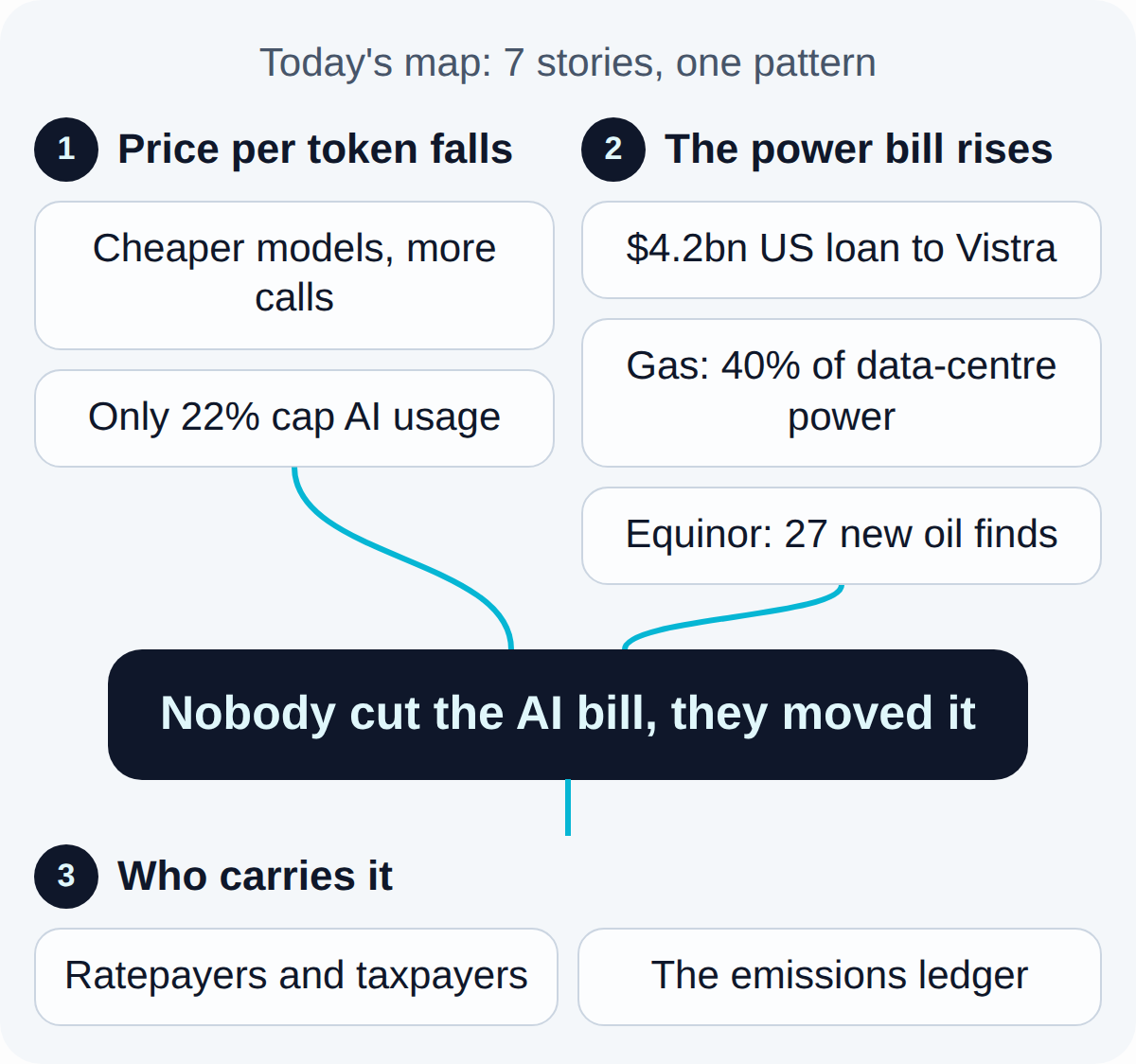
Sunday, and I keep circling a sentence that sounds like good news until you follow it one step further. Model prices are falling. Then the firms doing the demand modelling say the quiet part out loud: cheaper tokens mean more electricity, not less, because the call that costs almost nothing gets made in ten more places. We scanned 190,000 articles this week so you don't have to. In the same two days Washington agreed to lend Vistra about $4.2 billion to squeeze more out of reactors it already owns, and a study in Nature put most of AI's added emissions not in the server room but in the oil fields AI helps find. So the price of the thing went down and the cost of the thing went up, in different accounts, on different balance sheets.
The Bottom Line: The price per token fell. The bill went sideways, onto the grid, the taxpayer and the oil field.
 | Yves' take |
Questionable? Are cheaper models pushing the innovation loop in the right direction? The budget stays the same. Consumption goes up. We find the 'wrong - oil' resources to feed the loop. Pretty clear who is pulling the strings.
Advertisement

New AI tools launch every day. A few will change how you work. The rest will be forgotten by next month.
TLDR AI is the free newsletter that tells you which is which. Every morning, Anthropic and ex-Google engineers pick the new tools, updates, and open source releases worth trying, with a quick note on what each one does and who it's for.
You find the good ones early, without testing all of them.
One email, 5 minutes a day, read by 1.1M+ people. Get tomorrow's picks.
 The Tracks That Matter
1. Cheaper AI Models Just Became A Power Grid Problem
The consultants doing the forecasting landed on an awkward conclusion this week: falling token prices raise electricity demand rather than lowering it, and global data-centre power consumption is still tracking 24% growth a year through 2030, the fastest-rising load in developed power markets. BCG's most AI-mature group is not naive about the money: three-quarters of them manage token spend against a named return. Only 22% actually set a limit or a control. Half of them deliberately push staff toward the paid tools, because adoption is the whole point. Markets have already priced the consequence, with electricity demand projected to rise 60% by 2045. Efficiency is not a brake on this. It is an accelerator with better press.
Here's what works: Forecast your AI usage at the volume your cheapest model invites, not the volume you budgeted at today's price. That gap is the real number.
2. Washington Is Lending Vistra $4.2 Billion For Old Reactors
The US will lend Vistra about $4.2 billion to get more power out of reactors it already runs, and the mechanism matters more than the money. Uprating an existing plant needs no new licence from the Nuclear Regulatory Commission, which had already approved more than 170 uprates as of 2022. Vistra's six reactors across four plants make over 6.5 gigawatts today, roughly 3.25 million homes, and Energy Secretary Chris Wright is announcing the loan at the plant on Lake Erie. In parallel, NextEra is proposing to buy Dominion Energy, which sits in a major data-centre market. New generation takes a decade. Squeezing the old fleet and buying the utility next to the customers takes a quarter.
Here's what works: Ask your data-centre provider which named plants serve its sites, and whether that capacity is contracted or merely planned. Planned is not power.
3. AI Found 27 New Oil Fields For Equinor
The pitch was always that AI would cut emissions. A study in Nature ran the number the other way: AI could raise global energy-related CO2 by 1.2% to 4.8%, with most of the increase coming from making fossil-fuel production more productive rather than from the data centres themselves. Equinor re-processed Norwegian seismic data with new models and got 27 fresh oil discoveries out of ground it had already surveyed, saving $130 million last year on top. McKinsey puts the upstream prize at $65 billion a year now, $230 billion at full potential. And US data centres are already the biggest reason electricity demand grows to 2030 in several markets, with gas covering over 40% of what they draw. Both ends run off the same pipeline.
Here's what works: If you publish an AI efficiency claim, state the denominator. Energy per task and total energy drawn moved in opposite directions this year.
Quick hits:
- Anthropic is paying to train everyone else's engineers. It committed $100 million to train 10,000 engineers with first cohorts from Accenture, Bain, Capgemini, Deloitte, McKinsey, Morgan Stanley and Novo Nordisk, which means the people who will recommend your AI architecture are being badged by one of the vendors.
- Brussels is close to naming AWS and Azure gatekeepers. The Commission's preliminary view calls them the two largest cloud services in the EU, and switching charges are prohibited from 12 January 2027, so price your next multi-year commit against an exit that goes free mid-term.
- GPUs are now collateral. Sharon AI raised a $356 million debt facility backed by its GPUs, which is what happens when chips stop being equipment and start being an asset class somebody will lend against.
Advertisement
Leave Granola and get up to 12 months free of Wispr Flow Notetaker + Dictation

If you have paid time left on an individual Granola plan, we'll match it with a Wispr Flow subscription that includes Notetaker and dictation, and add bonus time, up to 12 months total. Sign in or create a Wispr account and submit proof of your plan to check eligibility.
Your Turn
Which of today's three reads do you think is wrong?
One tap. No wrong answers.
 Signal vs. Noise
🟢 Signal: data security. Its grip on everything else moving in AI tightened sharply on Friday while the volume of writing about it fell, and the buying confirms it: AWS launched a locally hosted sovereign service in the UAE endorsed by the country's Cybersecurity Council and aimed squarely at banks and government bodies. Most coverage is still reading security as a compliance chapter. Buyers are treating it as the procurement gate.
🔴 Noise: ”agentic AI” as a phrase. It pulled heavy volume again and its hold on the rest of the story slipped harder than almost anything we track. In the same window OpenAI shipped always-on work agents and Salesforce put agents into three priced bundles. The label is fading precisely because the thing became an ordinary line item.
 From the 190K
We scanned 190,000 articles this week. Here's what no one's talking about:
A data-centre partnership is funding a 10-year restoration of 132 acres at Georgia's Towaliga Preserve, Nvidia paused the AI programme it signed with Oregon's schools and colleges a year into the deal, and Bloom Energy walked into 2026 with a $6 billion order book, up 140%.
The nature desk files the first as conservation. The education desk files the second as a broken promise, with a state agency left holding a curriculum plan and no partner. The markets desk files the third as a stock to watch. Read them on one morning and they sort into two piles that have nothing to do with subject matter: what the AI buildout promised a community, and what it contracted with a supplier. The forest deal and the schools deal are goodwill. The power order book is a purchase order with a delivery date. Only one of those has a penalty clause, and it is never the one with the ribbon-cutting.
On Monday, go through your own AI plan and mark every vendor commitment as either a contract or a programme. The programmes are the ones that get paused, and they are usually the ones your business case leaned on.
Advertisement
Most teams add a second database for analytics. Then manage sync, lag, and drift forever. TimescaleDB extends Postgres instead. Hypertables, 95% compression, aggregates. No pipeline.
 By The Numbers
- Global data-centre electricity demand is set to grow 24% a year through 2030 — then slow to 5% a year to 2040, which makes the next four years the whole negotiation with your utility.
- The US is lending Vistra roughly $4.2 billion — for six reactors already producing 6.5 gigawatts, about 3.25 million homes, with no new NRC licence required to uprate them.
- Natural gas supplies more than 40% of the electricity US data centres use — per the IEA, and US data-centre spending on new gas turbines recently beat every other country's total.
- McKinsey puts AI's upstream oil and gas prize at $65 billion a year — rising to $230 billion at full potential, which is the real reason that sector's AI budgets keep clearing committee.
- Only 22% of the most AI-mature companies set limits or controls on AI usage — in BCG's own sample, while three-quarters claim to manage token spend toward a specific return.
- Bloom Energy entered 2026 with a $6 billion backlog, up 140% — on-site generation is the fastest-moving order book in this story, which tells you what operators expect from the grid.
- See what's rising across AI and data this week →
 Deep Dive: The Cheap Round Costs The Most
Drop the drink price and the club does not spend less. It spends more on bar staff, more on glassware, more on the two people at the door. Volume is the cost. Every promoter learns this the hard way, usually on the night the room is fullest and the takings are worst.
The unit price fell, the bill did not
Per-call AI pricing has been dropping all year and the response was not restraint. It was permission. The call gets embedded in the support flow, the triage flow, the thing sales asked for. Each one is cheap. All of them together are a load, and the load lands on a grid that plans in decades while your product team plans in sprints.
The supply answer is old plants, not new ones
Nobody is building for 2030 demand with 2030 assets. Washington's Vistra loan buys more output from reactors standing today, because an uprate skips the licensing queue. NextEra is buying a utility that already sits next to the customers. That is not a technology strategy. It is a lead-time strategy, and lead time is the only thing in this story that cannot be bought cheaply.
The efficiency went somewhere you did not expect
The sharpest finding of the week is that AI's efficiency gains are real and are being spent on finding more oil. Equinor got 27 discoveries out of old survey data. Exxon's Permian work with Microsoft was projected to add 50,000 barrels a day. The saving did not disappear. It got reinvested into the thing the saving was supposed to reduce.
What Actually Works
- Forecast on volume, not on price: build your AI model with usage growing as price falls. A per-unit saving with no usage ceiling is a bigger invoice wearing a discount.
- Name the plants behind your region: ask your provider which generating assets serve each site and whether that power is contracted. A roadmap is not a megawatt.
- Split goodwill from contract: every vendor commitment in your AI plan is either enforceable or it is a programme. Mark them, then re-plan around the enforceable half.
- Publish the denominator: when you report an AI efficiency gain internally, report total consumption beside it. Per-task and total have been moving in opposite directions all year.
Cheap drinks night never lost money on the drinks. It lost money on everything the crowd brought with them.
 What's Coming
Leaving Your Cloud Becomes Free In January 2027
Brussels is moving to designate AWS and Azure under the Digital Markets Act, and the Data Act already bans switching charges from 12 January 2027 with notice periods capped at two months. Any three-year commit you sign this quarter crosses that date in the middle. Price the second half differently from the first.
Your Integrator's Engineers Graduate With A Vendor Badge
The first Claude Frontier Deployed Engineer badges are expected in early 2027, drawn from cohorts at the firms most enterprises hire for AI advice. Vendor-funded certification is how tooling choices get made two years before anyone writes an RFP. Ask your integrator who paid for their training.
Hardware Becomes A Credit Story
Chips are moving onto balance sheets as collateral rather than capex, with Amazon seeking to offload $8 billion of Nvidia chips to investors. When the asset moves, the risk moves with it, and your compute price starts tracking somebody's financing cost rather than their manufacturing cost.
 For Your Team
Monday's meeting prompt: ”If our AI tooling got 50% cheaper per call tomorrow, would our total AI spend go down, and can anyone here show the usage curve that proves it?”
Share-worthy stat: Data-centre electricity demand is tracking 24% growth a year through 2030, and only 22% of the most AI-mature companies in BCG's sample set any limit on AI usage at all. The efficiency gains are real. Almost nobody is capturing them.
 The Track of the Day
”If you want to train a god-like super intelligence that can autonomously commit cyber-attacks and felonies on the open internet, you don't need a health inspection permit.”
Kevin Roose, on how the AI race started
Worth sitting next to this week's other permitting fact: squeezing more power out of a nuclear reactor does not need a new licence either. The whole stack is running on approvals somebody signed for a different decade.
We scanned 190,000 articles this week so you don't have to. Data Pains → Business Gains.
Published: October 4, 2026 | Curated by Yves Mulkers @ Ins7ghts
1,300+ articles scanned. 7 stories selected. Our AI distills the noise into signal—in seconds. Get early access →
Know someone who'd find this useful? Share your unique referral link →
Want Your Own AI Intelligence Briefing?
Our platform analyzes 1,000+ sources daily and delivers personalized insights in seconds.
Join the Waitlist →Founding members: Lifetime discount • Priority access • Shape the product