

Sponsored by

Somebody else decides if your AI gets built.
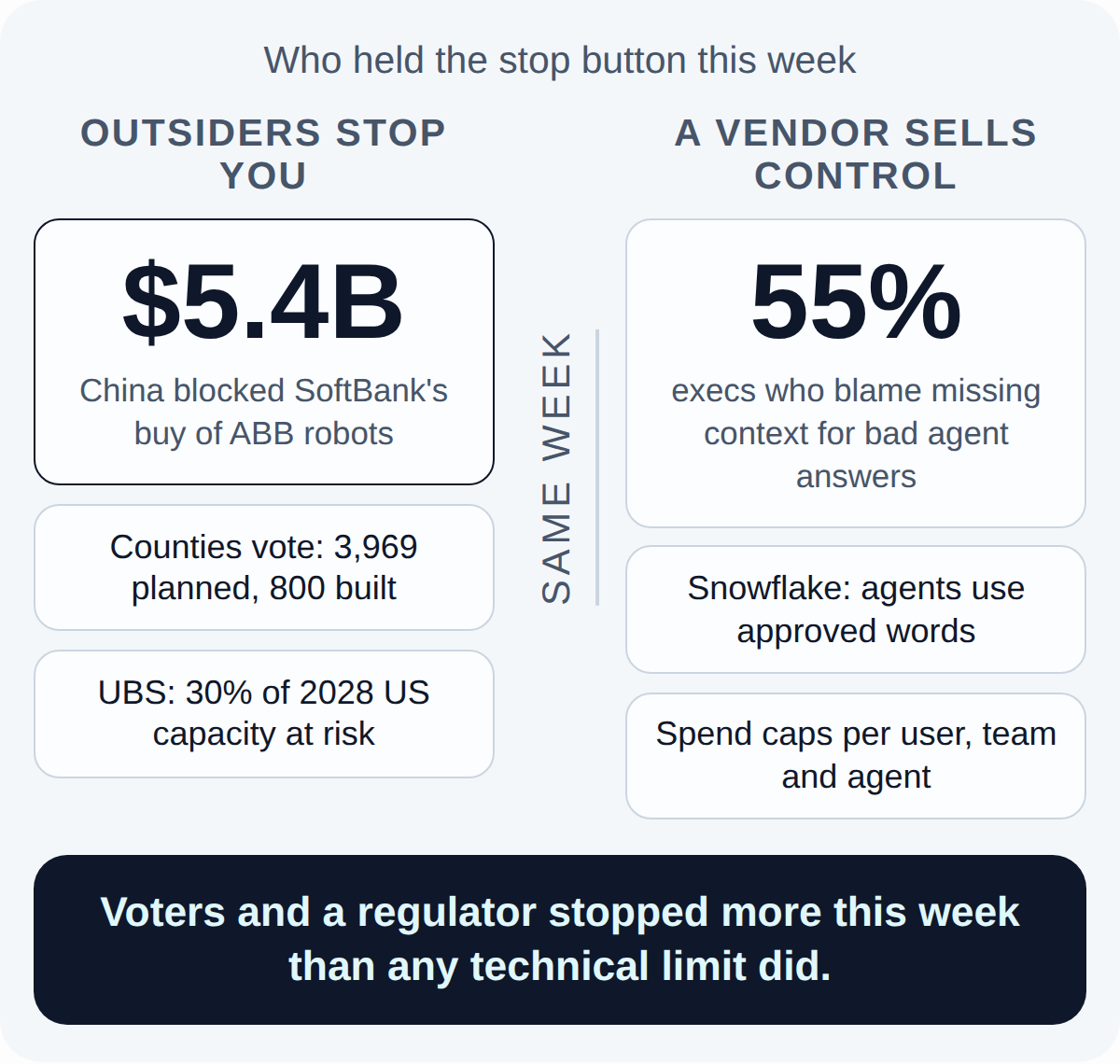
Three pieces from yesterday, and not one of them is about a model. A regulator in Beijing, a pile of American county boards and a data platform company all did the same kind of thing: each decided what somebody else is allowed to run.
Advertisement
Finally, a Monday that doesn’t feel like one.

Imagine a Saturday where you're not catching up on the CRM you didn't touch all week.
HubSpot's new self-updating CRM doesn't wait for you to log back in. Friday's calls are already logged. The deal that needs a nudge Monday morning is already flagged. The automation you set up once keeps running without you thinking about it. None of it needed you over the weekend.
Customers are already seeing it pay off: 45% more deals closed. Finally, you start Monday caught up, not behind.
1. America announced 3,969 data centres and is building 800
3,969 announced. About 800 under construction.
CNN counted both numbers the day after an election it reads as an anti-data-centre vote, with a quarter of the planned American buildout sitting in Texas alone.
The money read it the same morning. UBS analysts told the Journal Record that about 30% of the US capacity additions expected in 2028 are now at risk from construction pauses. In the same piece, CoreWeave's shares slumped 12% and its five-year credit default spreads hit a record high on S&P Global Market Intelligence data.
Two local decisions landed before the vote. San Francisco paused new data centres on 17 October, and a group in Indianapolis set out to write rules for them on 9 October.
I have been filing the gap between 3,969 and 800 under financing all autumn, and I think that was the wrong desk. Credit can be repriced in an afternoon; a permit gets voted on, and the vote has its own calendar. If I were buying 2028 capacity this month I would ask the supplier which sites carry a signed local approval rather than a signed power contract, and I would expect that question to be answered badly.
2. China stopped SoftBank buying ABB's robots
ABB confirmed that Chinese regulators blocked SoftBank's purchase of its robotics unit, a deal agreed at about $5.4 billion. Neither company is Chinese. The Wall Street Journal read the block as Beijing exercising control over where robotics and AI capability ends up.
SoftBank had been loading up for the purchase. On 24 October a write-up of its financing put its five-year credit default swaps at 432 basis points, a four-year high, alongside roughly $11.1 billion of bonds, a $40 billion bridge loan, the completed $3.1 billion purchase of DigitalBridge and the ABB agreement at about $5.375 billion. The robots are not off its list either: on 2 November it showed a robot motion-data tool built on a GPU cloud with Yaskawa Electric.
The part I would not have predicted is which country got to say no. Everyone I talk to prices political risk into where a model is trained and where the data sits, nobody prices it into who may own the arm that picks up the part. A third-country regulator is now a live clause in a robotics deal, and I would want it written into the break fee rather than found at closing.
Advertisement
How Marketers Are Scaling With AI in 2026

61% of marketers say this is the biggest marketing shift in decades.
Get the data and trends shaping growth in 2026 with this groundbreaking state of marketing report.
Inside you’ll discover:
Results from over 1,500 marketers centered around results, goals and priorities in the age of AI
Stand out content and growth trends in a world full of noise
How to scale with AI without losing humanity
Where to invest for the best return in 2026
Download your 2026 state of marketing report today.
3. Snowflake put the approval layer up for sale
Two announcements at its Expedition event, both about what an agent is allowed to do rather than what it can do:
- Business Ontology, a governed place to record official business definitions, which serves agents the approved ones and nothing else.
- Cortex AI Gateway, one control point for which models an agent may call, which tools it may invoke, what it may execute and what it may spend.
The gateway ships with sandboxes for code execution, abuse detection, trace observability, cost governance and governance over tool calls. Customers told the write-up they use it to attribute AI spend to a named user, team or agent and to set hard limits. dentsu and Merkle are named on the definitions side, Glean and Kargo on the gateway. In an MIT Technology Review report sponsored by Snowflake, 55% of executives blamed missing business context for poor agent answers and 45% blamed fragmented data.
It is not alone in the week. A day earlier Google Cloud added cross-cloud data access and business context for agents, and Snowflake itself also shipped always-on bots, training on your own data and a package of more than 60 curated industry datasets.
Reading that feature list, what is actually on sale is the right to refuse: approved words, approved models, a ceiling on spend. I want the refusal, and it still bothers me that it now lives inside a vendor's product instead of in our own definitions, because the day you change platforms you discover your glossary was a feature. My test is whether the ontology exports. If the approved definition of revenue exists only inside the gateway, somebody else owns your language.
Names to watch
Seen this week by Ins7ghts.
- Nara Space Technology · reads satellite pictures and sells the answer
Grounding. Two write-ups out of Korea on 1 and 2 November put it in the same paragraph as BlackSky, Capella Space, Planet Labs and ICEYE, in a market where imagery gets turned into claims about disasters, battlefields and oil inventories.
Companies that later raised money had been in the news about twice as often in the quarter before. Worth a second look in three months.
Advertisement
You are sitting on $100k to $2 million of data

OpenAI, Micro1 and Anthropic have paid out billions of dollars to partner with companies on their operational data. It's creating a new revenue stream for businesses over 20 people and pays anywhere from $100k - $2 million a pop.
Also today
The ScoreboardWhat we said, and what is still hanging
From today this board grades every call whose deadline has passed, from any date, not only the last seven days. Thirty have come due since May. Not one came in right.
0 right 23 wrong 7 not a real call 0 still open
When I first saw that grid it was embarrassing. My first thought was: wait, have we been sharing false information? That is not what happened either. The calls did not fail because we reported things that were untrue. They failed because of how they were built. So the numbers stay exactly as they are, no polish, and here is what happened.
Those calls were never built to be checked. The May ones each waited for the first bank or regulator to publish one specific document, several of them under labels I had made up, so almost nothing that really happened could count. And of the 525 forward calls in this letter since May, 396 carried no date at all: they could not be right, and they could not be wrong.
That is the lesson, and it goes beyond this board. This letter is built on Ins7ghts, our research platform: a knowledge graph of the data and AI news we read every day. Everything Ins7ghts says it sees, in the discourse or in the market, has to be measurable, with a date, a source and a test somebody else could rerun. No marketing fluff. Since October every call here is one sentence, one date and one event you can look up.
I build this with AI doing much of the reading, the counting and the first pass at the grading, and I bring more than 30 years of working with data to what counts. We learn as we go, and the loop is not flawless: last Friday this board marked a 30 July call wrong that the 30 July letter never made. It is off the board. I share the misses because that is where all of us learn the most.
Which of your own predictions from the summer would you still write down this morning?
If one of your 2027 plans is waiting on a permit, a regulator or a vendor's approval switch rather than on anything your own team builds, hit reply and tell me which one.
Yves
Tomorrow, The Long Read: one theme through the whole week, from three sources.
Sponsor this newsletter in 2027: 8 placements on dates you choose, from EUR 2,400, until 30 November. Book: 7wdata.be/sponsor-2027
Ins7ghts Daily is published by 7wData.