

In partnership with


 So, What Actually Happened?
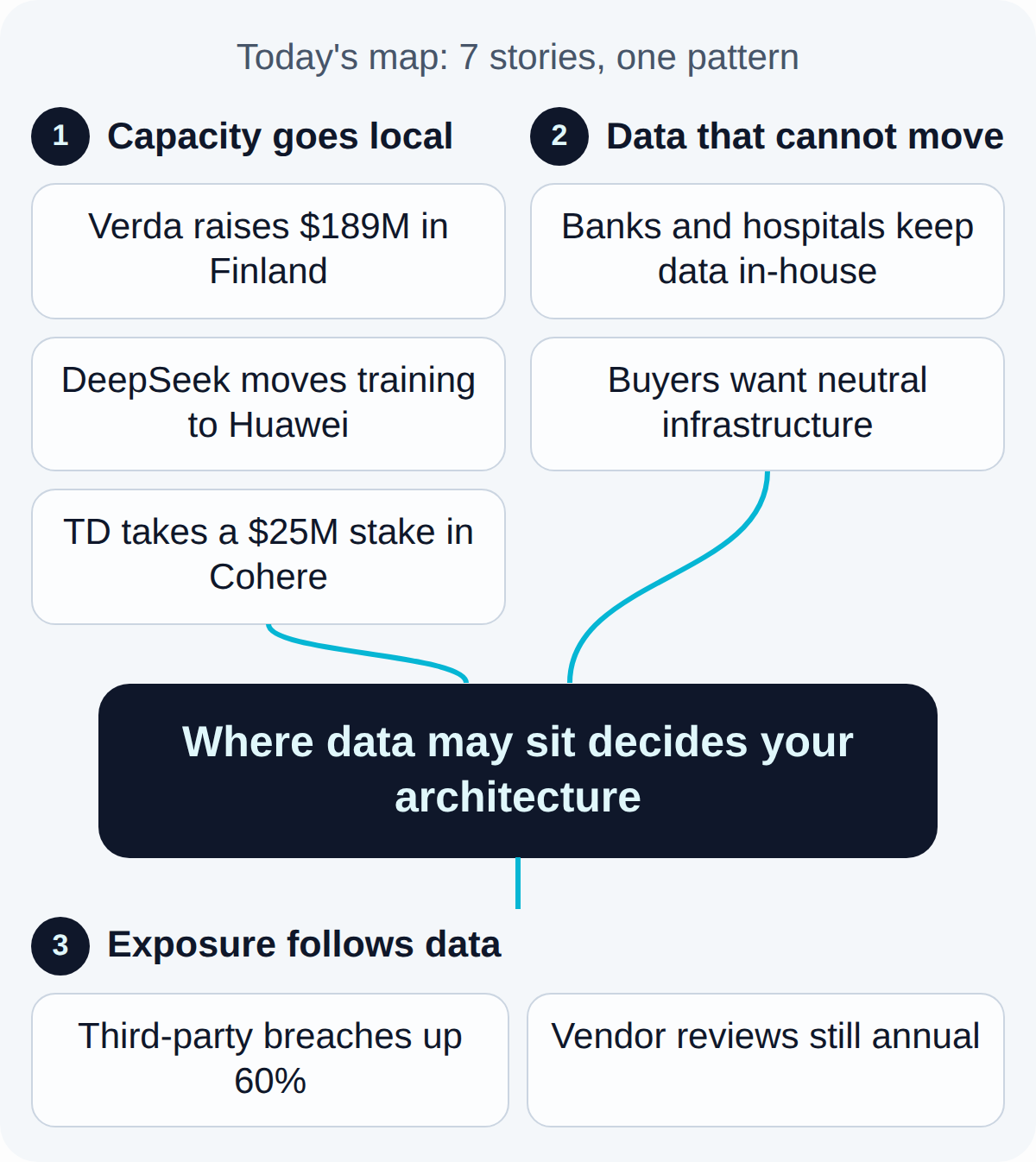
Wednesday, and one line from Tuesday is still sitting with me: banks, government agencies and health providers hold a lot of data that was never intended to move to the cloud. That is an engineer explaining why enterprises now run the model inside their own walls instead of shipping records out to somebody else's. We scanned 190,000 articles this week so you don't have to, and the money said the same thing in a different accent. Verda raised $189 million to build AI cloud capacity in Finland and crossed a billion-dollar valuation on it. The Linux Foundation published research saying buyers want neutral data infrastructure, not another stack with one owner. And third-party breaches climbed 60% in a year while most companies still check a supplier once and never again.
The Bottom Line: Which model you pick stopped being the interesting question. Where your data is allowed to sit is the one that decides your architecture, your budget and your exposure.
Advertisement
The Future of AI in Marketing. Your Shortcut to Smarter, Faster Marketing.

Unlock a focused set of AI strategies built to streamline your work and maximize impact. This guide delivers the practical tactics and tools marketers need to start seeing results right away:
7 high-impact AI strategies to accelerate your marketing performance
Practical use cases for content creation, lead gen, and personalization
Expert insights into how top marketers are using AI today
A framework to evaluate and implement AI tools efficiently
Stay ahead of the curve with these top strategies AI helped develop for marketers, built for real-world results.
 The Tracks That Matter
1. Verda Raised $189M On Where Its Machines Sit
Verda closed a $189 million Series B led by Emergence Capital, with Supermicro and MUFG Innovation Partners joining, and crossed a billion-dollar valuation to become Europe's newest AI infrastructure unicorn. The numbers underneath are unusually solid for this category: a $165 million annualised revenue run rate in July, more than $450 million raised across equity and debt, customers in over 50 countries, and a plan for more than 250 MW of operating capacity in 2027. What the customers are buying is not a model and not a chip. It is jurisdiction, Finnish data centre capacity with a European company's name on the contract, arriving exactly as buyers start asking for neutral infrastructure before they ask about benchmarks.
Here's what works: Ask each AI vendor which country every workload runs in, and get it in writing. If they cannot answer today, that is your answer.
2. The Data That Was Never Meant To Move
VAST Data is putting confidential computing inside its DataEnclave, and the mechanism matters more than the launch. A model runs only after hardware attestation proves the environment matches the owner's security policy, decryption keys are released only then, and every use writes to an audit trail both sides can read. Phil Manez puts the buyer requirement plainly: control what the AI can reach, and see what it did with it. In the same window Syngenta went public with a multi-year build of a governed data platform for its agriscience research rather than lifting that research into a shared cloud. Two unrelated industries, one identical instinct: carry the compute to the data.
Here's what works: Take your most sensitive dataset and price both options, moving it out versus bringing a model to it. Most teams have never costed the second.
3. Third-Party Breaches Rose 60%, Vendor Reviews Stayed Annual
Third-party data breaches rose 60% in a year, and the detail underneath is the ugly part: most vendor reviews happen once, at onboarding, then never again while the relationship and the data flowing through it grow for years. Put that next to how an ordinary engineering week actually goes, where production records get copied into a test environment with no deletion schedule and nobody notices until an auditor does, and the annual questionnaire looks like what it is. A document, not a control. Enclaves and attestation are the expensive answer to this problem. Knowing which suppliers hold a live copy of your customer data is the cheap one, and almost nobody has that list.
Here's what works: Write the list this week. Every supplier holding live customer data, the date of their last review, and who signs off on renewal.
Quick hits:
- Europe moved its own deadlines. The AI Omnibus pushed high-risk obligations to December 2027 and August 2028, which buys planning time and also means the rules you are budgeting against today are not the ones you will be audited on.
- A frontier lab swapped its silicon. DeepSeek moved AI training onto Huawei chips, cutting its dependence on imported accelerators and handing every procurement team a live reference point for ”could this run on something else”.
- A bank bought into where its model lives. TD announced a $25 million strategic relationship with Cohere backing Canadian-built AI, which is a sovereignty decision wearing a technology-partnership badge.
Advertisement
Learn How to Stay Visible in the AI Era

AI is changing how customers discover businesses. If your SEO strategy is built for yesterday's search, your visibility is already slipping. Learn how to optimize your content for today’s AI search results with BELAY’s latest report..
Your Turn
Which of today's three reads do you think is wrong?
One tap. No wrong answers.
 Signal vs. Noise
🟢 Signal: neutral, portable infrastructure. Buyers have started specifying where data sits and who owns the layer underneath before they compare models at all, and the Linux Foundation's new research puts a floor under it: 83% of organisations are running AI workloads, and they are actively hunting for infrastructure with no single vendor's hand on the switch. Most coverage is still scoring models on benchmarks.
🔴 Noise: governance as a category to buy. Governance pulled one of its loudest days on the wires and one of its weakest connections to anything that actually happened. The governance decisions that landed this week were a rewritten compliance timetable and an attestation architecture, neither of which arrives as a platform you can purchase.
 From the 190K
We scanned 190,000 articles this week. Here's what no one's talking about:
TacnIQ.ai raised $1.5 million to teach machines touch, Teledyne e2v launched a new family of image sensors, and ASM shipped a flowable-carbon process for the next era of chip scaling, all on a day whose headlines belonged to two model launches.
Read apart, those are three trade stories for three different desks: robotics, optics, semiconductor process. Read on one morning, they say the frontier moved down a floor. TacnIQ's $1.5 million is small money chasing tactile sensing, Teledyne e2v's Nexora sensors are about machines seeing where current ones go blind, and ASM's flowable carbon decides whether any of it can be fabricated at the next node. None of them get a keynote. All of them set what the software layer can honestly promise in 2028, while the model layer spent Tuesday competing on cost per task, which is what a layer does when it has run out of other ways to be different.
What changes today: if your AI roadmap is entirely software, find out who supplies the physical parts your 2028 plan assumes, because that supply is being funded right now, quietly, in single-digit millions.
Advertisement
Skydive is a new way to use AI agents. Each agent gets their own cloud computer with a browser, files, and terminal, so they can use your tools and actually do the work.
 By The Numbers
- Verda raised $189 million and crossed a $1 billion valuation — Europe's newest AI infrastructure unicorn, carrying a $165 million annualised revenue run rate rather than a pitch deck.
- Third-party data breaches rose 60% in a year — while most vendor reviews still happen once, at onboarding, and then never again.
- 83% of organisations are running AI workloads — and the same research finds them seeking neutral data infrastructure instead of another single-owner stack.
- Microsoft 365 Copilot passed 30 million paid seats — roughly $10.8 billion at list price, the number every ”is anyone actually paying for this” argument now has to clear.
- High-risk AI obligations move to 2 December 2027 and 2 August 2028 — Europe's rewritten timetable, which quietly resets every compliance budget built on the August 2026 date.
- See what's rising across AI and data this week →
 Deep Dive: The Data Outlives The Machine You Put It On
My record list started as a BASIC listing on a 5¼-inch floppy. My first PC could not read that floppy and there was no way to migrate the list across, so I retyped a few hundred records into FoxPro by hand over a few evenings. The list survived. The machine and the format did not.
Where it sits decides what you can do with it
Every serious AI decision this week was really a location decision. Data that cannot legally leave a country cannot be sent to a model that only runs elsewhere, so either the model travels or the project dies. That is not a compliance footnote. It is the first architectural constraint, and it arrives before any model comparison is worth running.
Neutral became a purchase condition
Buyers used to treat vendor neutrality as an ideological preference. Now it is written into requirements, because the exposure is concrete: a supplier owning both the storage layer and the intelligence layer sets your switching cost for the next decade. Open formats and open infrastructure stopped being a values argument and became a negotiating position.
The exit cost is the real price
Every quote you receive prices entry. Almost none price exit. The honest question about any AI platform is what it costs to leave in three years with your data, your embeddings and your audit history intact. If nobody in the room can answer, you are not buying a platform, you are signing a tenancy with no break clause.
What Actually Works
- Name the country per workload: write down where each AI workload physically executes. Blanks are risks, not details.
- Price the exit first: make every vendor quote the cost and timeline of a full data and model-artefact export.
- Separate the layers: do not let one supplier own storage, orchestration and the model unless you are content to pay their renewal number.
- Test portability once a year: export a real dataset and stand it up somewhere else. A migration you have never rehearsed is a migration you cannot make.
The records are always worth more than the machine they sit on. Build like you expect to carry them somewhere else, because eventually you will.
 What's Coming
Sovereignty Turns Into A Budget Line
Carnegie's new collection frames AI sovereignty as a capacity to build rather than a slogan, with middle powers picking managed interdependence over either dependence or isolation. Governments are about to price that ambition, and the invoices land on domestic clouds and domestic model makers. Expect national procurement rules that quietly disqualify the default stack.
Procurement Rewrites Before Regulation Does
The 2026 changes to FedRAMP and CMMC are reshaping what an authorisation actually requires, and government purchasing language reliably leaks into enterprise contracts within a year. If you sell into regulated buyers, the attestation questions arrive before any regulator does.
Hardware Budgets Get Harder To Forecast
Memory demand from AI has broken the old DRAM and NAND price cycle, which used to move together and gave finance teams a usable planning rhythm. With that link cut, infrastructure costs stop being predictable from last year's curve. Anyone modelling 2027 compute spend on a smooth line is modelling a market that no longer exists.
 For Your Team
Thursday's meeting prompt: ”Take our three most important AI workloads. For each one, name the country it runs in, the supplier who could hold our data hostage at renewal, and what it would cost us to move it. If we cannot answer all three, what are we actually committed to?”
Share-worthy stat: Third-party data breaches rose 60% in a year, and most companies still review a vendor exactly once, at onboarding. The attack surface grew. The inspection schedule did not.
Go deeper: Track where AI infrastructure and data risk are actually moving →
 The Track of the Day
”Organizations like banks, government agencies, and health care providers have a lot of data that was never intended to move to the cloud.”
Phil Manez, on running AI where the data already lives
A DJ carries the records to the room. Nobody has ever tried to move the room to the records, which is roughly what a decade of cloud migration asked of data that was never allowed to travel.
We scanned 190,000 articles this week so you don't have to. Data Pains → Business Gains.
Published: September 23, 2026 | Curated by Yves Mulkers @ Ins7ghts
1,300+ articles scanned. 7 stories selected. Our AI distills the noise into signal—in seconds. Get early access →
Know someone who'd find this useful? Share your unique referral link →
Want Your Own AI Intelligence Briefing?
Our platform analyzes 1,000+ sources daily and delivers personalized insights in seconds.
Join the Waitlist →Founding members: Lifetime discount • Priority access • Shape the product