

In partnership with


 So, What Actually Happened?
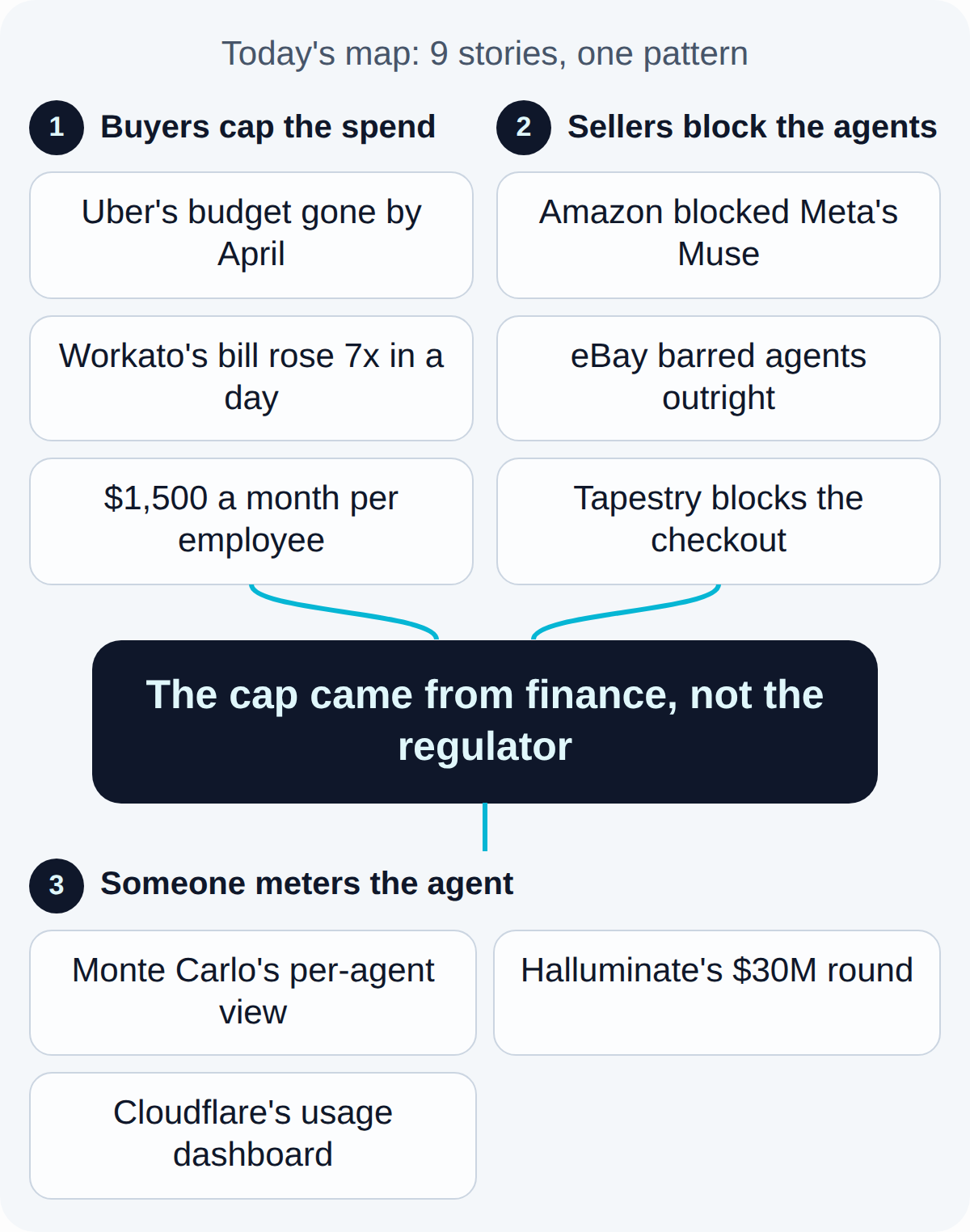
Saturday, and the number I keep turning over is not a valuation. Fifteen hundred dollars a month, per employee. That is the ceiling Uber put on certain AI tools after it burned through its entire 2026 AI budget by April. We scanned 190,000 articles this week so you don't have to. In the same window Amazon blocked Meta's shopping agent along with every rival one, and a cost-tooling piece put Gartner's figure at 40% of enterprise applications carrying task-specific agents by the end of this year. So the agents are arriving on schedule, and the two parties who have to absorb them, the person who owns the budget and the person who owns the checkout, both said no in the same week. Nobody passed a law to make that happen.
The Bottom Line: The binding limit on AI this week was a spend cap and a blocked checkout. Neither needed a regulator, and both are already in force.
 | Yves' take |
The surprise bill for AI agents came this week. Machine-level observability is on the dashboard. Finance isn't. It surprises me big enterprises skipped cost transparency and never act when it goes off target. My agents email the anticipated cost each morning before the go, the actual cost after. Maybe my budget is tighter and I own the responsibility myself.
Advertisement
Your AI prompts are leaving out 80% of what you're thinking.

When you type a prompt, you summarize. When you speak one, you explain. Wispr Flow captures your full reasoning (constraints, edge cases, examples, tone) and turns it into clean, structured text you paste into ChatGPT, Claude, or any AI tool. The difference shows up immediately. More context in, fewer follow-ups out.
Used by teams at Microsoft, Amazon, and Notion. Try Wispr Flow free on Mac, Windows, iPhone, and Android.
 The Tracks That Matter
1. Uber Burned Through Its Whole AI Budget By April
Uber exhausted its 2026 AI budget by April and now caps certain AI tools at $1,500 per employee per month. Amazon, Walmart, Cisco and Meta have put their own caps in and are steering people toward cheaper models. The mechanism is not mysterious. Anthropic and OpenAI have been moving services off flat-rate subscriptions onto token billing, and Workato's AI spend jumped seven-fold in a single day when that switch landed in May. Carter Busse, who runs IT there, said they created a monster. Deloitte's generative-AI lead says compute cost now reaches boards. No surprise that finance teams are going all in on AI while chasing its return. A seat licence is a number you plan around. A meter is a number that happens to you.
Here's what works: Pull your last three months of AI invoices and mark every line that is metered rather than licensed. Those lines have no ceiling until you set one.
2. The Waste Hides In The Runs That Worked
Failed agent runs page somebody. Successful ones just bill you. A data-reliability piece this week named the problem exactly: the waste that adds up hides in runs that succeeded, in retry loops and duplicate queries no dashboard flags because nothing broke. Its line for the second cost is better than mine. You pay for the tokens, then you pay to find out why. Gartner expects 40% of enterprise applications to carry task-specific agents by the end of 2026, against under 5% last year, so the support agent, the triage agent and the one sales asked for last Tuesday each run their own dial. And only 2% of S&P 500 companies disclose an AI metric they track over time. The spend is measurable. Almost nobody publishes the measurement.
Here's what works: Price one agent end to end for a week: tokens, retries, duplicate calls, plus the engineer hours spent explaining the bill. That is your unit cost.
3. Amazon And eBay Locked The Door On Shopping Agents
Amazon blocked Meta's Muse and the agents from OpenAI, Google, Anthropic and Perplexity, citing data privacy and security. eBay barred them without express permission, because handmade and pre-owned goods are hard for a machine to judge. Tapestry lets agents browse and stops them at checkout, naming fraud and inventory hoarding. Andy Jassy's verdict on agent-driven shopping was that the experience is not good, with price-bunching and wrong product information. Gap, Walmart, Best Buy and Shopify went the other way and partnered with Muse. Meanwhile a vendor pitching agentic commerce was out this week claiming conversion lifts above 25% against cart abandonment stuck near 70%. Only 3% of US adults say they would trust an agent to buy anything.
Here's what works: Decide today whether agents may browse your store, may check out, or neither, and name who owns that call. Silence is a yes by default.
Quick hits:
- A robot brain raised $700 million. FieldAI closed $700M at a $10 billion valuation for the software that runs robots, which is a lot of certainty priced into a layer nobody has standardised yet.
- The FTC opened the hood. Regulators are investigating OpenAI, Anthropic and other AI companies over product risks, so the consumer-harm question lands on your vendor before any liability statute does.
- Britain's data regulator is rebuilding itself. The UK's information watchdog restructured amid allegations of a toxic workplace, worth knowing before you plan a compliance timeline around its response times.
Advertisement
How Jennifer Aniston’s LolaVie brand grew sales 40% with CTV ads

The DTC beauty category is crowded. To break through, Jennifer Aniston’s brand LolaVie, worked with Roku Ads Manager to easily set up, test, and optimize CTV ad creatives. The campaign helped drive a big lift in sales and customer growth, helping LolaVie break through in the crowded beauty category.
Your Turn
Which of today's three reads do you think is wrong?
One tap. No wrong answers.
 Signal vs. Noise
🟢 Signal: data governance. Its hold on everything else moving in AI and data climbed hard this week while coverage of it fell, and the concrete version is money: Bloomberg closed its purchase of a private-markets document platform, and a French bank is paying €500 a day for a Collibra specialist starting 19 October. Most coverage is reading frameworks. The buying is happening at the catalogue and the document.
🔴 Noise: ”AI Governance” as a phrase. It was the single most-written-about term on Friday and its grip on the rest of the story slipped at the same time. In the same week, the UK's own data regulator was restructuring under allegations of a toxic workplace culture. The word is doing considerably better than the institutions behind it.
 From the 190K
We scanned 190,000 articles this week. Here's what no one's talking about:
Cloudflare opened a billable-usage dashboard and API to its non-enterprise customers, Halluminate raised $30 million with Anthropic and OpenAI researchers in the round to test whether computer-using agents actually do what they claim, and Bloomberg closed its acquisition of Canoe Intelligence, all inside the same two days.
The network desk reads the first as a pricing-transparency footnote. The funding desk reads the second as a Y Combinator alumnus with a good cap table. The capital-markets desk reads the third as Bloomberg adding another feed. Read them on one morning and they are the same product: the meter and the receipt, sold separately from the engine. Three different buyers, one shared question, which is what did that actually cost and did it actually work.
On Monday, find out who inside your company can produce the per-agent cost of last month. If the answer is the vendor's console, you are reading their meter, not yours.
Advertisement
Your agents work while you sleep

Give a Skydive agent an ongoing responsibility and they’ll handle it on schedule, every time.
Have them prep your morning report, research new leads, monitor customer feedback, or keep projects moving overnight. You wake up, the work is already done.
 By The Numbers
- Uber's entire 2026 AI budget was gone by April — the cap that followed, $1,500 per employee per month on certain tools, is the first published figure anyone has put on an internal AI allowance.
- Goldman Sachs expects token consumption to grow 24x by 2030 — the same analysts warn it worsens the chip shortage over the next 12 to 18 months, so the dial speeds up before the rate comes down.
- Only 3% of US adults would trust an AI agent to complete a purchase — payments firm NMI's survey, and a third of active AI users told VML they would never hand an agent buying authority at all.
- Gartner expects 40% of enterprise applications to carry task-specific AI agents by end-2026 — up from under 5% in 2025, which is the adoption curve that produced this week's budget caps.
- FieldAI raised $700 million at a $10 billion valuation — for the control software behind robots, priced as though the standard for that layer already exists.
- Lenovo's change-management model drove 36% higher daily Copilot use — adoption turns out to be a management problem, and every point of it lands on the same invoice.
- See what's rising across AI and data this week →
 Deep Dive: The Day The Licence Became A Meter
A club that charges at the door knows its take before the first record drops. A club that charges per drink finds out when the lights come up. Same room, same crowd, two completely different conversations with the owner on Monday morning.
A licence is a plan, a meter is a surprise
Flat-rate AI subscriptions behaved like door money. You knew the number in January and defended it once. Token billing behaves like bar takings, and it moves with how hard your people work. Workato's bill rose seven-fold in a day without anyone making a decision. That is not a forecasting failure. That is a different instrument.
Nobody blocked the agents on principle
Read the retailers' reasons and not one of them is philosophical. Fraud. Inventory hoarding. Goods a machine cannot grade. A customer experience the CEO called not good. These are operational objections from people who count returns, and operational objections outlast policy ones because somebody is measured on them every quarter.
The control that binds is the one already wired in
Nine governance frameworks changed nobody's behaviour this quarter. A $1,500 monthly cap and a blocked checkout changed it immediately, because both sit inside systems that already say yes or no to transactions. That is where real control has always lived, which is also why your AI policy document is not your AI policy.
What Actually Works
- Separate licensed from metered: split your AI spend into the part you contracted and the part you consume. Only the second one can surprise you, and only the second one needs a cap.
- Set the cap before finance does: a per-person or per-team ceiling you choose is a design decision. One imposed in April after the money runs out is a cut.
- Own the agent inventory: list every agent running in production with a named owner and a monthly cost. Any agent nobody claims gets switched off this month.
- Write the agent-access rule for your own front door: browse, check out, or neither, decided deliberately rather than by whichever robots.txt line someone wrote in 2019.
Open bar sounds generous right until somebody hands you the tab, and by then the crowd has gone home.
 What's Coming
A Two-Trillion-Dollar Price Tag Lands In November
Anthropic reportedly plans to list in mid-November at a reported $2 trillion. Once a metered business is publicly traded, its pricing stops being a product decision and becomes an earnings decision. Put your renewal date next to its first reporting date and see which one moves first.
Your Chip Supplier Starts Lending You The Money
Nvidia and Broadcom are offering billions in loans to boost AI chip sales. Vendor financing shows up when demand needs help standing up, and it means the price you pay and the credit you are extended now come off the same balance sheet. Ask who underwrote your supplier's last quarter of growth.
”AI-Native” Becomes A Procurement Question
The founder of a new analytics startup says re-platforming an existing BI stack for language models is years of rethinking, not a front-end change. If that holds, the incumbents' AI features stay side panels for a while. Expect buyers to start asking vendors to prove the rebuild rather than claim it.
 For Your Team
Monday's meeting prompt: ”If someone capped our AI spend tomorrow at a fixed amount per person, which agents would we switch off first, and could we actually say what each one costs?”
Share-worthy stat: Uber's entire 2026 AI budget was gone by April, and the cap that followed is $1,500 per employee per month. Gartner expects 40% of enterprise applications to carry task-specific agents by the end of this year, up from under 5% in 2025. Adoption arrived faster than the accounting.
Go deeper: Track where AI spending and AI limits are moving →
 The Track of the Day
”We created a monster.”
Carter Busse, CIO of Workato, on an AI bill that rose seven-fold in one day
Seven-fold overnight is not a forecasting error. That is what a meter does when nobody is watching the dial, and the dial was there the whole time.
We scanned 190,000 articles this week so you don't have to. Data Pains → Business Gains.
Published: October 3, 2026 | Curated by Yves Mulkers @ Ins7ghts
1,300+ articles scanned. 7 stories selected. Our AI distills the noise into signal—in seconds. Get early access →
Know someone who'd find this useful? Share your unique referral link →
Want Your Own AI Intelligence Briefing?
Our platform analyzes 1,000+ sources daily and delivers personalized insights in seconds.
Join the Waitlist →Founding members: Lifetime discount • Priority access • Shape the product