

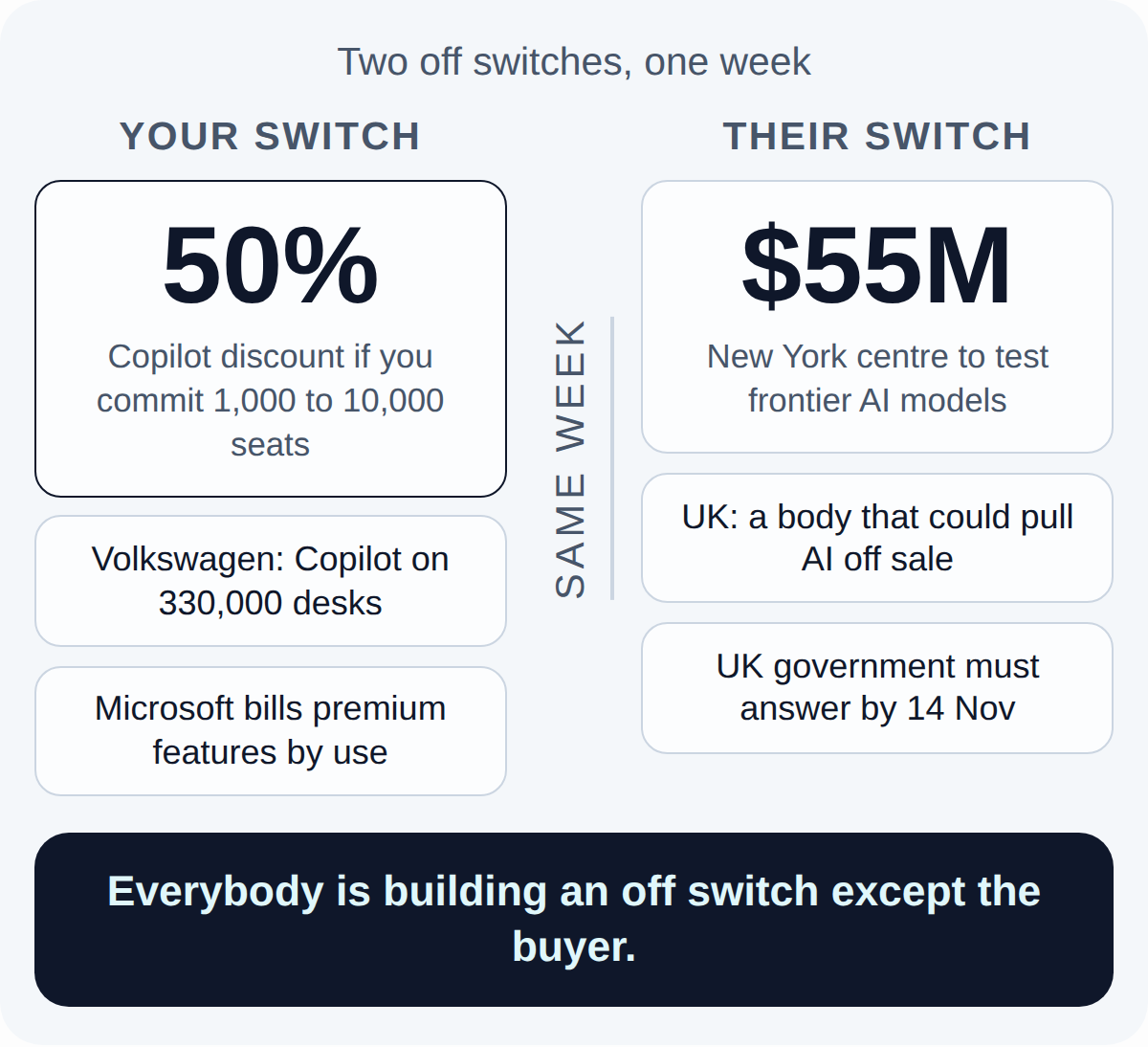
Everybody is building an off switch except the buyer
Three things landed yesterday and they all describe the same object: the moment somebody switches an AI system off. Two of them are about who in public gets that power. The third is about what it now costs you to keep yours.
Advertisement
 |
Destination AI, the eBook by Celonis |
AI agents, assistants, and co-pilots, explainedFinally. A book about Enterprise AI that isn't boring 👀. (You're welcome 😉). |

1. A UK committee asked for the power to pull an AI system off the market
The Joint Committee on Human Rights published its report on 14 September 2026, finding that UK law does not protect people from AI harms. The government has to answer it by 14 November 2026. What it asks for:
- A dedicated AI Act. The UK has none.
- A statutory body with the authority to test risky AI systems and withdraw them before market release.
- Mandatory transparency where AI decides something about a person, with recruitment as the committee's own example: an explanation of how the system reached its conclusion.
- Liability pushed toward designers and developers rather than resting on the business that deployed the system.
The UK has signed the Council of Europe's Framework Convention on AI and has not ratified it.
The recommendation I would not bet on is the liability shift. A statute can move who pays for a harm, but it cannot move who holds the prompts, the logs and the model version from the afternoon it went wrong, and that is the deployer. So I expect the transparency duty to arrive years before the liability shift, because it costs a developer almost nothing and costs me a records system I do not have yet. If I ran a recruitment pipeline in the UK, I would spend this quarter writing down which decisions my system actually makes on its own, and what I could put in front of a tribunal about any one of them.
Our research · We tried to prove Crunchbase and Dealroom miss deals. They don't.

I tested whether Crunchbase and Dealroom miss deals and they don't: they hold the funding rounds, so funding is context in ins7ghts now, never the lead.
Advertisement
OpusClip started with clips. Now it edits entire videos.

With OpusClip 4.0, drop in raw footage, toggle on the edits you want, and get back a finished video. You never have to touch a timeline! Speech cleanup, captions, AI B-roll, Viral Hook, Motion Graphics: it's all there. Try it for 40% off your first month of Pro Plan.
2. New York put $55 million into a lab that tests models before they ship
The New York Center for AI Responsibility and Research opened with $30 million from philanthropist Tom Secunda, $25 million from SUNY and state support behind it, and more than 80 scientists to write safety standards and run tests on frontier models. Governor Kathy Hochul launched it as a state-run testing programme, Politico reported on 10 November. It lands ahead of the RAISE Act's compliance date.
The state has been stacking dates all autumn. Its ban on unsafe AI companion features for minors starts on 1 January, and a study published on 22 October put New York alongside California and Illinois as the three states writing rules for the largest models.
Eighty scientists and a cheque from one wealthy donor is not a regulator. It is a laboratory a regulator can phone, and that is a better design than it sounds, because what American AI policy has lacked all year is anybody holding instruments. The federal centre with the same brief stopped publishing its work, which we covered on 9 November. Instruments in a university are harder to switch off than instruments in a department. The real test is whether this centre publishes a method a lab in Illinois could repeat on the same model and get the same answer, because a standard nobody else can run is an opinion with a budget.
3. Microsoft is cutting the Copilot price and lengthening the commitment
Microsoft is reportedly letting its sales teams hand out discounts of 30% to 50% on Microsoft 365 Copilot to enterprises that commit to between 1,000 and 10,000 seats and accept usage-based charges on premium features, with the pricing linked to Azure consumption.
The procurement advisers at NPI, who read the trade and wrote it up, list what a buyer should have in hand before signing: the tier calculation verified, the metered features named, the effect on the Azure commitment modelled, and the exit terms negotiated. Three of those four are arithmetic. The fourth is the one that gets left out.
Volkswagen rolled Copilot out to more than 330,000 employees, reported on 10 November.
This is a volume discount dressed as a price cut, and it converts a licence into a forecast. The half-price number is real, and so is the part it hands over, because the metered half is the half nobody can model, and an estate that size has no quick way back out of either. I would take a discount like this only on the seats I can already prove are in daily use, and leave the rest at list price until somebody shows me the usage.
Two vendors put the buyer's off switch on sale on the same day
Nobody put these two together. Zingtree announced a governance and orchestration layer for customer-service agents in regulated firms: the part that decides which agent is allowed to act, and leaves a record of what it did (the announcement, and what it means for regulated firms). The same day, AvePoint widened its Microsoft partnership to govern AI agents across Copilot and the services around it. Separate companies, separate pitches, and one product underneath: the controls over your own agents, bought from somebody else and renewed every year.
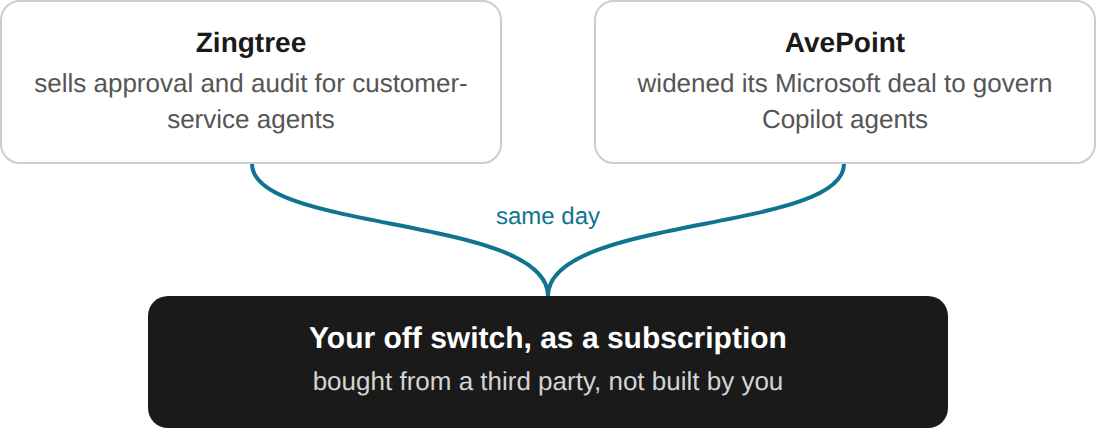
So the buyer's switch does arrive. As a line item.
Today's context on 7wData
- Zipline raises $1.5 billion at a $21.5 billion valuation as Walmart adds 300 drone sites On 5 November Zipline, the drone delivery company, announced a $1.5 billion raise at a $21.5 billion valuation, the same day Walmart agreed to add 300 Zipline drone delivery sites in the US.
- Manus AI joins October's unicorns after Beijing unwound Meta's deal Manus AI, the Singapore-based AI agent company, has raised more than $500 million led by Boyu Capital and IDG Capital, after Chinese regulators ordered Meta's agreed acquisition of it reversed.
Advertisement
Your next adventure may leave cell coverage behind. Keep in touch with ZOLEO. Save 20% on a regularly priced ZOLEO Satellite Communicator with code GEAR20.
Not valid on sale-priced devices or with other discounts. Valid outside promotional sale periods.
Also today
- France unveiled the Paris Call for AI Safety and Security, signed by OpenAI, Anthropic and Mistral, committing them to build emergency off-switches into advanced models (read it). (7 min read)
- Google opened Gemini 4 Carbon to developers and enterprises, aimed at long-running tasks rather than quick answers (read it). (2 min read)
- T-Head, Alibaba's chip unit, filed a confidential application to list on the main board of the Hong Kong stock exchange (read it). (6 min read)
The ArgumentThe off switch nobody is building for Tuesday
Read today's three stories in a row and you get a complete off switch, as long as the system in question has not shipped yet. The UK committee wants a body that can withdraw a model before it reaches the market. New York built a laboratory that tests frontier models before they go out. Both sit upstream of the only moment that matters to the person running the thing: agent live, inside the business, halfway through a process, something going wrong at twenty to four on a Tuesday, and nobody in the building certain who is allowed to halt it.
Who in your company is allowed to stop a live AI system, and what do they have to do it with?
My call: by 30 June 2027, at least one national or state regulator publishes an enforcement action in which a deploying company's inability to stop a live AI system is named as a failing.
If somebody in your company has ever halted a live AI system, I want to know who was allowed to give that order and how long it took, hit reply and tell me.
Yves
Tomorrow, the Scoreboard: I grade my own calls of the past week, the misses included.
Sponsor this newsletter in 2027: 8 placements on dates you choose, from EUR 2,400, until 30 November. Book: 7wdata.be/sponsor-2027
Ins7ghts Daily is published by 7wData.