

In partnership with

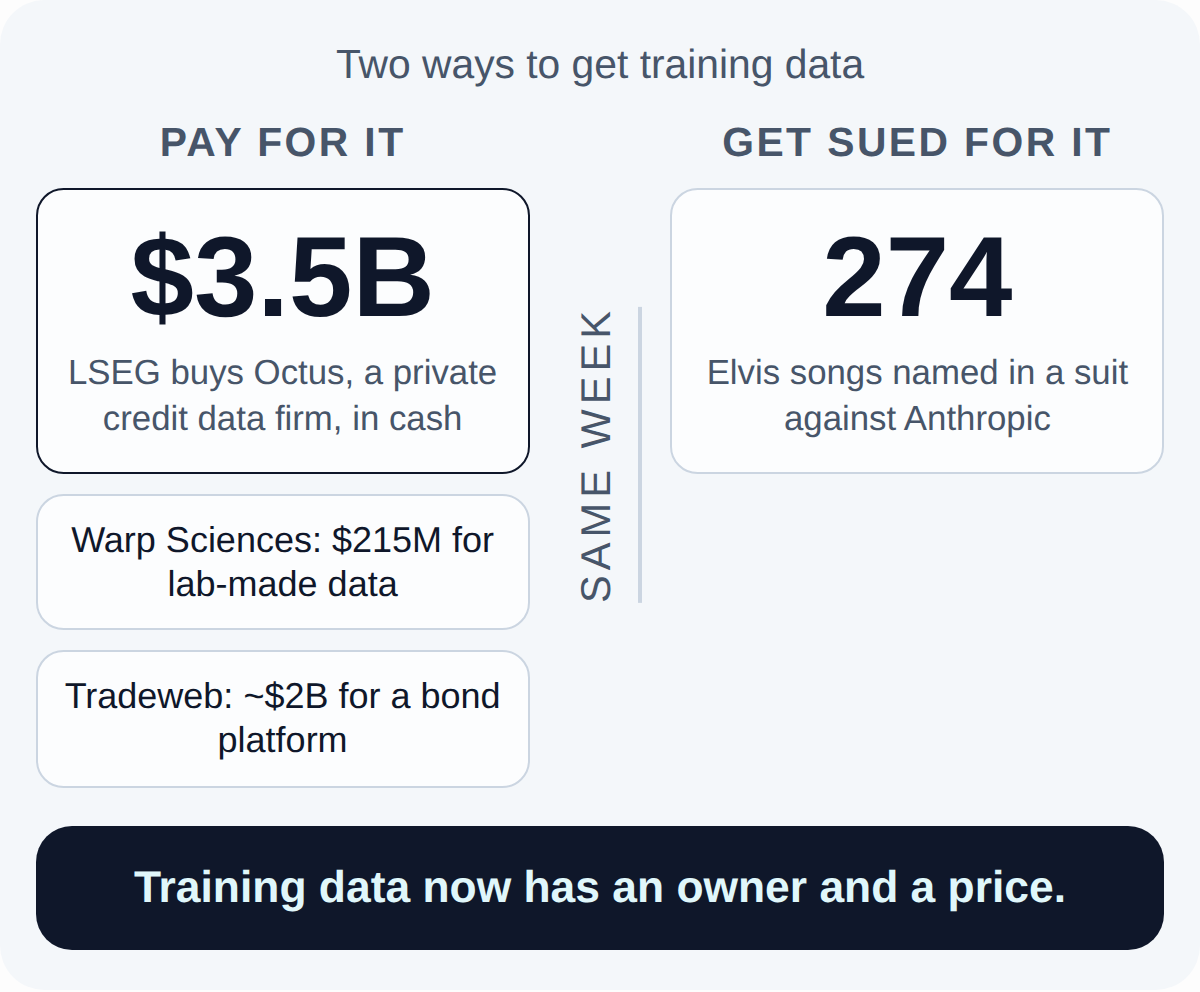
Training data now has an owner and a price.
Three things from last week landed in three different sections of the news and are the same story. An exchange wrote a cheque. A record catalogue filed a suit. A new company raised money to build a plant. All three are about where the next batch of data comes from, and who gets paid when it moves.
Advertisement
Your Next Side Hustle is Already on This List

Ready to stop scrolling job boards and start building something of your own?
The Hustle's free "Side Hustle Ideas Database" uncovers 100 unconventional, actually-actionable ways to earn on the side.
Inside you'll find:
A curated list of 100 real side hustle ideas spanning e-commerce, services, content, and weird corners of the internet most people never think to look
Opportunities at every level, whether you have 5 hours a week or 50, zero capital or a small runway
Offbeat, under-the-radar ideas you won't find in generic "how to make money" listicles
Subscribe for free today and get instant access. Your next income stream is one click away.
1. LSEG paid $3.5 billion for data a model cannot reach
On 22 October LSEG agreed to buy Octus, a private credit intelligence and workflow business, from Permira.
$3.535 billion, all cash.
Reuters filed the deal as a move to shield LSEG's data business from AI disruption. Fintech Global's write-up puts the same number on it and reads it as private credit reshaping the data market.
Reuters reported the talks on 13 October at about the same price, so the nine days in between were paperwork rather than a change of mind. The same week, Tradeweb agreed to buy the bond-trading platform Trumid for almost $2 billion.
I read this as a bet on ownership, not on analytics. Private credit marks are not sitting on the open web. They come from people who agreed to hand them over, and that agreement is the thing being bought. If I ran a data business today I would stop counting dashboards and start counting which of my inputs I could still get if every public source went behind a licence next quarter. The inputs with a signed origin are the only ones I would plan 2027 around.
2. Elvis Presley's rightsholders sued Anthropic over 274 songs
The rightsholders for Elvis Presley's catalogue filed against Anthropic over 274 songs they say sat in the training data. A second write-up the same day frames it as a music case rather than a technology case.
A song is a clean test case, which is why I expect this one to move faster than the book suits did. Anyone can count 274 titles and anyone can look up who owns them. There is no fair-use argument that survives a spreadsheet of names. I would not wait for a verdict to act on it: if I had a model in production I would want, this week, a list of what went into it that a lawyer could read without a three-month excavation. Most teams I talk to cannot produce that list, and the ones that can built it before they needed it.
Advertisement
Free email without sacrificing your privacy

Gmail tracks you. Proton doesn’t. Get private email that puts your data — and your privacy — first.
3. Warp Sciences raised $215 million to make the data it needs
Warp Sciences launched on 22 October with $215 million to build an American contract research organisation that runs chemistry with AI and robots. The coverage names Kevin Weil behind it and frames it as speeding up AI drug work, with Lightspeed, IVP and Premji Invest among the investors.
Crunchbase put it in the week's ten biggest rounds, and Axios carried it in its deals brief the day it launched.
Nobody puts this part in a slide. When the readable world runs thin, you do not scrape harder, you build a factory and generate your own. A robot lab has a maintenance schedule, a failure rate and a floor somebody pays rent on, which makes it a very different asset to own than a licence. My expectation is that the companies that win the next round of science models will read like manufacturers on the balance sheet, and I would look at their capital spending before I look at a model card.
Your Turn
Which of today's three reads matters most to your work?
Advertisement
A Smarter Start for Talent Visas
Get started on your talent visa journey in one guided intake. Manifest Law can then assess which talent-visa options deserve a closer attorney review.
Attorney Advertising
Also today
- Varonis and Collibra linked up to tag sensitive data automatically. (1 min read)
- Moonshot's Kimi K3.1 Pro moved to the front of the open-weights field while allegations about paid influencer posts followed the release. (14 min read)
- An SAS survey puts 18% of banks with AI governance fully embedded. (3 min read)
What ShiftedThree decisions about AI, none of them by a lab
Years ago I interviewed at McKinsey for a data modeler role. They asked about SQL Server and ETL, I explained it in two minutes, and they moved on as if it were furniture. Then they put an Excel sheet in front of me and asked how I look at data. I talked them through filtering, pivot tables, profiling what was actually in the columns. Two hours, a rate discussion, hired. Nobody tested the tools. They tested what I do with something I have not seen before.
Last week three parties made a decision about AI, and not one of them builds models.
Who is setting the terms your AI has to meet, and did you read them or inherit them?
My call: by the end of Q1 2027, at least one large enterprise AI contract names an outside benchmark inside the contract rather than in an appendix.
If you can already produce the list of what went into your production model, hit reply and tell me.
Yves
Tomorrow, First Move: the company in the news, and the one right behind it that nobody covers.
Reach data and AI leaders in this inbox: book a placement.
Ins7ghts Daily is published by 7wData.