

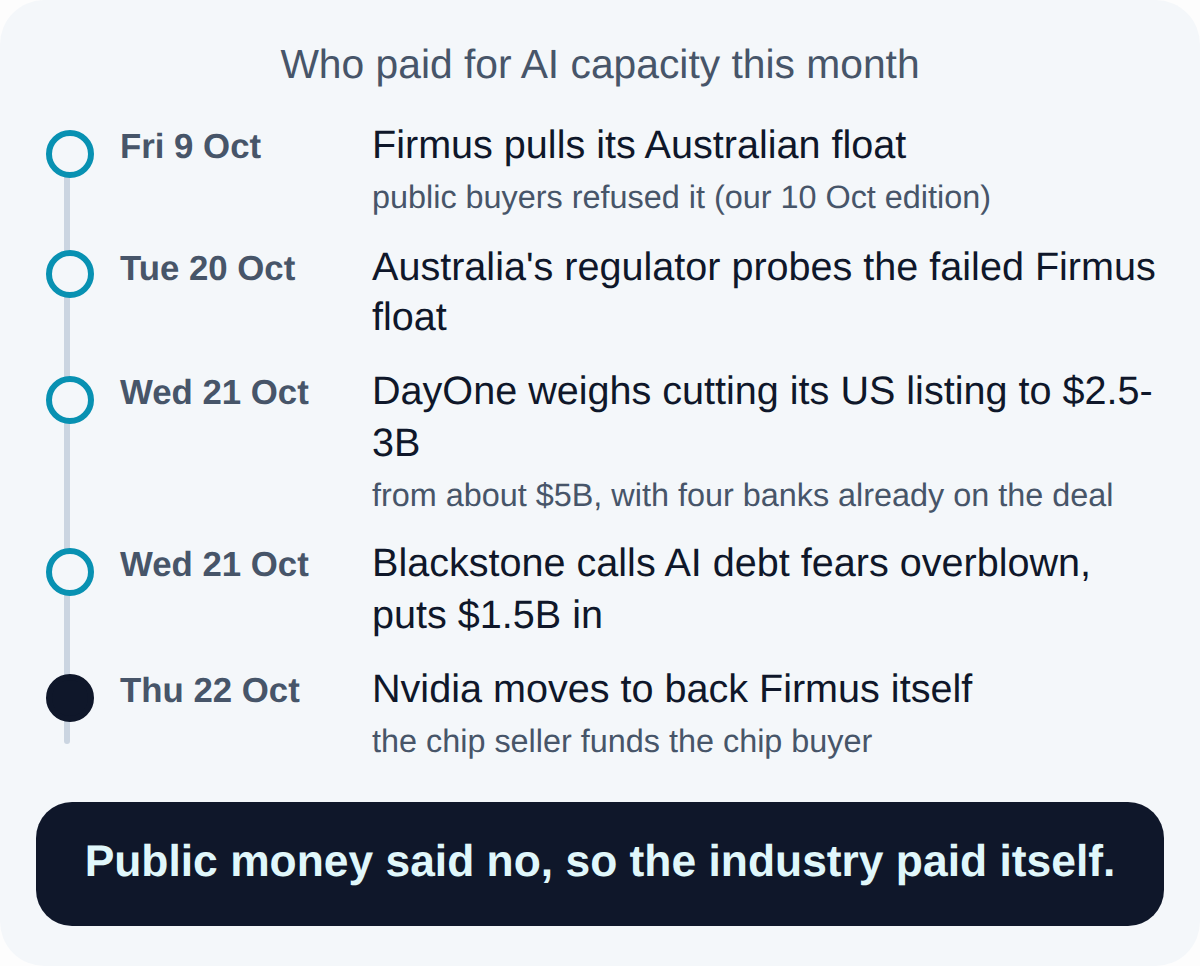
Public money said no, so the industry paid itself.
Three money items from yesterday and this morning, all sitting on the same gap. Outside investors are putting a lower price on AI capacity than the people building it are, and the difference is now being covered by the companies that sell into it.
Advertisement

Answer a few questions about your data, latency, filtering and deployment. In 30 seconds you'll know whether a flat file, keyword search or pgvector is enough, or whether you really need a vector database.
1. DayOne is weighing a listing half the size
DayOne Data Centers is considering postponing or shrinking its planned US listing, looking at an issue of $2.5 to $3 billion instead of the roughly $5 billion it was aiming for. Morgan Stanley, JPMorgan Chase, Bank of America and Citi are already on the deal.
The proceeds were earmarked for construction. DayOne runs or is building sites in Singapore, Malaysia, Indonesia, Thailand, Hong Kong, Japan, Finland and Spain.
On 6 October it was still pursuing the listing as its footprint grew. Reuters wrote in late September that data centre hopefuls were walking into a tougher market as scrutiny grew, and last week Dealroom put it flatly: investor appetite for data centre listings is reaching its limit.
I read the halved number as the honest one and the $5 billion as the hopeful one. Eight countries of construction do not get cheaper because the raise got smaller, so the gap closes with debt or with a strategic backer, and both of those arrive with conditions a public shareholder would never have been able to impose. If I were signing a three-year capacity contract with an operator in this position, I would want to know what its lender can force it to do with the racks my workloads are sitting on.
2. Nvidia is moving in where the public buyers would not
Nvidia is moving to back Firmus, the GPU cloud operator, after investors balked at its listing. We covered that collapsed float on 10 October. This is the first sign of who covers the hole it left.
Since then, Australia's corporate regulator has opened a probe into the failed float, and a week and a half later the fallout is still sitting on ASX-listed AI names.
A chip vendor funding the customer who buys its chips is neither new nor automatically wrong. What bothers me is the paperwork it removes. A float would have produced a prospectus, audited accounts and holders who could sell on Monday morning if the story changed. A private cheque from the supplier produces none of that, and the people with the most at stake in those numbers, the enterprises renting the capacity, now have nowhere to read them. I would write a disclosure clause into the contract rather than wait for a filing that is no longer coming.
Advertisement
How Jennifer Aniston’s LolaVie brand grew sales 40% with CTV ads

The DTC beauty category is crowded. To break through, Jennifer Aniston’s brand LolaVie, worked with Roku Ads Manager to easily set up, test, and optimize CTV ad creatives. The campaign helped drive a big lift in sales and customer growth, helping LolaVie break through in the crowded beauty category.
3. Blackstone says the debt worry is overdone
Blackstone's Jas Khaira told TechCrunch that fears over AI buildout debt are overblown. The same piece carries the position underneath the opinion: Blackstone has formed a $1.5 billion joint venture called Ode, with Anthropic and Hellman & Friedman.
We wrote on 16 October about the $35 billion private-credit vehicle Apollo and Blackstone assembled to buy chips and lease them to Anthropic. Same lender, six weeks on, now a part owner. Around it, the Guardian asked on 20 October whether this is the beginning of the end of the AI stock market boom, and Reuters reported last week that the selloff and rising rates are testing the data centre deal boom.
Everybody being quoted on whether AI debt is safe is holding AI debt. Khaira may well turn out right, and private credit has digested worse than this. What I will not do is read it as a forecast: it is a position statement from a firm whose returns depend on the answer, and going from leasing chips to Anthropic to co-owning a venture with Anthropic is a deeper commitment, not a hedge. For anyone running vendor risk, the practical consequence is that your model supplier and your model supplier's financier are turning into one conversation, and the old trick of quietly asking the lender what it thinks of the borrower stops working.
Your Turn
Which of today's three reads matters most to your work?
Names to watch
Seen this week by Ins7ghts.
- Courtroom Insight · verified people and matter records for legal work
Grounding. On 21 October it put a connector into Harvey's library so the assistant answers from checked records instead of from whatever it absorbed, announced by both companies. - Storyteller AI · AI that rebuilds commercial software from the outside
Provenance. Korean trade press wrote up its replicas of Adobe and Microsoft products, and GitHub then removed one of them, a Photoshop lookalike, over misuse of code.
Companies that later raised money had been in the news about twice as often in the quarter before. Worth a second look in three months.
Advertisement
22 ChatGPT Agents Built for Every Marketing Job

Most marketers use ChatGPT to do general research and then call it an AI strategy. The ones outperforming them are deploying specialized agents built for specific jobs.
We put together 22 plug-and-play ChatGPT marketing agents that handle the work eating your week, each with built-in instructions and structured outputs ready to go in under 5 minutes.
Subscribe to Marketing Against the Grain and get all 22 free.
Inside you'll find:
Competitive intelligence agent that visits competitor websites and builds detailed comparison matrices automatically
Customer feedback analyzer that ranks improvement opportunities by business impact
Social listening specialist that monitors brand mentions and flags reputation risks before they escalate
Campaign optimization agents that handle attribution analysis and surface what is actually driving results
Your competitors are already running agents like these.
Get 22 ChatGPT Marketing Agents free when you subscribe to Marketing Against the Grain today.
Also today
- OpenAI will sell its top models, GPT-6 Astra among them, through Google Cloud's marketplace, payable against cloud commitments customers have already signed. (2 min read)
- Microsoft launched Copilot for Legal, into a field where Anthropic, Google and OpenAI have all shipped legal-specific tools in the past five months. (2 min read)
- Pigment raised $250 million in a Series E for AI-driven business planning. (2 min read)
The ArgumentThe credit pack is the new policy
I emptied dancefloors, more often than I like to admit. The risk was always acceptable, because I knew what worked: sometimes one record brought them back, sometimes it took half an hour of patient rebuilding. I always had a way back.
Ohio State's technology office published how Microsoft's Cowork agents get paid for, and in that model there is no record left to play. A department buys a prepaid pack of 25,000 credits a month. When the credits are gone, the agent's work pauses until the monthly reset or until somebody approves more.
Who in your company decides which AI work stops when the credits run out, and do they know that is the decision they are making?
My call: by the end of Q1 2027, at least one large enterprise publicly reverses or renegotiates an AI rollout over per-task credit consumption rather than over model quality.
If an AI supplier of yours changed how it is funded this month, I want to know what you asked for in return. Hit reply and tell me.
Yves
Tomorrow, the Scoreboard: I grade my own calls of the past week, the misses included.
Reach data and AI leaders in this inbox: book a placement.
Ins7ghts Daily is published by 7wData.