

Sponsored by

Your security vendor is buying your AI controls
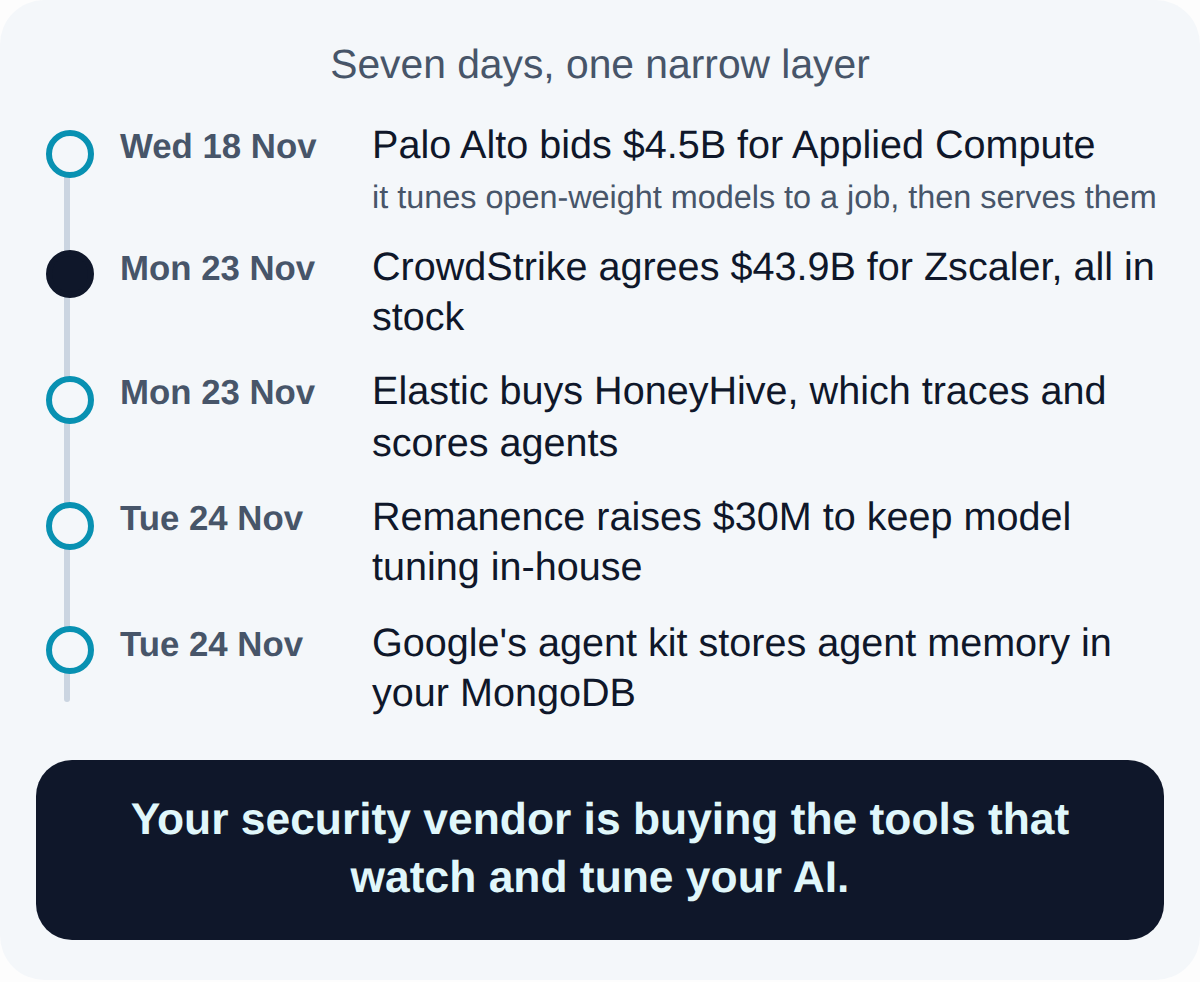
Four moves in seven days, all in the same narrow place: the tooling that tunes, watches and stores what your AI actually does. Two of them are security companies writing very large cheques. One is a Paris team raising a small one to argue you should be doing that work yourself.
Advertisement
A CRM so smart, it updates itself.

HubSpot's CRM is so smart, it now updates itself. Calls get logged and summarized the moment they end. New leads get researched and a first outreach drafted, automatically. Deals move forward on their own, with next steps flagged before you have to ask.
Even the one repetitive task you've been meaning to fix can now run itself, no code required. Customers using it are already seeing the difference.
This isn't the CRM you have to work hard to figure out. It's the one already working before you log in.
1. CrowdStrike agreed to pay $43.9 billion for Zscaler
CrowdStrike and Zscaler signed a definitive agreement on Monday, all in stock.
The announcement values Zscaler at about $43.9 billion, and its own title says where the parts go: network security and zero trust onto the Falcon platform.
The price moved while the story ran. On 20 November it was a report that CrowdStrike was looking at Zscaler. By 22 November CRN was writing up the talks and one market read, citing Bloomberg and Reuters, put the target at roughly $32 billion. Also on 20 November, Zscaler said it was putting Anthropic's Claude Mythos 5.1 inside its endpoint security product.
I do not think this deal is about AI, and that is exactly why it lands on your desk. Zscaler spent Friday wiring a frontier model into a product, and by Monday it had an owner whose roadmap it does not set. If you sign a three-year security contract this quarter, part of what you are buying is a merger integration plan nobody has shown you. I would ask for the price protection and the exit terms now, while there are still two sales teams who want the signature.
Our research · Can ChatGPT replace company research? For one company, mostly yes. For a whole category, you see half.

We asked ChatGPT, Perplexity, Claude and our own chat the same questions about ten companies. For a company you know by name, an assistant with web search gives you most of it; asked who offers a category, they named about 4 in 10.
Advertisement
AI is the new search engine. ChatFeatured shows where you rank in ChatGPT, Claude and Perplexity, then publishes the content that gets you visible.
2. Remanence raised $30 million to turn your agent logs into your own models
Remanence closed a $30 million seed round co-led by FirstMark, Zero Prime, Emblem, Drysdale, Global Founders Capital and Yellow.
What it sells is four steps run on your own material: read the traces your agents already produce, build training environments out of them, train against those environments, then serve the result. The model belongs to the company whose agents produced the traces.
The three founders come out of H Company, France's computer-use lab, where they led post-training on the open-weight Holo models. The money goes to a GPU cluster and to hiring in Paris, London and San Francisco. In the same write-up: a Reuters survey this month found 59% of large-company executives planning to lean harder on cheaper open-weight models because the bills have passed the budget, and Plurai raised $13 million for a neighbouring idea.
The appeal here is obvious and so is the catch. A model trained on your own traces is a model nobody can reprice on you, and it is also a model whose quality is capped by how good those traces are. Most agent logs I have seen are a mess: half-finished runs, retries nobody labelled, three versions of the same tool call. Recording quality decides what you can press, and that did not stop being true because the output is a set of weights. If I were buying this, I would spend the first month on the traces and not on the training.
Playbook · Let a second AI model check the first one's homework, and when not to trust the checker

Asked if a link was right, an AI model checking another caught 79 in 100 wrong links; asked if it was wrong, 55. The playbook shows how to let one AI model check another, and when not to trust the checker.
3. Google put the agent's memory in a database you can run yourself
Google and MongoDB shipped a MongoDB integration for Google's Agent Development Kit, the open-source framework Google uses for multi-agent systems, now at version 2.0. What the integration covers is everything an agent needs between one conversation and the next:
- sessions, events and application, user and session state in a MongoDB collection, with optimistic concurrency control
- longer-term memory in the same place
- retrieval over your own records through MongoDB Search, vector and hybrid
- a toolset that lets an agent read product catalogues and documents where they already sit
It runs on Atlas and on self-managed MongoDB 8.0 and up, and the kit itself is in Python, TypeScript, Go, Java and Kotlin.
The argument was already in the room. At KubeCon on 14 November a session made the case that data management should be built down from the agent, and Couchbase previewed Converge there, which takes MongoDB and Redis workloads onto Couchbase instead.
Where an agent's memory lives is a boring question that settles a lot. Keep it in a vendor's managed service and the record of what your agents did and decided sits behind somebody else's export tool. Put it in a collection you already back up and it is yours to query, audit and carry out the day you change models. I expect the agent frameworks that last inside enterprises to be the ones that write their state where the customer already runs a database, not the ones with the cleverest planner. The cost of that is also yours: the retention policy, the index bloat, the 3 AM page when the session store fills up.
Today's context on 7wData
- Akamai acquired Concord.io, the stream-processing engine Alexander Gallego co-founded In an AI Magazine interview published on 22 November, Redpanda founder Alexander Gallego says Akamai acquired Concord.io, the stream-processing engine he co-founded; the interview gives no date and no price.
- DICK'S Sporting Goods completed its USD 2.4 billion Foot Locker acquisition DICK'S Sporting Goods completed its USD 2.4 billion acquisition of Foot Locker on 8 September 2025, per Next Move Strategy Consulting; a 22 November Motley Fool stock comparison retold the deal, which is done, not new.
- Together AI launches Alibaba's Qwen4-Max on its inference platform On 22 November af.net reported, citing The Futurum Group, that Together AI has added Alibaba's Qwen4-Max to its serverless inference platform with an introductory 30% discount on API rates.
Advertisement
Stop typing AI prompts. Start talking.

You think 4x faster than you type. So why are you typing prompts? Wispr Flow turns your voice into ready-to-paste text inside any AI tool. Speak naturally, tangents and all, and Flow cleans it up. Available on Mac, Windows, iPhone, and Android.
Also today
- Jensen Huang is back as Nvidia's chief executive, and the shares jumped on the reversal. (6 min read)
- Sierra raised $1.75 billion at a $30 billion valuation in a Series F. (3 min read)
- OpenAI's agents finish 46% of long research tasks on their own. (24 min read)
First MoveThe tuning shop behind a firewall company
I emptied dancefloors, often. The risk was never the experiment, it was whether I could get back, and I knew what worked, so one record, or half an hour of patient work, would fill the floor again.
The tools that let you check and tune your own AI are being bought by the companies that already hold your security contract, and the day the last independent one goes there is no record left to reach for. Palo Alto Networks, a firewall company, agreed on 18 November to pay about $4.5 billion in stock for Applied Compute, which tunes open-weight models to a job and then serves them.
Which of your AI tools could you still replace inside a quarter if its owner changed tomorrow?
My call: before 30 June 2027, at least one listed security vendor will make a tool it bought this quarter available only inside its own platform bundle, visible on that company's public pricing or product pages.
A security vendor buying your AI controls is the part of this week I cannot unsee. If a tool you depend on changed owners and it cost you something at renewal, hit reply and tell me.
Yves
Tomorrow, Reality Check: a claim everyone repeats, held against what actually happened.
Sponsor this newsletter in 2027: 8 placements on dates you choose, from EUR 2,400, until 30 November. Book: 7wdata.be/sponsor-2027
Ins7ghts Daily is published by 7wData.