

In partnership with

We are buying 2027 on numbers almost nobody checks.
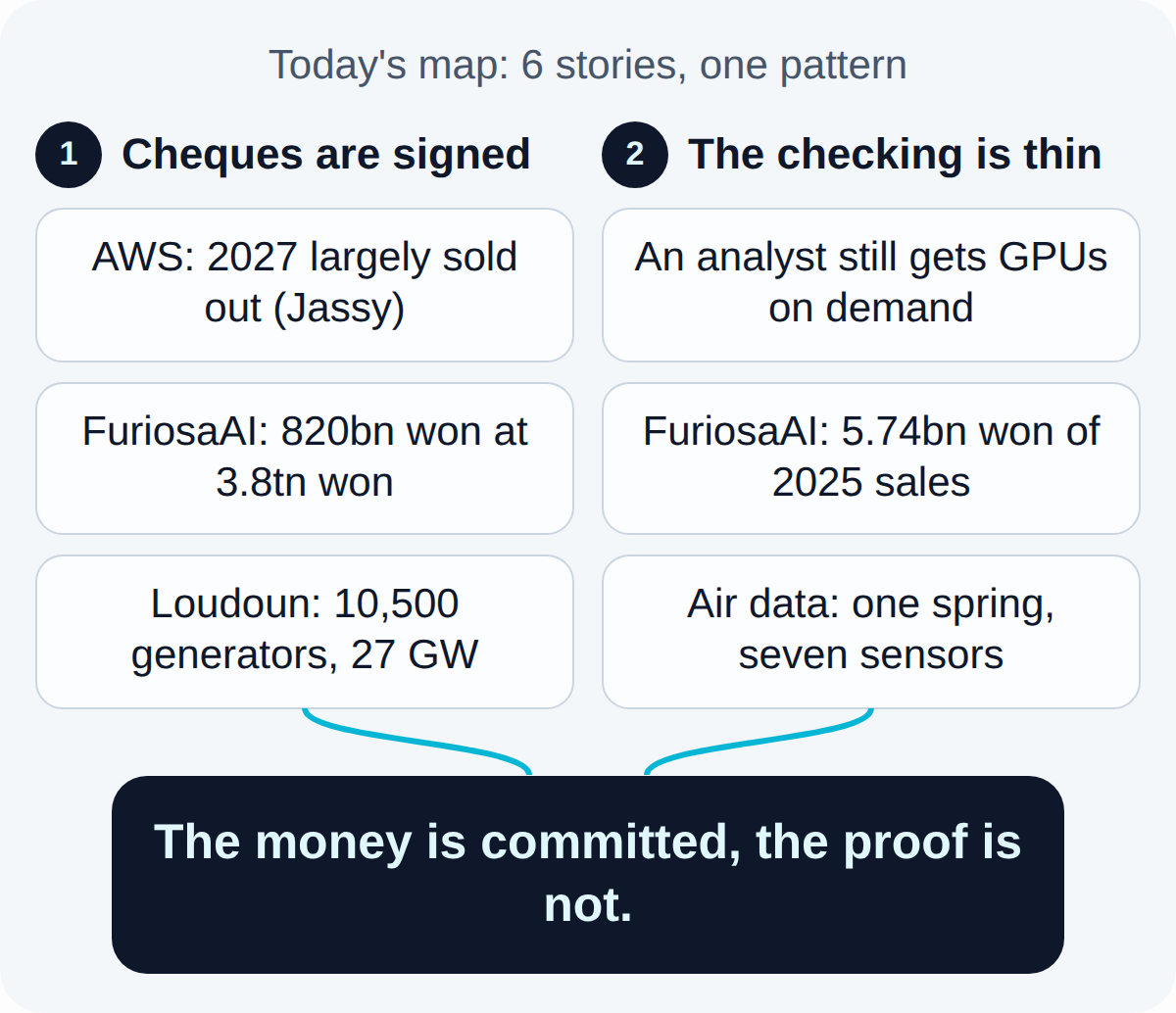
Three things from the weekend, and they have the same hole in them. A cloud boss says his 2027 is gone, a chip company is valued at 3.8 trillion won on 5.74 billion won of sales, and one American county runs 10,500 diesel generators measured by seven sensors. Every one of those numbers is doing a lot of work for somebody.
Advertisement
Monetize your company's operational data for $100k to $3 million

Few know it, but AI labs now let you monetize your company’s operational data. And they're spending $15 billion this year on it.
Your workflows, documentation, processes, and internal convos like Slack are extremely valuable and they're paying anywhere from $100k to $3 million for it per company.
You might think that sounds scary, but all the data is anonymized before, so no PII is sent over. Bezel (Y combinator backed) helps you partner with a lab that wants to license your data specifically if you have more than 20 employees and have existed longer than a year.
1. Amazon says 2027 is already sold out
Andy Jassy, on what is left of the committed capacity at AWS:
“2027 is largely sold out. A good chunk of 2028 is sold out.”
2026 is gone. A slice is held back for on demand, EC2 and Bedrock. Behind the remark sits around $220 billion of capital spending planned for the year, and a quieter move from January, when the price of Capacity Blocks for ML went up about 15% across regions, covering the P5 family, P4d, Trn2 and Trn1.
One person went and looked. The cloud analyst David Linthicum read the same remarks and said he suspects he can still open the AWS console today and allocate GPU capacity for AI work. Both can be true: the big committed blocks are taken, and the tap you actually use still runs.
I read “sold out” as a pricing statement rather than a physics one. When a supplier tells you the shelf is bare and has already put 15% on the reserved shelf, the scarce thing is the discount. With a 2027 AI budget to defend I would be asking my cloud rep for one number in writing, what my workload costs per month on demand in December 2027, because scarcity talk is the oldest way to move a buyer off cost control and onto a signature.
2. FuriosaAI is worth 662 times what it sold last year
The Series D: 820 billion won raised, a post-money valuation of 3.8 trillion won, about $2.9 billion. Where it came from is the story. More than 400 billion won is state money, 370 billion of that from the National Growth Fund and 30 billion from the Korea Development Bank. The one technology investor is Cisco Investments, a networking arm.
No semiconductor company is in the round: not Samsung Electronics, SK hynix, Arm, Nvidia or TSMC.
Against that: 2025 revenue of 5.74 billion won, an operating loss between 55 and 62.5 billion won, and about 53 billion won of cash. Sunday's read puts the valuation at 662 times sales. The Broadcom deal announced with the round is a turnkey design service contract, not a capital alliance, for a third-generation accelerator on TSMC's 2nm process with 12 HBM4 stacks per chip, sampling in the first half of 2028.
The week around it was busier than the valuation suggests. The round was written up on 29 October as money aimed at the data centre power bottleneck, and on 30 October the second-generation RNGD entered mass production, with Samsung SDS putting it behind an NPU-as-a-Service offering, LG AI Research signing a validation partnership and Upstage taking chips. The same day Chosun ran Korean AI startups struggling to list while they are still losing money.
Nearly half a round from policy funds, and nothing from the companies that actually make and sell silicon. The people best placed to judge whether this part lands in 2028 took a pass, and they are not short of cash. So I do not read 3.8 trillion won as a verdict on the chip, I read it as a decision about where Korea wants its inference to run. Anyone planning inference capacity on this silicon is carrying the 2028 schedule risk themselves, because on 5.74 billion won of revenue it is not FuriosaAI carrying it.
Advertisement
Your Boss Will Think You’re an Ecom Genius

Optimizing for growth? Go-to-Millions is Ari Murray’s ecommerce newsletter packed with proven tactics, creative that converts, and real operator insights—from product strategy to paid media. No mushy strategy. Just what’s working. Subscribe free for weekly ideas that drive revenue.
3. Ten thousand generators, seven sensors
In February the Virginia Department of Environmental Quality switched on an EPA-funded air monitoring pilot in Loudoun County, the largest data centre market in the world: seven Kunak AIR Pro monitors, one of them beside an existing regulatory station at Broad Run High School. Through May the readings stayed under every federal standard. Nitrogen dioxide never passed 35 parts per billion against a limit of 100, carbon monoxide never passed 2.6 ppm against 35, and fine particulates stayed under the 24-hour limit.
Two facts sit next to that. The region counts roughly 10,500 backup generators with a combined capacity close to 27 gigawatts. And the pilot covers a single spring: no summer heatwave, no grid stress event with generators running together.
In July the EPA proposed removing the public participation and transparency requirements from minor-source air permits, the class most data centre generators sit in. Sierra Club Virginia called that an exemption deal for data centres on 9 July.
The same county has been read two other ways this month. On 9 October a health reporting outlet published a guide for journalists on data centre air and public health, and on 23 October The Hill argued that data centres need protecting as critical infrastructure before a crisis arrives.
The clean readings are the good news and also the problem. Seven sensors over one spring is not a baseline, it is an anecdote with a calibration certificate, and if the comment step goes then the only public numbers about 27 gigawatts of standby diesel will be the ones a pilot chose to collect. My guess is that the next round of data centre fights is about records rather than zoning. If I had signed a colocation contract this year I would want generator runtime hours in my monthly report, because the day somebody asks what my AI actually ran on, the operator's permit file may no longer answer it.
Names to watch
Seen this week by Ins7ghts.
- Newlinks Technology · software that runs energy operations
Grounding. On 30 October it signed a strategic cooperation agreement with Tencent Cloud covering cloud services, AI and energy IoT, which puts models on top of live meter and grid data rather than documents.
Companies that later raised money had been in the news about twice as often in the quarter before. Worth a second look in three months.
Advertisement
You Build the Future. We Protect It.

WithCoverage replaces traditional brokers with AI-native insurance experts and attorneys. Get 40+ competing carriers, flat fees instead of commissions, and one platform as you scale.
Join 1,000+ businesses like Gopuff, Opendoor, and Polymarket.
Get a free, confidential policy review to uncover savings and better protect your business.
Also today
- A study of academic integrity counted 55 AI humanizer websites and found Turnitin's detection rate falling to 45.7% on paraphrased text, with Curtin University switching its AI-writing indicator off in January. (45 min read)
- Swiggy picked Snowflake to run decisions across its food, quick commerce and dining businesses. (2 min read)
- The Uptime Institute and Indonesia's communications ministry signed a letter of intent on data centre policy, governance and development. (4 min read)
What ShiftedWhat changed hands, and what did not
A data programme I worked on was tendered in parts, and each part went to a different consulting firm. The architect came from one. The technology was implemented by a consortium of smaller firms who also competed among themselves, and who wanted to squeeze in their own team, billed on time and material. The client said it was switching technology to get the incumbent vendor out.
Nothing in that programme was quite what the contract said it was, and last week three things moved the same way. A court, a provider and a founder each changed who stands behind somebody's software without changing the software.
Who is on the other side of your three biggest AI contracts this morning, and is it who was there when you signed?
My call: by 31 March 2027, at least one enterprise AI or data contract gets publicly contested over assignment or change of control rather than over price or model quality. It goes on the Scoreboard.
If you checked a supplier number this year and it came back smaller than the slide said, hit reply and tell me.
Yves
Tomorrow, First Move: the company in the news, and the one right behind it that nobody covers.
Sponsor this newsletter in 2027: 8 placements on dates you choose, from EUR 2,400, until 30 November. Book: 7wdata.be/sponsor-2027
Ins7ghts Daily is published by 7wData.