

Sponsored by

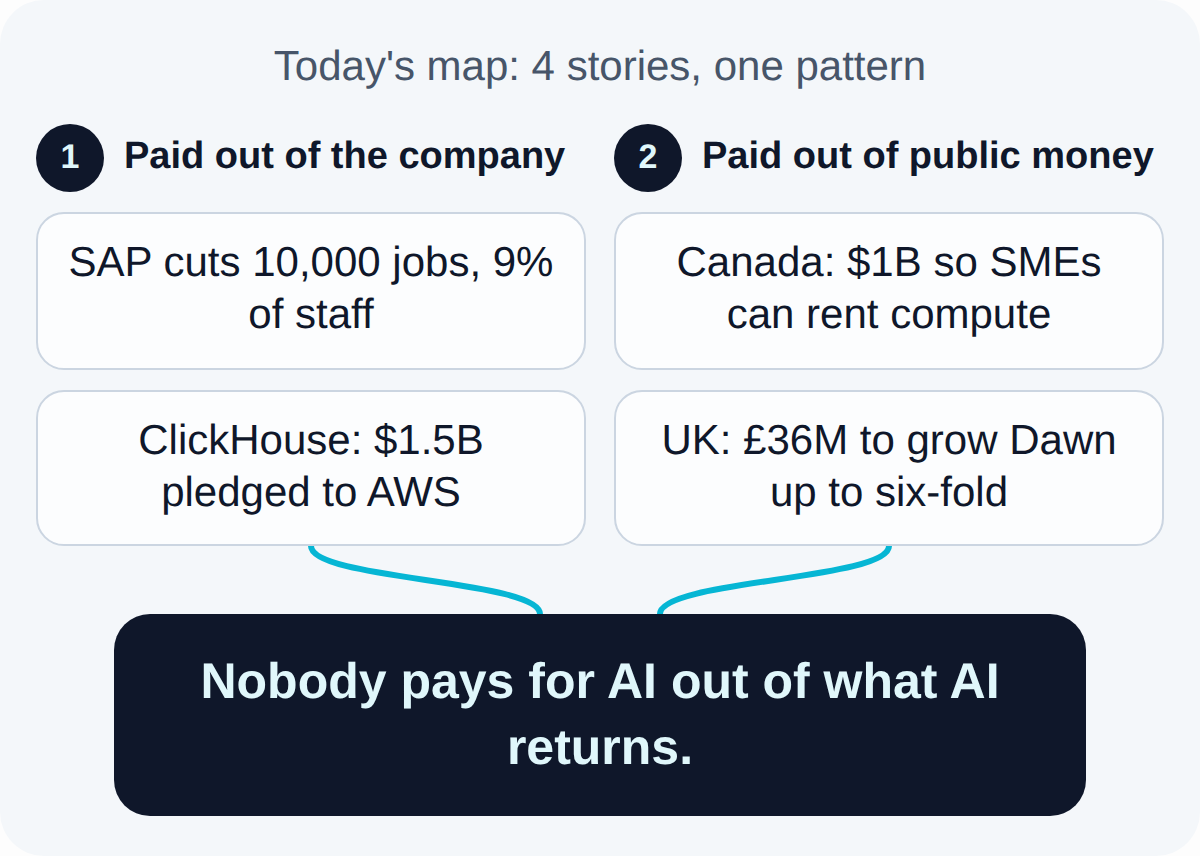
Nobody pays for AI out of what AI returns.
Three things from the last few days sit on the same question: where the money for AI actually comes from. One company found it in its payroll, one found it in a five-year cloud commitment, one government found it in the budget. What I keep noticing is that none of the three is paying for it out of what the AI has brought in so far.
Advertisement
A CRM so smart, it updates itself.

HubSpot's CRM is so smart, it now updates itself. Calls get logged and summarized the moment they end. New leads get researched and a first outreach drafted, automatically. Deals move forward on their own, with next steps flagged before you have to ask.
Even the one repetitive task you've been meaning to fix can now run itself, no code required. Customers using it are already seeing the difference.
This isn't the CRM you have to work hard to figure out. It's the one already working before you log in.
1. SAP is preparing to cut at least 10,000 jobs
SAP is getting ready to cut at least 10,000 jobs as part of an AI-centred restructuring, according to reporting on Friday.
That is about 9% of the global workforce.
It has run this before. The 2024 restructuring removed around 10,000 roles, and hiring then took the workforce back to roughly 113,000 people. On the same day the cuts surfaced, SAP's own newsroom put out a whitepaper on building your first agentic use case.
I do not believe a tenth of the work disappeared. The 2024 round did not remove the work either, which is why the headcount came back. So the work moves, and the place it lands is the part nobody prices: the people who know why a given configuration in your system exists, and who answer the ticket when it breaks. I would ask my account team, in writing and before renewal, which named support and consulting roles on my contract survive this.
2. ClickHouse committed $1.5 billion to AWS for five years
ClickHouse signed an expanded five-year collaboration agreement with AWS and committed to invest more than $1.5 billion to run its data stack there, reported on 23 November.
The commitment lands on top of a year of buying. It took Langfuse, an open-source AI engineering platform, in January, and on 9 November it bought Xata, a branch-native Postgres company, then shipped an expanded platform that folds Xata in and adds observability and security.
A five-year spend commitment is the part of this I read first. ClickHouse is selling itself as the single store under your analytics, your observability and now your transactional Postgres, and it has just told AWS where all of that will sit. If you put your observability data in there, your exit has two doors to get through instead of one, and the second door is not yours. The sentence I want in the renewal is the dull one: what format my data leaves in, and what the egress costs.
Advertisement
Follow agent work from Slack to merged PR

Whether agent work starts in Slack, Teams, or Jira, Jira by Atlassian keeps every session, decision, and PR in one place, so your team and your agents share the same context and everyone can see what was done and why.
3. Canada put another $700 million behind compute for small firms
Canada topped up its AI Compute Access Fund by $700 million, taking it to $1 billion. The next phase prioritises sovereign compute capacity inside Canada, widens who is eligible and changes the cost-sharing levels.
It sits inside something larger. The Council on Foreign Relations wrote on 23 November that Ottawa has committed C$2 billion to sovereign compute over five years. On the same day as the top-up, the UK published its baseline evaluation of its AI Research Resource, with £36 million committed to expand the Dawn supercomputer up to six-fold.
Public money for compute is not really a subsidy to small firms. It is a price signal about what compute costs. When a government has to put $1 billion behind SMEs renting capacity, the honest reading is that the market price sits above what a small company can carry on its own revenue, and that is worth saying out loud before anyone builds a business case on today's rate card. What bothers me is the shape: a fund that pays for rented capacity makes renting the normal state, and in three years the same firms are back for the next tranche.
A government bought the lesson, small firms hired the teacher
Nobody put these two together. On Friday the UAE signed nine technology companies, AWS, Accenture, Google and Anthropic among them, to train more than 80,000 federal employees in agentic AI. The same day, Indian small and mid-size businesses that put AI skills on their own payroll reported workforce growth above 5%, ahead of the firms that did not. Both are the same bill arriving in two shapes. One buys a course for 80,000 people from the vendors whose products the course is about. The other pays a salary and keeps the person who learned.
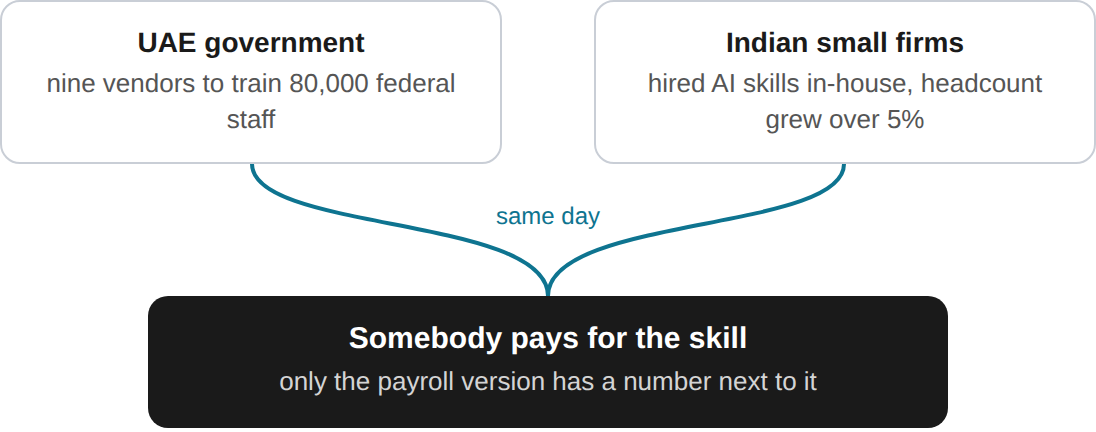
The skill gets paid for either way. So far only the payroll version has a number next to it.
Names to watch
Seen this week by Ins7ghts, our research platform: a knowledge graph of the data and AI news we read every day.
- Noeri · $110 million for many small models instead of one big one
Ownership. Stanford professors Yejin Choi and Carlos Guestrin run it, and the pitch is teams of specialised models trained on a customer's own data, proposing their own refinements from live traffic with a human approving each change. - Vero Security · $11 million seed for AI security engineering
Governance. TLV Partners, GTM Capital and Maple Capital put in the money, and alongside the round it opened AISecurityEngineering.org as a public knowledge centre for the discipline it wants to define. - Mechademy · $9.5 million to take machine diagnostics into power generation
Observability. Silverton Partners led the Series A, and the company also turns up as a working reference in Tiger Data's Postgres-to-Iceberg release notes.
Companies that later raised money had been in the news about twice as often in the quarter before. Worth a second look in three months.
Today's context on 7wData
- Is ElevenLabs raising at a $33 billion valuation? On 25 November Bloomberg reported that ElevenLabs, the voice AI company, is in early talks to raise money at a $33 billion valuation; ElevenLabs declined to comment, so these are talks, not a round.
- Did Ironclad raise USD 150 million in a Series F? A ResearchAndMarkets report released on 26 November says Ironclad, the AI contracting software company, has USD 150 million in Series F funding; the report gives no date or investors, and Ironclad has not confirmed it in these sources.
- Netcall issues 781,689 earn-out shares for its Govtech and Parble deals Netcall, the UK automation software company, is issuing 781,689 new shares to the sellers of Govtech and Parble as the contingent payment for both deals, with trading on AIM expected from 30 November 2026.
Advertisement
Watch on demand: Tabs + PwC break down how finance teams are operationalizing usage-based pricing — without the manual overhead.
Also today
- Microsoft's Agent 365 extends its agent controls to agents running on clouds Microsoft does not own (read it). (6 min read)
- Cognition says it got ten times the token speed out of the same coding model (read it). (4 min read)
- nexos.ai put more than 200 models behind one gateway with spend limits attached (read it). (4 min read)
The Long ReadThe agent that quotes a price may need a licence
My record collection started as a BASIC listing on a 5¼-inch floppy. My first PC could not read that floppy, and there was no path from one to the other, so a few hundred records went back in by hand, into FoxPro, over a few evenings. The data had existed the whole time. I simply had no way to produce it.
That is the gap the UK's financial regulator opened this week when it published how it will treat autonomous agents, in the same days that a governance survey found most firms cannot produce the communications record they already owe.
If a regulator asked tomorrow what your agent did and why, which system would you open?
My call: before the end of September 2027, a UK-authorised financial firm is publicly fined or formally censured over records it could not produce for an AI-driven customer interaction.
If you have an AI line in next year's budget that is funded by something the AI itself brought in, hit reply and tell me.
Yves
Sundays are for Week Ahead: what is already on the calendar for the coming week.
Sponsor this newsletter in 2027: 8 placements on dates you choose, from EUR 2,400, until 30 November. Book: 7wdata.be/sponsor-2027
Ins7ghts Daily is published by 7wData.