

In partnership with

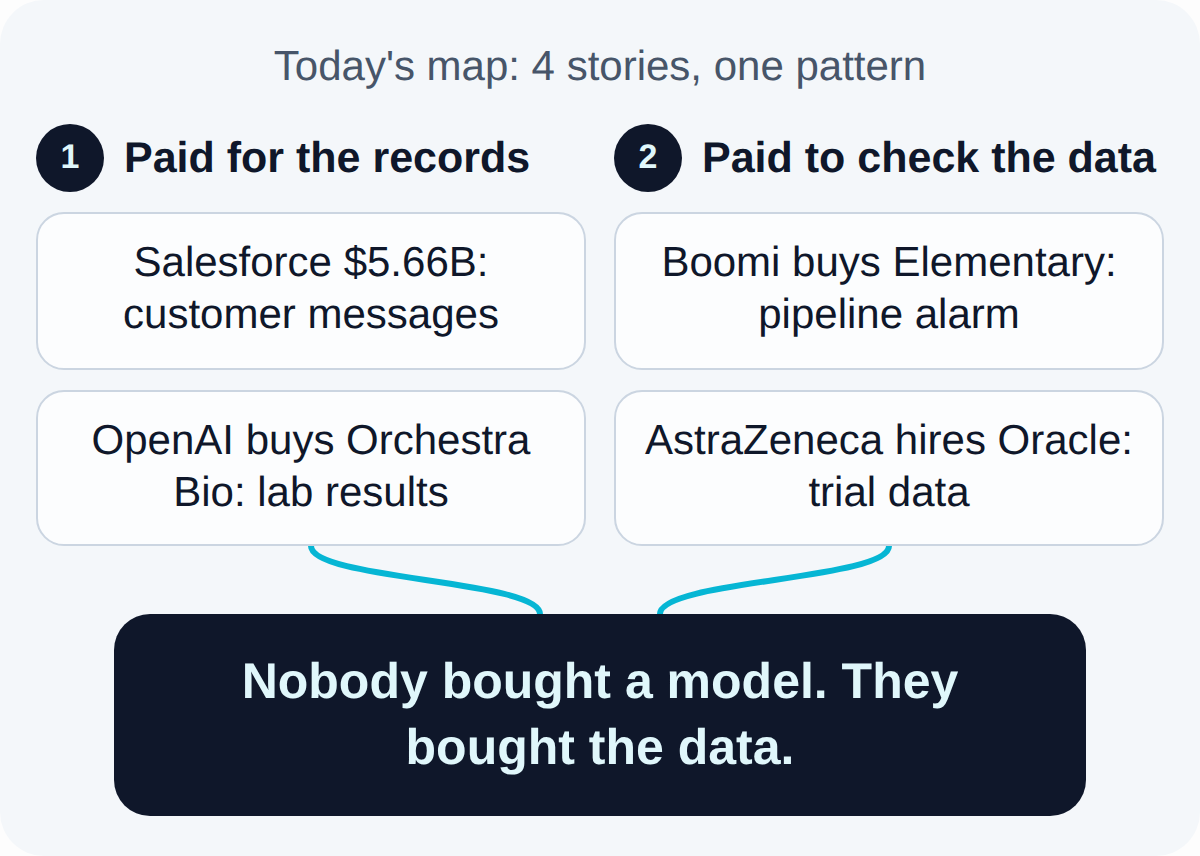
Nobody bought a model yesterday. They bought the data.
Three purchases landed inside a day. One company sells software to marketers, one sells a model, one sells pipes between systems. Not one of them paid for model capability, and all three paid for a place where records are made or kept.
Advertisement
Your AI prompts are leaving out 80% of what you're thinking.

When you type a prompt, you summarize. When you speak one, you explain. Wispr Flow captures your full reasoning (constraints, edge cases, examples, tone) and turns it into clean, structured text you paste into ChatGPT, Claude, or any AI tool. The difference shows up immediately. More context in, fewer follow-ups out.
Used by teams at Microsoft, Amazon, and Notion. Try Wispr Flow free on Mac, Windows, iPhone, and Android.
1. Salesforce paid $5.66 billion in cash for the customer record
The terms, as signed:
- All cash, at a $5.66 billion enterprise value, per Salesforce's own agreement.
- Braze shares rose 51% on the news.
- Antitrust review is named as the main regulatory hurdle.
On the same day it committed $5.66 billion in cash, Salesforce raised its quarterly dividend by 5.8%.
Braze is not a model and not an agent. It is the system that holds the messages sent to a customer and the profile behind them.
Eight days after the Loops deal we wrote about on 13 October, Salesforce has bought a second data asset, and the trade press is already asking the awkward question: what happens to Marketing Cloud now, with MarTech asking whether the deal brings clarity or chaos to a stack many of its customers already run twice.
The cash is the part I keep looking at. You pay cash when you want the asset now and you do not want the seller holding your shares, and what Salesforce wanted now was ownership of the record of the conversation, because an agent that does not know what was already said to a customer is worth less than the person it replaced. I expect the next year of its pitch to be about who holds the customer record rather than which model sits on top of it, and I would not sign an agent contract without knowing which database the history ends up in.
2. OpenAI bought the lab instead of licensing the results
Axios reported it first: OpenAI has acquired Orchestra Bio, a biotech working in drug development, and the company's own announcement says the same. The same reporting has OpenAI working with Novo Nordisk and Moderna to put AI inside their research workflows.
So the model company now owns a place where new biological results get produced, not just a licence to read them.
Around it, the other half of the same trade. AstraZeneca went the opposite way and signed Oracle to work on its clinical research, renting the AI and keeping the trial data. On 13 October, Zealand Pharma and Generate struck an AI obesity drug deal worth up to $1.2 billion, which is the same bargain priced per molecule.
Buying a company that runs experiments is a quieter admission than it looks. The cheap ground truth is gone, the public text is read, and the only way to get facts nobody else has is to make them, which costs lab time and reagents rather than GPUs. The argument against me is that this is ordinary vertical integration dressed up, and OpenAI simply wants the revenue. My answer is that you do not buy a wet lab for margin. When a vendor tells me its model is unusually good in my domain, the question that decides it for me is where the new data was generated and who else can get at it.
Advertisement
Most AI Tools Weren't Built for This

B2B customer issues move across teams and systems, not through a single chat window. A new Harvard Business Review Analytic Services briefing paper, sponsored by Front, breaks down where AI tools fall short in B2B service and what to ask before you invest.
3. Boomi bought the alarm that goes off when data lies
Boomi acquired Elementary Data, an open-source data observability project built around dbt with a cloud service on top. The press release frames it as trusted, governed data for the AI era. Trade coverage adds the detail that matters to anyone running it today: Elementary stays standalone only “for now”.
A week earlier the same company and Jade Global put audit trails on factory AI agents, so this is the second piece of evidence in eight days that Boomi is selling the paperwork around automation rather than the automation.
An alarm is worth more than a dashboard, and the price list is starting to agree with that. Nobody is paying for data quality because it is virtuous; they are paying because an agent acting on a broken pipeline produces confident nonsense at machine speed, and somebody has to be told in the first hour instead of the first quarter. I expect two or three more observability tools to disappear into integration and governance vendors before next summer, and with a data team of my own I would rather own the alarm than fund another agent pilot.
Your Turn
Which of today's three reads matters most to your work?
Names to watch
Seen this week by Ins7ghts.
- Dream Labs · a robot brain sold as an API
Grounding. The founders came out of NVIDIA's GR00T robot-model work and ship Dream-1 for other people's machines to call, on a $90 million seed led by B Capital. The same week, Andreessen Horowitz led a Series A into Eka Robotics, so two sets of backers are funding the same problem from different ends.
Companies that later raised money had been in the news about twice as often in the quarter before. Worth a second look in three months.
Advertisement
Privacy-first email. Built for real protection.

End-to-end encrypted, ad-free, and open-source. Proton Mail protects your inbox with zero data tracking.
Also today
- South Korea will require government-backed AI projects to disclose their training data, and the detailed criteria are still being argued over. (4 min read)
- Binance's policy arm proposed a “Know Your Agent” framework for agentic finance. (3 min read)
- China defended DeepSeek after the United States banned its AI from government systems. (2 min read)
Reality Check605 deaths on easy
Years ago I had a residency where one channel of the venue's sound system was broken. I asked the boss early in the evening to call the sound engineer. He told me to fix it myself. There was nothing to fix from where I stood, I played the night out, and the bad room was put down to my performance. I lost the residency.
Yesterday four AI agents finished Minecraft in 27 hours and the number almost nobody repeated was that they died 605 times, on easy difficulty. Minecraft at least tells you the moment you are dead.
Do you know how many times your agents failed last month, and who counted?
My call: by 31 March 2027, the first published failure-per-task number for a live enterprise agent deployment comes out of an incident report or a regulator's filing, not from a vendor.
If something in your stack got bought this year for the records it holds rather than the software it runs, hit reply and tell me.
Yves
Tomorrow, The Argument: one position, argued with the best case against it.
Reach data and AI leaders in this inbox: book a placement.
Ins7ghts Daily is published by 7wData.