

In partnership with


 So, What Actually Happened?
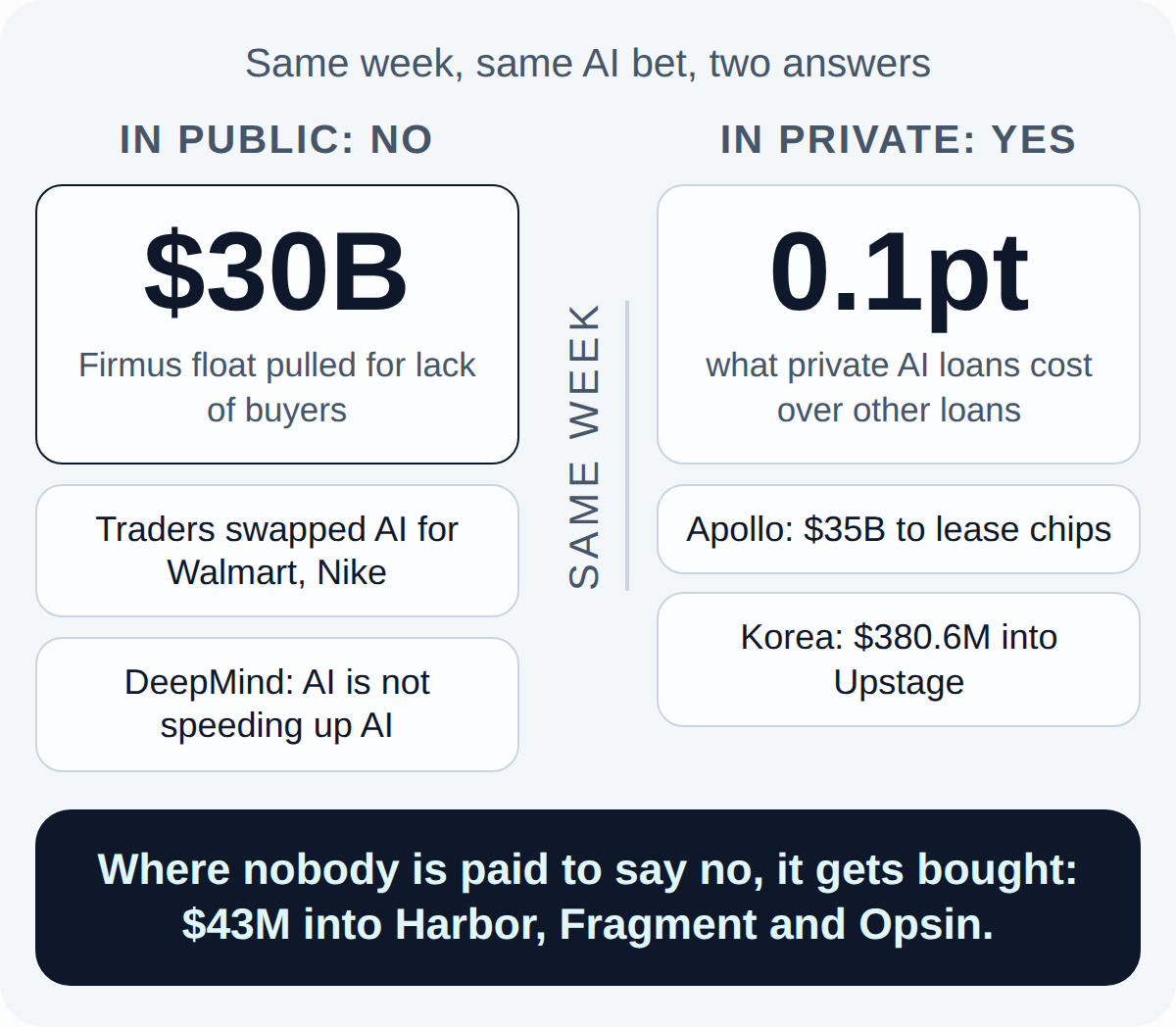
Friday, and what I keep turning over is where the word ”no” actually came from this week. A $30 billion AI float collapsed in Australia because the buyers said the valuation did not add up, out loud, with their names on it. Traders rotated out of AI names and into Nike, Moderna and Walmart. We scanned 190,000 articles this week so you don't have to. Then in the same window a $35 billion private vehicle went out to buy chips and lease them, and the risk premium on that paper landed a tenth of a percentage point above ordinary private credit. Same bet, two rooms. One room priced the doubt. The other never had to listen to it.
The Bottom Line: Public money said no this week. Private money was never asked.
Advertisement
Blu Dot surpasses 2,000% ROAS with self-serve CTV ads

Home furniture brand Blu Dot blew up on CTV with help from Roku Ads Manager. Here’s how:
After a test campaign reached 211,000 households and achieved 1,010% ROAS, the brand went all in to promote its annual sales event. It removed age and income constraints to expand reach and shifted budget to custom audiences and retargeting, where intent was strongest.
The results speak for themselves. As Blu Dot increased their investment by 10x, ROAS jumped to 2,308% and more page-view conversions surpassed 50,000.
“For CTV campaigns, Roku has been a top performer,” said Claire Folkestad, Paid Media Strategist, Blu Dot. “Comping to our other platforms, we have seen really strong ROAS… and highly efficient CPMs, lower than any other CTV partner we've worked with.”
Using Roku Ads Manager, the campaign moved from a pilot to a permanent performance engine for the brand.
 The Tracks That Matter
1. The Buyers Killed A $30 Billion AI Float In Public
Firmus Technologies went out at roughly $30 billion and the float collapsed, with UniSuper's chief investment officer saying plainly that it just did not have a compelling valuation. That is not a market condition, that is a judgement with a name attached. James Packer's answer was that Australia tends to tear down its entrepreneurs, and a Reuters columnist conceded the scapegoating has an iota of truth while noting the pricing did most of the work. What makes it worth your attention is the same company's private side, where Blackstone, Jane Street, Coatue and Nvidia all sat in a $2 billion raise and nobody ever had to say the quiet part into a microphone.
Here's what works: Ask which of your AI suppliers has ever had to price itself in front of buyers who were free to walk away.
2. A $35 Billion Chip Lease Priced AI Risk At Almost Nothing
Apollo and Blackstone assembled a $35 billion private-credit vehicle to buy chips and lease them to Anthropic, bigger than the roughly $23 billion direct lenders extended to every private-equity-backed US company in the same quarter. Chamath Palihapitiya, working through the AI infrastructure financing boom, notes AI-related private loans pricing at 6.2 percentage points against 6.1 for everything else. A tenth of a point, for a wager on compute demand years out. His read: lenders are underestimating AI risk, equity investors are overestimating future profits, or both. And Big Tech is tracking toward $800 billion of AI spend this year, a growing slice of it routed through lenders who never publish a mark.
Here's what works: Find out whether your compute or inference capacity sits on a lease. If it does, your capacity reprices when the lender's paper does.
3. Google's Own Safety Team Could Not Find The Acceleration
DeepMind's safety report on Gemini 4 Argon says AI now writes about 75% of the company's code, then states flatly that there is no significant end-to-end acceleration of machine-learning R&D, AI-driven or otherwise. Haydn Belfield's summary adds that roughly 88% of pull requests still need multi-turn human steering or outright human authorship. Argon does sit above trend, and the report puts that down to compute and headcount, not a machine improving itself. A month earlier Dario Amodei said recursive self-improvement was already accelerating. One of those is a claim; the other is a measurement published by a team with every commercial reason to say the opposite, and the Argon benchmark detail supports the cautious reading.
Here's what works: If your three-year plan assumes AI tooling compounds on itself, swap that line for a measured rate from your own repository.
Quick hits:
- The global financial stability body put its AI practices on the record. The FSB published its final report on responsible AI adoption, which gives national supervisors a document to copy, and its wording will surface in your next vendor questionnaire.
- An authentication bypass turned up in an AI feature inside Siebel. A disclosed flaw in Oracle Siebel's AI component lets an attacker skip the login entirely, a reminder that the newest code bolted onto your oldest system is where the hole opens.
- Korea's state fund put $380.6 million into one company. The Korea National Growth Fund approved a 560 billion won investment in Upstage, its second direct bet, so sovereign capital is now a third route to money that answers to nobody on a trading floor.
Advertisement
Leave Granola and get up to 12 months free of Wispr Flow Notetaker + Dictation

If you have paid time left on an individual Granola plan, we'll match it with a Wispr Flow subscription that includes Notetaker and dictation, and add bonus time, up to 12 months total. Sign in or create a Wispr account and submit proof of your plan to check eligibility.
Your Turn
Which of today's three reads matters most to your work?
 Signal vs. Noise
🟢 Signal: data governance. Coverage of data governance fell hard on Thursday while its grip on everything else moving got stronger, which is the shape a topic makes when it stops being a story and becomes a condition of doing business. Certification, event logging and vendor due-diligence clauses are what buyers are actually purchasing, and most coverage still files it under compliance paperwork.
🔴 Noise: AI governance. The phrase pulled enormous volume again and lost its hold at the same time. One industry piece gets at why: point-in-time governance snapshots go stale against systems that change weekly, so the artefact everyone is producing is already out of date on the day it gets signed.
 From the 190K
We scanned 190,000 articles this week. Here's what no one's talking about:
Harbor came out of stealth selling liability insurance for AI agents, Fragment raised $12 million to stop agents spending company money badly, and Opsin took $21 million for the layer standing between an agent and the data it wants.
Read apart, these are three unrelated trade items, filed by an insurance desk, a fintech desk and a security desk that do not read each other. Harbor's $10 million seed sells the payout for when an agent gets it wrong. The other two sell the prevention: Fragment took $12 million to keep agents from going rogue with company money, and Opsin raised $21 million for the gate between an agent and the records it reaches for. Three industries, one product, and the product is refusal. Somebody has to be able to tell an agent no, and the companies that need it most have nobody in that chair, so they are buying the chair. Worldpay's agentic commerce research finds the same nerve from the consumer end: people hesitate exactly when money moves.
On Monday, pick the one agent in your estate that can already move money or data, and name the human who can reverse what it did. If that name does not exist, you are the buyer these three companies just raised against.
Advertisement
Stop Making Shoppers Spell It Out
“Running shos” shouldn’t return zero results. Neither should “red waterprof trail runners under $150.”
Traditional search needs exact keywords. Gladly understands what shoppers mean, typos and all, and turns dead-end searches into products that fit what they asked for.
 By The Numbers
- Firmus Technologies' float collapsed at a roughly $30 billion ask — the first big AI infrastructure name this cycle to be told no by public buyers who signed their refusal.
- Direct private loans to US borrowers went from $96 billion in 2010 to $2.4 trillion in 2025 — nearly 25 times, and that is the pool now buying chips, which is why the pricing question stopped being academic.
- AI writes about 75% of the code at Google DeepMind, and 88% of pull requests still need a human — the automation is real, the compounding is not, and those are two very different investment theses.
- ISO 42001 carries 38 reference controls across nine objectives — including event logging across an AI system's whole life cycle, which turns the audit trail from a nice-to-have into a certifiable requirement.
- Korea approved $380.6 million for a single AI startup — a state fund's second direct bet, at a size no domestic private round would have cleared.
- See what's rising across AI and data this week →
 Deep Dive: Who Is Allowed To Say No
A label can talk itself into a hit. It pays for the pressing, the promo, the launch party, and every person in that building has a reason to agree with the decision already made. The dancefloor is the first room where nobody is paid to be polite, and it answers in about thirty seconds.
The rooms where no is cheap
A public float is a dancefloor. So is a safety report you have committed to publishing. Firmus got the answer because a pension fund CIO's whole job is being unimpressed in public. DeepMind got it because its own measurement had to be written down before anybody could spin it. Cheap refusal is a feature of those rooms, not a malfunction.
The rooms where no costs you the deal
Private credit is not that room. A lender in a $35 billion club deal who holds out for a wider spread does not improve the paper, they lose the allocation. So the doubt comes out as a tenth of a percentage point and the structure keeps everything that was going to happen anyway. Sovereign funds have the same shape: the mandate is to deploy.
So the refusal gets outsourced
Which is why that refusal layer is suddenly getting funded. When no part of your organisation contains somebody whose job is to stop an agent, you buy a vendor whose entire job is to stop an agent, or an insurer who pays out because nobody did. That is not governance maturing. That is governance being sold back to you as a line item.
What Actually Works
- Name the refuser, per decision: for your three largest AI commitments, write down who can cancel each one and what evidence would make them do it. No name means no brake.
- Separate the room from the mark: if a number comes from a party that loses money by doubting it, file it as a quote, not a valuation.
- Check the lease, not the logo: ask every compute and inference supplier whether the capacity is owned or leased, and who holds the paper behind it.
- Make the internal no cheap: give one person standing permission to stop a pilot without convening anybody. A veto that costs political capital is not a veto.
Every room where the record gets chosen is full of people paid to agree. Worth knowing who in your building is paid to say it is bad.
 What's Coming
The Pentagon Writes An Order Nobody Gets To Refuse
The Pentagon is eyeing $50 billion to scale autonomous weapons production. Procurement at that size does not pass through a market that can decline it, and the autonomy accountability specs it sets will become the reference standard in adjacent regulated industries inside two years.
Supervisors Start Copying The FSB's Wording
The stability board's sound practices for responsible AI adoption is now final, which is the version national regulators quote. Watch its language appear close to verbatim in bank and insurer questionnaires over the next two quarters. That is how an international recommendation turns into your compliance deadline.
Governance Turns Into A Product Feature
ServiceNow is shipping AI Passport and expanded governance controls as platform capability rather than policy. When the control plane belongs to a vendor, your governance posture becomes a function of your platform contract, which is a procurement decision wearing a policy hat.
 For Your Team
Monday's meeting prompt: ”Take our three biggest AI commitments. For each one, name the person who can cancel it and the evidence that would make them do it. If a name is missing, we don't have a decision on that one. We have momentum.”
Share-worthy stat: Private loans to US borrowers grew from $96 billion in 2010 to $2.4 trillion in 2025, and the AI-related slice of that pool prices just 0.1 percentage points above everything else in it. The money funding the compute has not yet priced the possibility of being wrong.
 The Track of the Day
”It just doesn't have a compelling valuation.”
John Pearce, chief investment officer, UniSuper
One sentence, said in public, by somebody whose career survives being unpopular. That is the gap between the two halves of this week: the float that had to hear it, and the $35 billion of paper that did not. If you want to know how much a market really believes a story, skip the funding announcements. Find out who was in a position to refuse, and what refusing would have cost them.
We scanned 190,000 articles this week so you don't have to. Data Pains → Business Gains.
Published: October 16, 2026 | Curated by Yves Mulkers @ Ins7ghts
1,300+ articles scanned. 7 stories selected. Our AI distills the noise into signal—in seconds. Get early access →
Know someone who'd find this useful? Share your unique referral link →
Want Your Own AI Intelligence Briefing?
Our platform analyzes 1,000+ sources daily and delivers personalized insights in seconds.
Join the Waitlist →Founding members: Lifetime discount • Priority access • Shape the product