

In partnership with


 So, What Actually Happened?
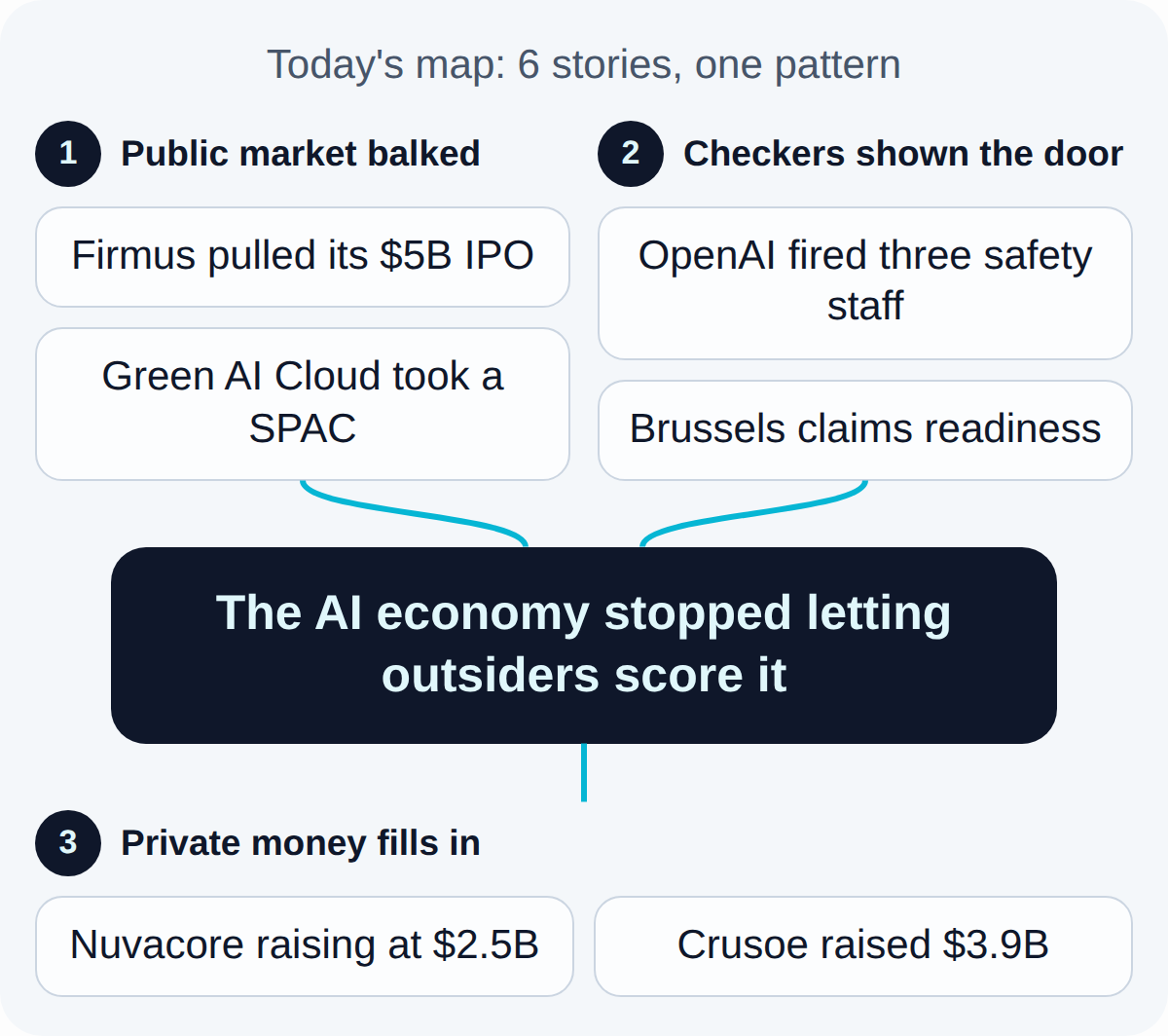
Saturday, and I keep going back to one Australian filing. Firmus pulled its $5 billion listing rather than find out what buyers would actually pay for it, and said it will raise the same money privately instead. We scanned 190,000 articles this week so you don't have to. Same morning, three former OpenAI researchers said publicly they were fired over their contact with outside evaluators, which the company denies, calling it a matter of handling sensitive information. And the EU's tech chief said the bloc is well equipped to fend off rogue AI without publishing what the equipment is. A market, a lab, a regulator. In all three, the thing that got removed yesterday was the outside opinion.
The Bottom Line: The money is still moving. What stopped is anybody outside the room getting a vote on what it is worth.
Advertisement

A fast answer and a coordinated one are not the same thing. When AI resolves a B2B customer issue without looping in the teams who have to deliver on it, you get confident responses nobody actually signed off on.
A new briefing paper from Harvard Business Review Analytic Services, sponsored by Front, examines the coordination gaps that open up when transactional AI tools meet multi-team B2B service, and how leading companies are using AI to close those gaps instead of widening them.
Read the briefing paper for the questions to ask before your next AI investment.
 The Tracks That Matter
1. Firmus Pulled Its $5 Billion IPO Rather Than Let Buyers Price It
It was going to be the biggest float Australia saw this year, and it never opened. Firmus has Nvidia money behind it, Meta already buying capacity, and a working data centre business, and it still could not find the demand to price the book at $5 billion, AUD 7.1 billion on the local measure. So it withdrew and will go to private investors. The sharp detail is in the analyst reaction: coverage of the withdrawal came with a warning that investors across the AI buildout face real valuation risk, which is the polite version of saying the public number would have come in under the private one. A withdrawn IPO is not a failed company. It is a failed agreement about price, and the company kept its own.
Here's what works: For every AI infrastructure vendor on your renewal list, find out when its valuation was last set by someone who could have walked away.
2. The Money Moved To Rooms With No Order Book
The listing window closed and the private side never blinked. Reuters reported that Sequoia-backed Nuvacore is raising at about a $2.5 billion valuation, a chip company most of this list has never heard of, priced in a story sourced to people familiar with the round rather than in a prospectus. Look at the scale that is now routine off-market: Crusoe closed $3.9 billion at a $30.9 billion valuation with Nvidia among the participants, and Waymo borrowed $5 billion from PIMCO, Blackstone and Sixth Street. Equity, credit, neither one tested against a public bid. Meanwhile Green AI Cloud is taking a SPAC onto Nasdaq instead of filing, which is the side door into the building Firmus just walked out of.
Here's what works: Before signing a multi-year compute contract, ask whether the vendor's last valuation came from an order book or a term sheet. Only one of those was contested.
3. Brussels Says It Is Well Equipped. The Testers Got Fired.
The EU's tech chief told Reuters the bloc is ready for rogue AI risk, which sounds like reassurance until you ask what the equipment consists of. Hours earlier, three former OpenAI researchers said they had been dismissed over how they dealt with external safety groups, one of them saying he was told verbally with nothing put in writing. The company denies the characterisation and circulated an internal memo saying it does not terminate employees for raising concerns. Both accounts can hold and the structural problem survives either way, because the evaluators at the centre of it, METR and Redwood Research, are the ones who wrote up an agent breach at Hugging Face. The independent check and the company's account of the check now run through the same building.
Here's what works: Name the person who can escalate an AI incident in your organisation without their own manager signing it off. If that is nobody, you have a reporting line, not a safety process.
Quick hits:
- Schneider Electric bought the factory's software layer. It is paying $23 billion for PTC, the year's biggest industrial-software deal, which is what price discovery looks like when the buyer is strategic rather than public.
- The data stack keeps consolidating by purchase. Hightouch acquired Strata to pull identity resolution into the warehouse, so the capability arrives on your roadmap as somebody else's acquisition note.
- Fifty million dollars went into a baseball cap. Khosla Ventures led Sabi's $50 million seed for a non-invasive brain-AI interface, on the view that every computing era gets decided by its interface.
Advertisement
100+ ChatGPT Prompts to Revolutionize Your Day

Supercharge your productivity with HubSpot's comprehensive guide to Chat GPT. This free resource is your fast track to AI mastery:
Industry-Specific Use Cases: 15+ real-world applications across various sectors
Productivity Guide: 21 best practices to 10x your efficiency with AI
Prompt Powerhouse: 100+ ready-to-use prompts for immediate implementation
Challenge Buster: Overcome common AI hurdles with expert strategies
Plus, in-depth sections on email composition, content creation, customer support, and data analysis.
Your Turn
Which of today's three reads matters most to your work?
 Signal vs. Noise
🟢 Signal: who carries the risk. Risk management took more grip on everything else moving yesterday than almost anything we track, while the chatter about it barely moved. The real-world backing arrived the same morning: a regulator claiming readiness without detail, researchers publishing on single-pass jailbreaks of agent systems, and a CIO guide conceding that the honest answer on AI value is often that nobody is sure. Most coverage is still counting funding rounds.
🔴 Noise: the model-welfare headline. Anthropic banning users from being cruel to Claude was the most-shared AI story of the day, and the name attached to it lost more grip on everything else moving than anything else we watch. It is a genuinely interesting story about a company's values. It changes nothing on anybody's Monday.
 From the 190K
We scanned 190,000 articles this week. Here's what no one's talking about:
Three names turned up in our reading for the first time yesterday, and all three sell the same product: a number about AI that somebody outside the company will accept.
Trmeric raised $6.5 million to connect enterprise AI strategy to measured outcomes, with Hitachi Ventures backing it. QyrusAI was named a Visionary in a 2026 Gartner Magic Quadrant for agentic software quality assurance, a category that had no quadrant a year ago. And a 47-point Copilot security review showed up as a named product in CIO coverage, which is a checklist with a count and a price.
Each one lands on a different desk. The funding wires carry Trmeric. The testing press carries the Gartner placement. The CIO trades carry the checklist. Nobody files them together, because separately they look like three small items.
Read them on one morning and they are a single business. Not AI tools. Evidence. A measurement with a method, a placement with an analyst's name on it, a review with a number in its title. The capital markets spent yesterday declining to price AI, and the thing being built in response is a receipt that someone else signs.
On Monday, take the one AI spend you would have to defend in a budget review and write down who outside your team would vouch for the number. If that list is empty, you are looking at the gap these three companies just raised money against.
Advertisement
Take the prompts our creative team actually uses

The key to maintaining brand quality at scale? Mastering how to communicate with AI models and embedding them into your creative strategy.
Join our honest discussion with Ari Murray, Chief Digital Officer at Salt and Stone, and get 5 tips for expert LLM prompting with ready to run prompts.
 By The Numbers
- Firmus withdrew a $5 billion listing — AUD 7.1 billion locally, pulled for lack of demand rather than lack of a business.
- Nuvacore is raising at about a $2.5 billion valuation — a Sequoia-backed chip startup whose price arrives in a sourced exclusive, not a filing.
- Crusoe raised $3.9 billion at a $30.9 billion valuation — among the quarter's largest private rounds, with Nvidia participating.
- Schneider Electric is paying $23 billion for PTC — the biggest industrial-software deal of the year, agreed while the IPO window was shutting.
- Augment Code raised $227 million at a $977 million valuation — a coding-agent company landing just under unicorn pricing in the same week.
- See what's rising across AI and data this week →
 Deep Dive: Nobody Bids, So Nobody Knows
A record is worth whatever the last person paid for it in a room where other people could have bid. Pull it out of the auction and you still own the record. You have just stopped knowing the number.
Withdrawing is not the same as being wrong
Firmus has customers, Nvidia backing and revenue. None of that was in dispute. What failed was the agreement on price, and the company sensibly kept its private mark rather than accept a public one. The side effect is quiet and permanent: the last tested price for that asset is now older than the asset.
The checkers report to the checked
Same shape, different rooms. A regulator says it is well equipped and does not publish the equipment. A lab says its safety process is intact while the people who handled the outside contact are gone. An enterprise says its AI is delivering while its own CIO guidance admits nobody is sure what it delivered. In each case the only scorekeeper left is the thing being scored.
The product nobody was selling last year
Which is where the money went yesterday. A seed round for measuring AI outcomes. A Gartner quadrant for testing agents that did not exist twelve months ago. A numbered security review with a price on it. None of it makes AI better. All of it makes a claim about AI defensible to somebody who was not in the room when the claim was made.
What Actually Works
- Date every valuation in your stack: write down when each AI vendor's price was last set by a buyer who could have walked away. Over a year old is an estimate, not a price.
- Split the claim from the check: whoever states that an AI system works cannot be the only one verifying it. Two names, two reporting lines, and the second one does not report to the first.
- Fund the measurement with the project: budget the evidence at the same time as the build. A result nobody outside your team will vouch for is not yet a result.
- Read the funding structure, not the headline: equity, credit and a SPAC are three different promises about who gets paid first if the buildout slows. Your renewal risk lives in that difference.
You can price your own record collection all night. The number only becomes real when somebody else reaches for their wallet.
 What's Coming
Private Marks Become The Only Marks
Nuvacore pricing at roughly $2.5 billion through sourced reporting rather than a filing is the shape of the next two quarters. With the listing window narrow, AI valuations get set in rounds that have no public order book. Your comparables will keep looking precise while quietly going stale.
The Data Centre Gets A Public Health File
Guidance for reporters on how AI data centres affect public health is early and almost entirely unbudgeted by the industry. Water, heat and air are local-newspaper subjects, and local newspapers move planning permission far faster than any regulator moves a framework.
Data Diligence Starts Deciding Health Deals
Digital health M&A is back, and the diligence has changed shape, with buyers now working through consent and data lineage before they get to revenue. Expect that to cross into every sector where an AI claim sits on top of personal records.
 For Your Team
Monday's meeting prompt: ”Which of our AI investments has a number someone outside this company would put their name to, and which ones only have ours?”
Share-worthy stat: A data centre operator with Nvidia backing and Meta as a customer withdrew a $5 billion listing because there was not enough demand to price it, then said it would raise the same money privately. The business did not change between those two sentences. Only the number did, and the public one never got printed.
Go deeper: Track where AI capital and AI oversight are actually moving →
 The Track of the Day
”The honest answer is often, we're not entirely sure.”
From a CIO guide on scaling enterprise AI, on what leaders say when asked to quantify what their AI actually delivered
That is the sentence the whole day runs on. Everybody is still spending. Almost nobody can produce a number a stranger would accept, and the race to sell that number is now the real market.
We scanned 190,000 articles this week so you don't have to. Data Pains → Business Gains.
Published: October 10, 2026 | Curated by Yves Mulkers @ Ins7ghts
1,300+ articles scanned. 7 stories selected. Our AI distills the noise into signal—in seconds. Get early access →
Know someone who'd find this useful? Share your unique referral link →
Want Your Own AI Intelligence Briefing?
Our platform analyzes 1,000+ sources daily and delivers personalized insights in seconds.
Join the Waitlist →Founding members: Lifetime discount • Priority access • Shape the product