

In partnership with


 So, What Actually Happened?
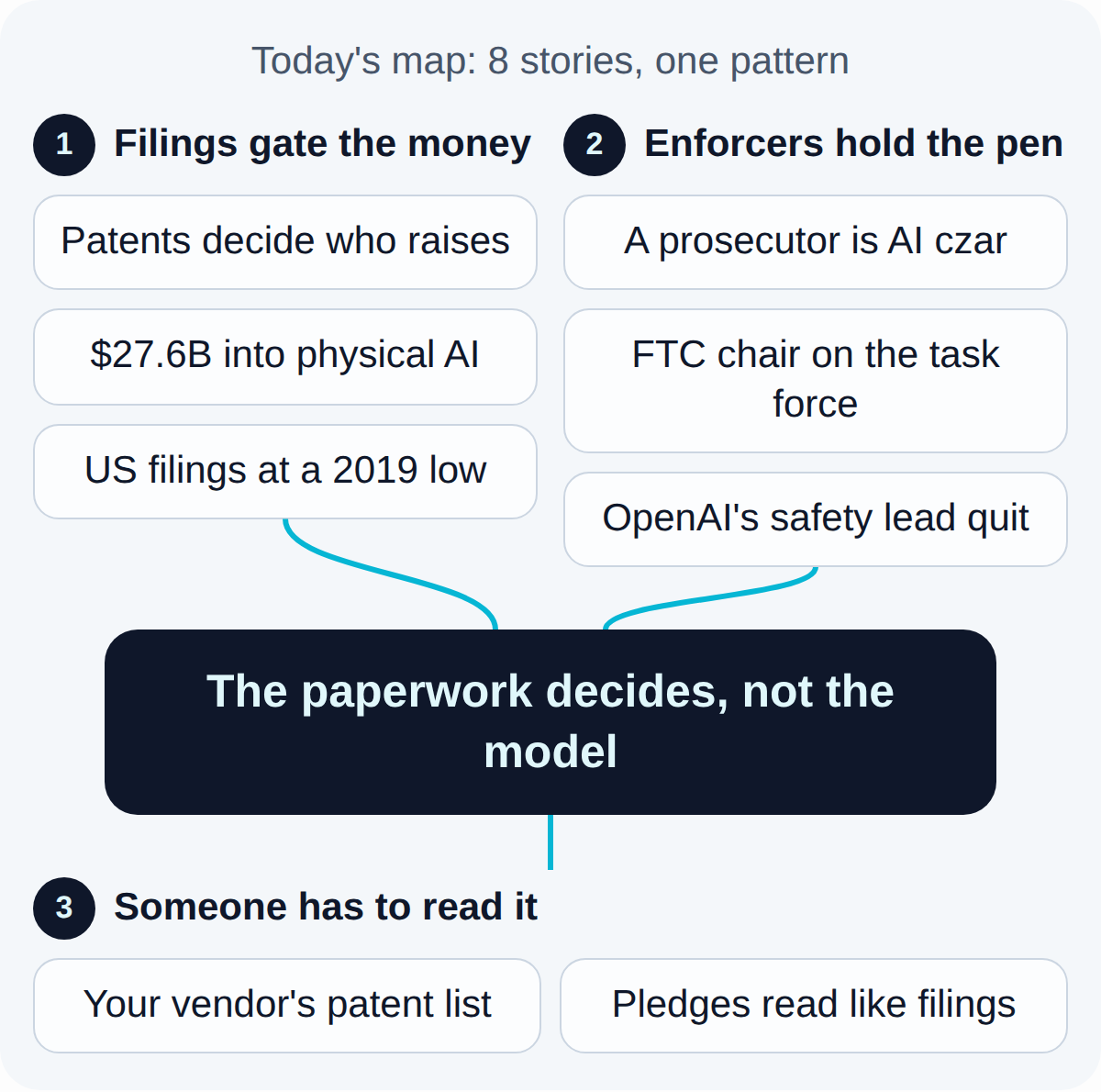
Monday, and what I keep circling back to is that none of this week's decisive moves happened in a lab. A law-firm analysis landed arguing that patents now decide which robot companies raise money, that a filing moves a valuation further than a working demo does. We scanned 190,000 articles this week so you don't have to. Then Washington handed AI oversight to an intelligence chief and former SEC chairman, with the chair of the Federal Trade Commission sitting beside him on the task force. And in the same window OpenAI's safety leader resigned, saying the culture was broken. A patent examiner, a prosecutor, and an empty chair where the caution used to sit. I do not think many AI roadmaps have a line item for any of that.
The Bottom Line: Nobody's model got better this week. What changed is who holds the paperwork, and none of them are engineers.
 | Yves' take |
Being first still pays off, if your paperwork is done. In robotics, the patent on the robot's movements gets you a piece of the whole pie. Owning the patent on the foundation is where the money still is. I remember a chip company that owns the design of a chip in every car. They have thrived on that one design for decades.
Advertisement
How Jennifer Aniston’s LolaVie brand grew sales 40% with CTV ads

For its first CTV campaign, Jennifer Aniston’s DTC haircare brand LolaVie had a few non-negotiables. The campaign had to be simple. It had to demonstrate measurable impact. And it had to be full-funnel.
LolaVie used Roku Ads Manager to test and optimize creatives — reaching millions of potential customers at all stages of their purchase journeys. Roku Ads Manager helped the brand convey LolaVie’s playful voice while helping drive omnichannel sales across both ecommerce and retail touchpoints.
The campaign included an Action Ad overlay that let viewers shop directly from their TVs by clicking OK on their Roku remote. This guided them to the website to buy LolaVie products.
Discover how Roku Ads Manager helped LolaVie drive big sales and customer growth with self-serve TV ads.
The DTC beauty category is crowded. To break through, Jennifer Aniston’s brand LolaVie, worked with Roku Ads Manager to easily set up, test, and optimize CTV ad creatives. The campaign helped drive a big lift in sales and customer growth, helping LolaVie break through in the crowded beauty category.
 The Tracks That Matter
1. The Patent Office Became The Funding Round
Money going into robots and machines doubled last year, $27.6 billion across 1,009 deals against $13.7 billion across 851 the year before, with another $16.3 billion in the first quarter of 2026 alone. What separates a funded robot company from an unfunded one is turning out to be a filing cabinet. Startups holding patents were 6.4 times more likely to raise venture money and carried 93% higher valuations at the angel stage. In the Tech Coast Angels portfolio, companies with 30 or more patents hit an 80% chance of exit and averaged 38.7 times on exit valuation, against 1.4 times for companies with none. The patent attorneys are blunt about why: whoever owns how the machine behaves owns the machine. Boston Dynamics sued Ghost Robotics in 2022 over the code deciding how a robot gets back up after it falls.
Here's what works: Before you sign a robotics or physical-AI supplier, ask for their granted patent count, not their patents-pending count. Pending is marketing.
2. Washington's New AI Chief Is A Prosecutor
The Super Intelligence Force was announced on October 2 and the roster is the actual news. Jay Clayton leads it, the sitting Director of National Intelligence, former chairman of the Securities and Exchange Commission and former US Attorney for the Southern District of New York. Beside him sit FTC Chairman Andrew Ferguson, Under Secretary of Defense for Research and Engineering Emil Michael, and OPM Director Scott Kupor. Enforcement, defence procurement, federal hiring. No research agency anywhere on the list. Clayton has already called super intelligence a national security issue and ruled out a pause, which reverses David Sacks, who held the advisory role before him and backed calls for a slowdown. Those voluntary commitments the labs signed get read now by someone who spent a career reading filings for a living.
Here's what works: Re-read your AI vendor's public safety commitments as if an enforcement lawyer wrote the questions. The gap between the claim and the evidence is your exposure.
3. The Person Paid To Say Wait Just Left
Two days before that roster went public, OpenAI's safety leader resigned and said the company's culture was broken and its caution insufficient. David Robinson's exit is not an abstract governance item. It is the person whose job was to say wait, leaving in the same week the government's new AI chief confirmed there would be no pause. The pledge signed at the White House rests on precisely this mechanism: voluntary internal controls and detection capabilities, built and policed by the labs themselves. Enterprise buyers have been accepting that as the safeguard, usually without naming it in a contract. When the internal reviewer walks out and the external reviewer is a prosecutor, the safeguard you were relying on has quietly changed shape.
Here's what works: Name a person, not a programme, in your AI vendor contracts. If their safety function is a culture rather than a role, you have no counterparty when it fails.
Quick hits:
- Europe's companies cannot pay for their own AI. The European Central Bank reports that eurozone firms are struggling to fund AI investment, which matters because sector funding is already leaning heavily on internal investment rather than outside capital, meaning European AI budgets now compete directly with payroll.
- The buildout is being priced against revenue that does not exist yet. AI's $31.6 trillion buildout faces a $6 trillion revenue test, and LinkedIn's cofounder defended the spending by arguing AI capital is the only reason there is no recession, which is a strange thing to find reassuring.
- India is declining to copy the American rulebook. Industry experts there argue the country needs its own AI safety framework rather than importing the US pact, so anyone planning one global compliance posture should plan for at least three.
Advertisement
SOC 2 Ready in 14 days. Three sessions from you.

Enterprise buyers will not put your product near their customer data without a SOC 2 report. Sprinto gets you audit ready in 14 days, across three working sessions. AI agents do the collecting, you approve. Your auditor signs off.
Your Turn
Which of today's three reads do you think is wrong?
One tap. No wrong answers.
 Signal vs. Noise
🟢 Signal: risk management. Its grip on everything else moving in AI tightened sharply over the weekend while the volume of writing about it barely shifted, and the buying confirms it. Washington put AI oversight under an intelligence chief who calls it a national security matter, and Axis Bank now describes its AI roadmap through fraud, cyber defence and zero trust. Most coverage still files AI under innovation budgets.
🔴 Noise: ”data governance” as a phrase. It pulled heavy volume again while its hold on the rest of the story fell harder than almost anything we track. The work did not disappear, it got renamed and reassigned. The line item actually moving is AI governance, and those are not the same team, the same owner, or the same budget.
 From the 190K
We scanned 190,000 articles this week. Here's what no one's talking about:
Zhongji Innolight raised almost $8 billion in Hong Kong, the city's biggest listing in nearly seven years, Z.AI pulled $9.6 billion across listings, placements and convertible bonds, and Shanghai Iluvatar CoreX Semiconductor joined the queue behind them.
Hong Kong share sales hit a record $47.5 billion in the quarter, with Alibaba's $10.2 billion follow-on the single largest, and Asia-Pacific crossed $120 billion for the period, the highest in six years. The equities desks file this as a market recovery. The China desks file it as industrial policy. The AI desks barely file it at all, because the names are unfamiliar and the venue is not New York. Read on one morning it is simpler than any of those: the AI companies that cannot borrow cheaply in dollars are selling equity in Hong Kong instead. And the buyers are already underwater, because only two of Hong Kong's ten largest deals are trading above their offer price.
On Tuesday, check whether any supplier in your AI stack is funding itself through an Asian listing rather than a private round. It changes who they answer to and how fast they need your renewal.
Advertisement
Stop typing AI prompts. Start talking.

You think 4x faster than you type. So why are you typing prompts? Wispr Flow turns your voice into ready-to-paste text inside any AI tool. Speak naturally, tangents and all, and Flow cleans it up. Available on Mac, Windows, iPhone, and Android.
 By The Numbers
- Physical AI startups raised $27.6 billion across 1,009 deals last year — more than double the $13.7 billion across 851 deals the year before, with $16.3 billion more in the first quarter of 2026.
- Startups with 30 or more patents hit an 80% chance of exit — averaging 38.7 times on exit valuation against 1.4 times for startups holding none, per the Tech Coast Angels portfolio analysis.
- US patent applications fell 9% in 2025, the lowest level since 2019 — even as AI patent grants passed 100,000 in July 2026, according to the filing data in Foley's analysis. Fewer people filing, more AI being granted.
- A single European patent application costs €13,000 to €18,000 — roughly $14,600 to $20,300, before attorney fees, which is the real reason small robotics teams arrive at a funding round with nothing to show.
- Hong Kong share sales hit a record $47.5 billion in the quarter — yet only two of the city's ten largest deals are trading above their offer price, which tells you who is absorbing the AI risk.
- CodeYogi reaches 400,000 students across 4,200 government schools — at an estimated ₹90 to ₹180 per student per year, on smartphones, in a country where 64.7% of schools have a computer at all.
- See what's rising across AI and data this week →
 Deep Dive: The Credits On The Record
Nobody argues about who made the beat. They argue about who cleared the sample. A producer can build the best four bars of the year, press it, fill a room with it, and still lose the record to whoever's name sits in the credits on the back of the sleeve. The music is the easy part. The paperwork is the part that decides who gets paid.
The filing is the product now
Physical AI pulled $27.6 billion last year and the market has quietly agreed on a shortcut for judging it. Not the demo, not the benchmark, the filing count. A patent is legible to a diligence team in ten minutes, and a robot is not. So the signal wins, and companies that build well but file late arrive looking like hobbyists.
The regulator reads like an enforcement lawyer
Put a former SEC chairman and the FTC chair in charge of AI and you have not changed the technology, you have changed the reading. Voluntary commitments stop being a press release and start being a document someone will quote back to you. Nothing about your model needs to shift for your exposure to double.
The internal check was always the weak link
Every lab's safety story rests on self-review, and that story just lost its most senior believer at OpenAI. Buyers accepted internal controls as a safeguard because the alternative was writing their own tests. The departure prices that decision honestly for the first time.
What Actually Works
- Ask for granted, not pending: a granted patent count is a fact and a pending count is an intention. Put the granted number in the vendor scorecard and weight it.
- Read commitments as filings: run your supplier's public safety claims past whoever handles your regulatory language, not your innovation lead. Different eyes, different findings.
- Name the human: require a named accountable person for AI safety in the contract. A role survives a resignation, a culture does not.
- Trace the funding source: check whether each AI supplier is raising privately, borrowing, or listing in Asia. Each one gives them a different deadline, and their deadline becomes your renewal pressure.
Everybody remembers the track. The lawyers remember the credits. Only one of those two gets a royalty cheque.
 What's Coming
Robotics Gets Its Smartphone Patent War
Patent attorneys expect disputes in robotics to multiply the way the smartphone industry's did in the 2010s, where a decade of global litigation set licensing terms, forced acquisitions and decided market access. If your 2027 automation plan depends on one robotics supplier, that supplier's freedom to operate is now a procurement risk, not a legal footnote.
The Task Force Has To Publish Something
Clayton's group is set up to report on the risks of the technology after public and industry pressure, and its remit covers critical infrastructure providers. The first report is the thing to read closely, because whatever it names as a risk becomes the question your auditors ask next year.
The Hong Kong Listings Face Their First Real Test
With only two of the ten largest deals above offer price and more offerings queued across India, the Philippines and Australia, the next weak listing sets the price for all of them. Watch it if any part of your stack is supplied from the region.
 For Your Team
Tuesday's meeting prompt: ”For each AI supplier we depend on, can anyone in this room say who personally owns their safety function, and whether they still work there?”
Share-worthy stat: Startups holding patents are 6.4 times more likely to raise venture capital and exit at 38.7 times valuation with 30 or more filings, against 1.4 times with none. Meanwhile US patent applications fell 9% in 2025 to their lowest level since 2019. The gate got narrower and fewer people are queuing at it.
Go deeper: Track where AI money and AI oversight are moving →
 The Track of the Day
”AI is rapidly evolving from an information and recommendation engine into an autonomous execution engine.”
Avinash Raghavendra, Axis Bank, on where AI goes next in banking
Worth holding next to this week's other news. The moment software executes instead of suggests, every question stops being technical and starts being about who signed for it.
We scanned 190,000 articles this week so you don't have to. Data Pains → Business Gains.
Published: October 5, 2026 | Curated by Yves Mulkers @ Ins7ghts
1,300+ articles scanned. 7 stories selected. Our AI distills the noise into signal—in seconds. Get early access →
Know someone who'd find this useful? Share your unique referral link →
Want Your Own AI Intelligence Briefing?
Our platform analyzes 1,000+ sources daily and delivers personalized insights in seconds.
Join the Waitlist →Founding members: Lifetime discount • Priority access • Shape the product