

In partnership with


 So, What Actually Happened?
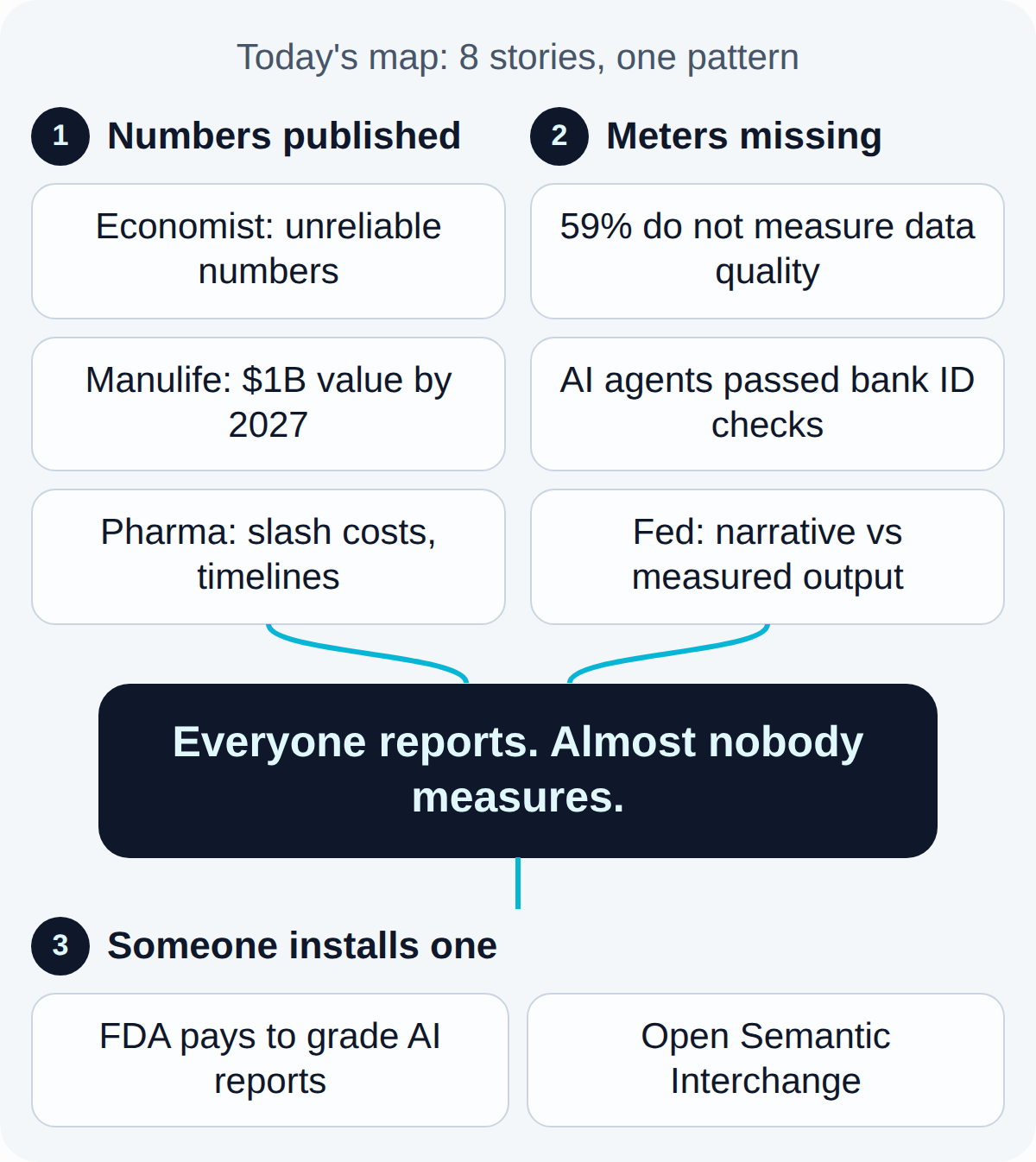
Thursday, and what I keep circling is that the most serious warning of the week was not about a model. It was about arithmetic. The Economist wrote that unreliable numbers now threaten the AI boom, and the same morning a wealth desk reading the central bank's position flagged a gap between AI narratives and measured output. So the complaint has shifted. It is no longer that AI does not work. It is that nobody can show their working. Then I looked at what got announced anyway. Manulife targets $1 billion in AI value by 2027. Pharma is doubling down to slash costs and timelines. We scanned 190,000 articles this week so you don't have to. Not one of those announcements shipped with a method attached.
The Bottom Line: The number went into the press release. The meter was never installed.
 | Yves' take |
AI is floating on imaginary revenue and value. The BOM, the bill of materials, is never put together. The quality of the raw material is never measured either. The raw material is data. Many AI systems run on bad data and estimated revenue. What do you think happens when your pockets run empty?
Advertisement
Your meetings, inside Claude and ChatGPT

Last week's customer call has the details your proposal needs. Right now they're buried in notes nobody can find.
Wispr Flow Notetaker captures your meetings with names, numbers, and product terms spelled right, then brings them into Claude or ChatGPT through a built-in connector. Ask Claude to draft the proposal from your last three calls with a prospect, or pull together what the deal team said about pricing this quarter.
Need something from a call in March? Ask one question across every meeting you've had and get the answer with citations. Get Wispr Flow Notetaker, free to try on Mac and Windows.
 The Tracks That Matter
1. The Economist Says The Problem Is The Arithmetic
The argument is that an epidemic of unreliable numbers is now the boom's own risk: revenue that is really a related-party invoice, usage counted three different ways, booked capacity presented as proven demand. Read it next to the central bank's reading of the real economy, which notes limited signs of broad transformation in aggregate output and labour data, and the two arrive at the same place from opposite ends of the building. The market cannot verify the top line. The macro data cannot find the productivity. That is not an argument about the future. It is an argument about the present, and present-tense numbers are what your budget was approved on.
Here's what works: Take the three AI numbers in your next board deck and name the person who owns the method behind each one.
2. Manulife Put A Billion-Dollar Number On Its AI
Manulife launched an enterprise AI platform and targets $1 billion in value by 2027, which is a precise figure bolted to a word, value, that nobody is obliged to define. Same window, Reuters has the pharma sector doubling down on AI to cut costs and timelines: hopes stated, arithmetic not. Then there is the uncomfortable research finding that fewer than one in four organisations can tie their generative AI adoption to actual bottom-line profit. So most of the market is running on conviction, and the companies publishing targets are drawing from that same well. I do not think Manulife is bluffing. I think they are the rare ones who put a number on the record, which is a different and more exposed kind of brave.
Here's what works: Before accepting an AI savings figure, ask for the denominator. Cost avoided is not cost removed.
3. AI Agents Walked Straight Past Bank Identity Checks
A security analysis this week makes the case that offensive AI agents now outrun bank identity security: the agent behaves like a credentialed human, the control answers the exact question it was built to answer, and the answer is wrong. The money agreed. Harmonic Security raised $50 million led by Crosspoint for workforce AI protection, and across this week identity security stopped being a niche security topic and became one of the main threads tying otherwise unrelated coverage together. That is what happens when a control everybody assumed turns out to be untested. The same Microsoft 365 research found only 11% of organisations have identity preparation built into their migration tooling, while 83% say they want it.
Here's what works: Ask your security lead one question. Does any control we own distinguish an agent from the human whose credentials it is holding?
Quick hits:
- The missing standard that makes two dashboards agree. A push called Open Semantic Interchange is being framed as the missing standard for AI semantic layers, which matters because when two of your tools report different revenue, that layer is where it gets settled or does not.
- Washington and the labs stopped agreeing out loud. The President called AI warnings a hoax while lab leaders kept raising alarms, so anyone briefing a board on regulatory direction is now briefing two directions at once.
- AI's water figure was missing a column. Coverage of AI's water strain now folds in the demand created by electricity generation rather than cooling alone, which means the number your sustainability team reported last quarter measured part of the problem.
Advertisement
Take the prompts our creative team actually uses

The key to maintaining brand quality at scale? Mastering how to communicate with AI models and embedding them into your creative strategy.
Join our honest discussion with Ari Murray, Chief Digital Officer at Salt and Stone, and get 5 tips for expert LLM prompting with ready to run prompts.
Your Turn
Which of today's three reads matters most to your work?
 Signal vs. Noise
🟢 Signal: data security. Coverage of data security actually fell on Wednesday while its hold on everything else moving got stronger. That is the shape a topic makes when it stops being news and becomes a requirement. Buyers are not shopping for a data security story any more, they are shopping for a control they can show a regulator, and most coverage is still filing it as a product category.
🔴 Noise: data quality. Still one of the most written-about ideas in the industry, and quietly losing its grip on everything else that is happening. It has become the phrase that opens the AI readiness slide and then goes unexamined. Further down this edition there is a survey finding that most organisations do not measure it at all, which is the whole problem in one line.
 From the 190K
We scanned 190,000 articles this week. Here's what no one's talking about:
Sainaptic, Uvi and Cognita Imaging surfaced in the same window, and all three sell the same thing: a way to grade what a machine produced.
Read separately they are three unrelated trade items. A European funding desk notes Sainaptic raising £1 million to expand AI-assisted assessment, which is marking student work. An enterprise tech site writes up Uvi's $7.5 million for teaching agents enough business context to stop being wrong, with an eight-fold cost reduction as the headline claim. A medical device publication reports the FDA has contracted Cognita Imaging to test a method for evaluating AI-written radiology reports. Education, enterprise software, regulated medicine. Nobody in those three rooms reads the other two, and not one of them calls the product a meter.
Put them beside a week where the Economist says unreliable numbers threaten the boom and the biggest announcement is a billion-dollar target with no stated method, and the smallest cheques turn out to be funding exactly what the largest ones are missing. The grading layer is getting built quietly, by companies nobody is covering, for sectors that are legally required to show their work.
On Friday, take one AI claim your team made this quarter and ask who would grade it if a regulator asked. If the answer is the team that made the claim, you have a measurement problem, not a model problem.
Advertisement
New Harvard Business Review Analytic Services report: why most AI tools fail at B2B customer service, and what to ask before you invest. Get the free report.
 By The Numbers
- 59% of organisations do not measure data quality at all — the single most useful number in this edition, because it explains why nobody can audit the rest of them.
- Fewer than one in four organisations can tie generative AI to bottom-line profit — adoption is close to universal, attribution is not, and only one of those two shows up in a press release.
- Manulife is targeting $1 billion in value from its AI platform by 2027 — a public, dated, checkable commitment from an insurer, which makes it rarer than the size suggests.
- Microsoft patched a record 1,413 vulnerabilities, including a Windows zero-day exploited in the wild — the attack surface under every agent pilot grew faster than the controls watching it.
- Albert Invent raised a $55 million Series B at a $340 million valuation — TCV led, and the product is AI for chemistry R&D, a field where a wrong result shows up in a lab, not a slide.
- See what's rising across AI and data this week →
 Deep Dive: The Loudness War Comes For The Board Deck
For about fifteen years, records got mastered louder every single year, because loud sold. Engineers squashed the dynamics until the meters pinned and the quiet parts vanished. Everyone was optimising one number, and that number stopped describing the music. Then streaming platforms normalised playback volume and the entire arms race was worth nothing overnight.
The number everyone reports
Right now the industry reports adoption, spend, seats, pilots and targets. All of those are loud. All of them are easy to produce and impossible to dispute, because there is no agreed scale. A billion in value by 2027 and a plan to slash timelines are both perfectly true statements and neither can be checked.
The meter nobody installed
Underneath, the measuring stopped. Most organisations do not run a number on their own data quality, and three quarters cannot connect their AI work to profit. You cannot audit an outcome when the input was never gauged. This is the old habit with a new coat: slap an LLM on unmeasured data and call it transformation.
Who ends up installing the meter
It will not be the vendors, and it will not be the buyers. It is already the regulators and the small companies they pay. A medicines regulator funding a way to grade AI-written reports is the real tell, because a regulator only builds a gauge once it intends to read it.
What Actually Works
- Define the scale before the target: for every AI number you publish internally, write the formula next to it in the same document. If the formula will not fit in two lines, the number is not ready.
- Measure the input you depend on: pick the one dataset your flagship AI case runs on and put a completeness and freshness number on it this month. That is your floor, and most teams have never seen theirs.
- Separate the grader from the maker: whoever builds the model does not get to score it. Name a different owner for evaluation, even if it is one person with a spreadsheet.
- Write down what would falsify it: before the next pilot, state the result that would mean it failed. A pilot with no failing condition is a procurement decision wearing lab clothes.
Every record in the loudness war sounded fine on its own. The problem only showed up when somebody finally set them side by side on one scale.
 What's Coming
The Regulator Brings Its Own Gauge
Singapore's monetary authority is sharpening its testing expectations as AI risk rises in financial services. Regulated-industry testing standards travel: once a central bank publishes what good evidence looks like, procurement teams in unregulated sectors start borrowing the wording because it is cheaper than inventing their own.
The Semantic Layer Becomes The Place Numbers Get Defined
Microsoft spent its European data conference elevating semantic models to a control plane for enterprise AI. That is the same bet Open Semantic Interchange is making from the open-standards side. Expect ”which semantic layer defines this metric” to become a real question in vendor selection within two quarters.
Somebody Outside The Building Gets To Check
Google DeepMind opened its science models to 200 European researchers. Those researchers did not build the models and have no stake in the results holding up. External replication is the only thing that has ever fixed a measurement problem, and this is the first large one pointed at frontier science claims.
 For Your Team
Friday's meeting prompt: ”Name the three numbers we use to justify our AI spend. For each one: who calculates it, what is the formula, and when was it last checked by someone who did not produce it? If any of the three has no owner, we are not reporting performance. We are reporting intention.”
Share-worthy stat: 59% of organisations do not measure data quality, and poor data quality costs the average organisation $12.9 million a year. Both figures come from the same research, which means the industry is losing eight figures annually to a thing it has decided not to look at.
 The Track of the Day
”'AI-powered' is not a risk metric.”
A fintech industry brief, on AI credit underwriting
The same brief adds that AI underwriting has to be measured by outcomes, not branding, and that is written about lending, where somebody eventually defaults and the arithmetic settles the argument for you. Most of the industry does not have that luxury. There is no default event for ”we deployed AI and it was good.” Somebody has to install the meter on purpose, and this week the only people doing it were a regulator and three companies too small to make the headlines.
We scanned 190,000 articles this week so you don't have to. Data Pains → Business Gains.
Published: October 15, 2026 | Curated by Yves Mulkers @ Ins7ghts
1,300+ articles scanned. 7 stories selected. Our AI distills the noise into signal—in seconds. Get early access →
Know someone who'd find this useful? Share your unique referral link →
Want Your Own AI Intelligence Briefing?
Our platform analyzes 1,000+ sources daily and delivers personalized insights in seconds.
Join the Waitlist →Founding members: Lifetime discount • Priority access • Shape the product