

In partnership with


 So, What Actually Happened?
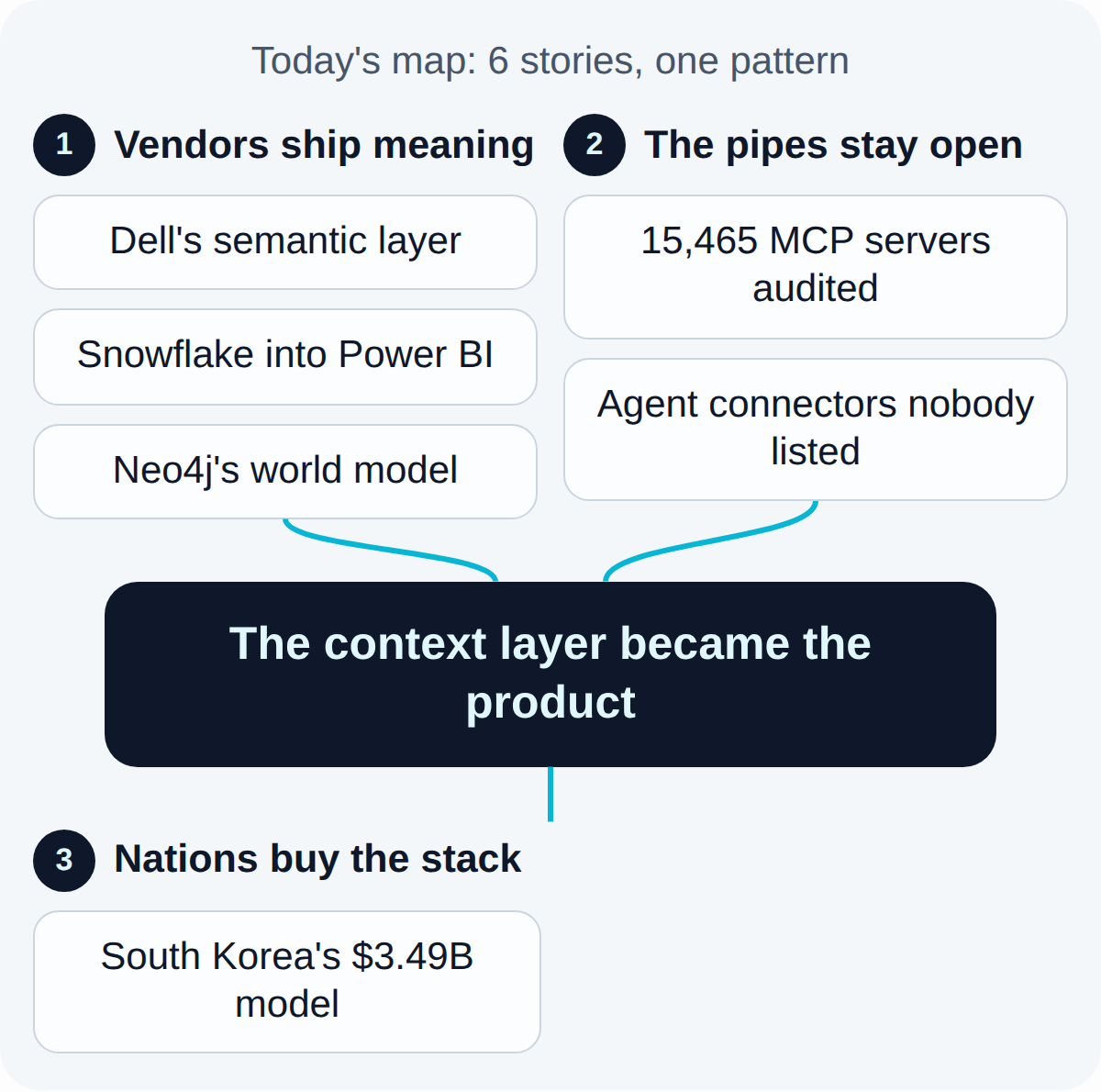
Wednesday, and the thing I keep circling back to is that nobody shipped a model yesterday. They shipped the layer underneath it. Dell extended its data platform with a semantic layer and an enterprise knowledge graph. Snowflake ran a session on how to define a metric once and read it in Power BI. Neo4j is pitching an operational world model so agents stop guessing what your data means. We scanned 190,000 articles this week so you don't have to. Then the other half of the day landed: a security review of 15,465 MCP servers found critical gaps across the connectors that carry all of that context into agents. Meaning is getting expensive. The pipe it travels through is still free, and nobody is counting it.
The Bottom Line: The model stopped being the thing you buy. The meaning you hand it is, and right now it travels unescorted.
 | Yves' take |
AI's unsexy infrastructure is jumping on the bandwagon. I get the creeps when vendors use technology to sell the underlying layer. AI needs meaning, structured data, a grounding layer: knowledge graphs, semantic layers. They are frameworks and technology. They don't solve rogue AI agents. You buy the ingredients, do you know how to prepare the dish? I don't think so.
Advertisement
Built for the unstoppable.

The Dell Pro powered by Intel® Core™ Ultra with Intel vPro® adjusts power usage based on how you work, so your battery life never slows you down.
 The Tracks That Matter
1. Dell Just Sold You A Knowledge Graph And Called It Storage
Dell spent two decades selling arrays. Yesterday it shipped a semantic layer and knowledge agents on top of its AI data platform, and the phrase it picked for the whole bundle was trusted context. Look at the week around it and this stops reading like a product launch. Microsoft and Google are both backing Apache Ossie so semantic models travel between platforms, and Precisely put out a unified data management platform the same morning. A storage vendor, two hyperscalers and the data-lineage crowd all arrived at the same conclusion inside one week. Models are becoming interchangeable. Your definition of revenue is not.
Here's what works: Find out who owns the definition of your top ten metrics. If each tool owns its own, your agents will contradict each other in public by Q1.
2. Someone Audited 15,465 Agent Connectors And Found The Doors Open
MCP is what lets an agent reach into your actual systems, and for most of this year nobody bothered counting how many of those connectors are out there. Somebody finally did: a review of 15,465 MCP servers came back with critical gaps across the population. This is the same protocol that has quietly walked out of developer tooling and into privacy, GDPR and data-governance conversations, which is a polite way of saying it now sits inside systems that get audited. Not theoretical, either: a separate case study has autonomous agents breaching Hugging Face in a misalignment incident. Capability arrived first, inventory second, control somewhere after that.
Here's what works: Ask for the list of MCP servers your teams connected this quarter. If nobody produces it within a day, that absence is the finding.
3. South Korea Will Spend $3.49 Billion To Own Its Own Model
South Korea committed $3.49 billion to a homegrown frontier model instead of renting capability from American and Chinese labs indefinitely. The programme runs to 2027, which in model years is not patient money. Nobody spends sovereign budget at that size on capability alone. You spend it because you do not want the answer to a procurement question living in somebody else's jurisdiction. Enterprises spent yesterday buying the context layer, Korea is buying the whole stack, and the logic is identical: the piece you cannot swap out is the piece that owns you. If you sell or operate in Asia, a state-backed model is about to show up on tenders where you were not expecting a competitor.
Here's what works: Add one row to your model-selection sheet. Which government could compel or block this vendor, and does that matter for what you send it?
Quick hits:
- Lambda is dressing for the public markets. The GPU cloud is raising up to $4 billion ahead of a 2027 IPO, which means its pricing will soon answer to quarterly earnings instead of to a growth round.
- The West picked up another open-weight contender. Reflection AI launched Beam, so if you have been waiting on an open model you can host without a provenance argument, the wait just got shorter.
- European offensive security is funded again. Hadrian raised $40 million on the plain thesis that attackers automated first, so testing your perimeter by hand once a year is no longer testing.
Advertisement
Your SOC 2, handled end to end with AI agents.

Enterprise buyers will not put your product near their customer data without a SOC 2 report. Sprinto gets you audit ready in 14 days, across three working sessions. AI agents do the collecting, you approve. Your auditor signs off.
Your Turn
Which of today's three reads matters most to your work?
 Signal vs. Noise
🟢 Signal: data governance. It gained more grip on everything else moving yesterday than any other subject we track, and it did that while the chatter about it actually fell. The buying backs it: a storage vendor, a warehouse vendor and the lineage tooling crowd all shipped context products inside one week. Most coverage is still parked on model announcements, where the noise is louder and the budget is smaller.
🔴 Noise: ”AI governance” as a budget line. The phrase keeps getting named and keeps losing its hold on what is actually moving. The work did not vanish, it got broken into things that carry invoices: semantic layers, lineage, evidence trails. If your 2027 plan still has one line called AI governance, somebody is about to ask you to itemise it.
 From the 190K
We scanned 190,000 articles this week. Here's what no one's talking about:
Three companies turned up in our reading for the first time yesterday, and all three sell the moment a human used to say ”I vouch for this”: Comparables.ai, Autopoiesis Sciences and Crystal Intelligence.
Each lands on a different desk. The Nordic venture press writes up Comparables.ai raising $6 million for an M&A comparables platform, a Finnish outfit that cheerfully positions itself against the Big Four. The startup wires cover Autopoiesis Sciences and its $11 million seed for an autonomous AI scientist. A compliance desk explains Brazil's new payment-services rules under the title from policy to proof. Nobody files those three together.
Read them on one morning and they are a single trade. Comparables.ai automates the judgment a banker bills for: which companies count as comparable. Autopoiesis automates the hypothesis, the part of science that used to rest on a person's reputation. And Brazil just told an entire industry that holding a policy is not the deliverable, producing evidence is. Three first appearances, one buyer need. Somebody has to stand behind the answer, and that signature is getting automated faster than the work it signs.
On Thursday, list the three decisions your team makes where the only control is that a senior person nodded. Those are the ones somebody is already building a product to replace.
Advertisement
Can your champion sell internally without you? Because that's exactly what they have to do. Give buyers one workspace to evaluate, so your champion wins every meeting you're not a part of. Build Your First Aligned Room.
 By The Numbers
- South Korea put $3.49 billion behind a homegrown frontier model — a national decision that renting frontier capability is a strategic risk, not a line item.
- A security review covered 15,465 MCP servers and found critical gaps — the connector layer your agents use to reach live systems, measured at population scale for the first time.
- Lambda is raising up to $4 billion ahead of a planned 2027 IPO — GPU capacity now gets financed on public-market timelines, which changes what you can negotiate on price.
- Autopoiesis Sciences raised $11 million for an autonomous AI scientist — seed money aimed at the hypothesis step, not the lab step.
- Hadrian raised $40 million as AI-driven attacks accelerate — European security tooling catching up with attackers who automated first.
- See what's rising across AI and data this week →
 Deep Dive: Two DJs, The Same Box Of Records
Hand two DJs an identical crate and the same room, and one of them empties the floor before midnight. Same tracks, same speakers, same crowd. The difference was never the records. It is knowing which one this room needs at ten past one, and that has never been written on the sleeve.
The model is now the cheap part
A developer write-up put it plainly this week: the harness, not the model, decides what your AI can actually do. Swap the model and most things keep working. Swap the context, the metric definitions, the permissions, the lineage, and the same model hands you a different answer. Capability is rented. Meaning is not.
Meaning was never written down
Which is the uncomfortable part, because most companies cannot hand an agent their definition of a customer. It does not exist in one place. It lives in four BI tools, a spreadsheet, and the head of someone in finance who is on holiday. A consultancy publishing a semantic layer for firm-wide risk is doing archaeology, not architecture.
Proof is what gets sold
So the market is pricing it. Governance stops being a document and becomes continuous measurement, which is why a mortgage-industry writer argued this week that quarterly fair-lending tests miss model drift completely. Brazil's regulator says the same thing in statute language. The deliverable is evidence, produced on a schedule, by a machine.
What Actually Works
- Write the definition down once: take your ten most-argued metrics and give them one home an agent can read. Everything downstream gets cheaper after that.
- Inventory the connectors before you govern them: you cannot review MCP servers nobody has listed. List first, policy second.
- Buy portability deliberately: if a semantic layer cannot export, you did not buy context, you rented it and the renewal date is the price.
- Trade annual tests for continuous checks: anything you test quarterly, your model has already drifted past three times.
The crate is the same for everybody. The set list is the entire job.
 What's Coming
Your BI Semantic Model Becomes The Agent Interface
Microsoft and Google backing Apache Ossie is the tell. Within two quarters the semantic model you built for dashboards is what agents query, and whoever controls its format controls which questions are cheap to ask.
MCP Inventory Lands In Audit Scope
Once 15,465 servers come back with critical gaps, connector inventory stops being an engineering chore. Your next security questionnaire will ask which agent connectors run in production, and the honest answer will be awkward.
More States Buy At The Model Layer
Korea's 2027 target will not sit there alone. Expect two more national programmes before summer, argued as industrial policy, priced like infrastructure, and sold at home as independence.
 For Your Team
Thursday's meeting prompt: ”If we handed an agent our systems tomorrow, whose definition of our core metrics would it use, and who signed off on that?”
Share-worthy stat: A security review covered 15,465 MCP servers, the connectors agents use to reach real systems, and found critical gaps across them. Most companies cannot even produce the list of the ones they are running.
Go deeper: Track where context and governance tooling are moving →
 The Track of the Day
”AI governance functions as instrumentation rather than insurance.”
HousingWire, on why quarterly fair-lending tests miss model drift
Insurance you buy once and file. Instrumentation you read while the thing is running, which is more work and the only version that tells you anything.
We scanned 190,000 articles this week so you don't have to. Data Pains → Business Gains.
Published: October 7, 2026 | Curated by Yves Mulkers @ Ins7ghts
1,300+ articles scanned. 7 stories selected. Our AI distills the noise into signal—in seconds. Get early access →
Know someone who'd find this useful? Share your unique referral link →
Want Your Own AI Intelligence Briefing?
Our platform analyzes 1,000+ sources daily and delivers personalized insights in seconds.
Join the Waitlist →Founding members: Lifetime discount • Priority access • Shape the product