

In partnership with

We hand over more than we can watch.
Three things from yesterday land on the same subject: how much of a working day now happens inside something nobody can inspect. Email and the assistant that drafts email went down together for hours, and the clearest public record of it came from a complaints site. A survey of IT teams put numbers on how few of them can see how their agents decide, and Databricks shipped agents built to work while nobody is looking.
Advertisement
Why are so many brands shifting ad spend to CTV?

People spend more time streaming than they do with cable, social media or video games, and advertisers know it. In fact, according to Advertiser Perceptions and Premion's 2026 CTV/OTT Advertiser Survey, 70% of advertisers are raising CTV budgets in 2026, with much of that budget diverted from social advertising.
For marketers who want a presence in streaming, Roku is the obvious place to go, with scale that speaks for itself. With more than 100 million households representing 47% of all streaming time in the US, Roku easily has more reach than every competitor.
With Roku Ads Manager, you can reach viewers across more than 100 premium apps in a single buy. Combine your customer data with Roku's insights to reach only the households you want, then measure and optimize to your heart's content.
Want to give it a try? Unleash your first campaign in just four steps: (1) Create your account, (2) define your objective and target audience, (3) upload creative, and (4) launch.
First-time spenders get a $5,000 match on the first $5,000 spent with code BEEHIIV5K. Terms apply.
1. Teams, Outlook and Copilot went down together for hours
Microsoft's first notice went up at 7:40 a.m. Pacific, about Teams in North America. By late morning the outage ran across Teams, Copilot 365, Exchange Online, SharePoint Online, Defender XDR, Outlook.com, OneDrive and Azure.
Downdetector's peaks arrived inside the same half hour: about 130,000 reports for Outlook at 10:11, about 46,000 for Microsoft 365, about 6,000 for Copilot, about 5,000 for Teams.
Microsoft said the elevated load was not more traffic. It was servers unexpectedly unavailable.
It paused all deployments, moved traffic off the affected infrastructure and restarted servers, and at 1:12 p.m. Pacific said it was “aggressively pursuing all pathways to reduce impact”.
The same day, two other Microsoft items were going through the partner channel: a new E7 licence tier that bundles E5, Copilot, Entra Suite and Agent 365 as the governance package, and a source filter for Copilot Chat, due to reach everyone in mid-November.
When the clearest record of a working day comes from a complaints site somebody else runs, the companies paying for the service are not measuring what their own people just lived through. Microsoft will book this as a few hours on a handful of services. What landed on desks was email and the thing that writes email, gone in the same window, and no in-house dashboard shows that pair falling over together. I keep a plain copy of the week's commitments outside the suite that holds them, which looked like paranoia until yesterday morning.
2. The agents are already in IT operations, mostly unwatched
Dynatrace published its State of Observability 2026, a survey of how companies watch their own software run. The global numbers:
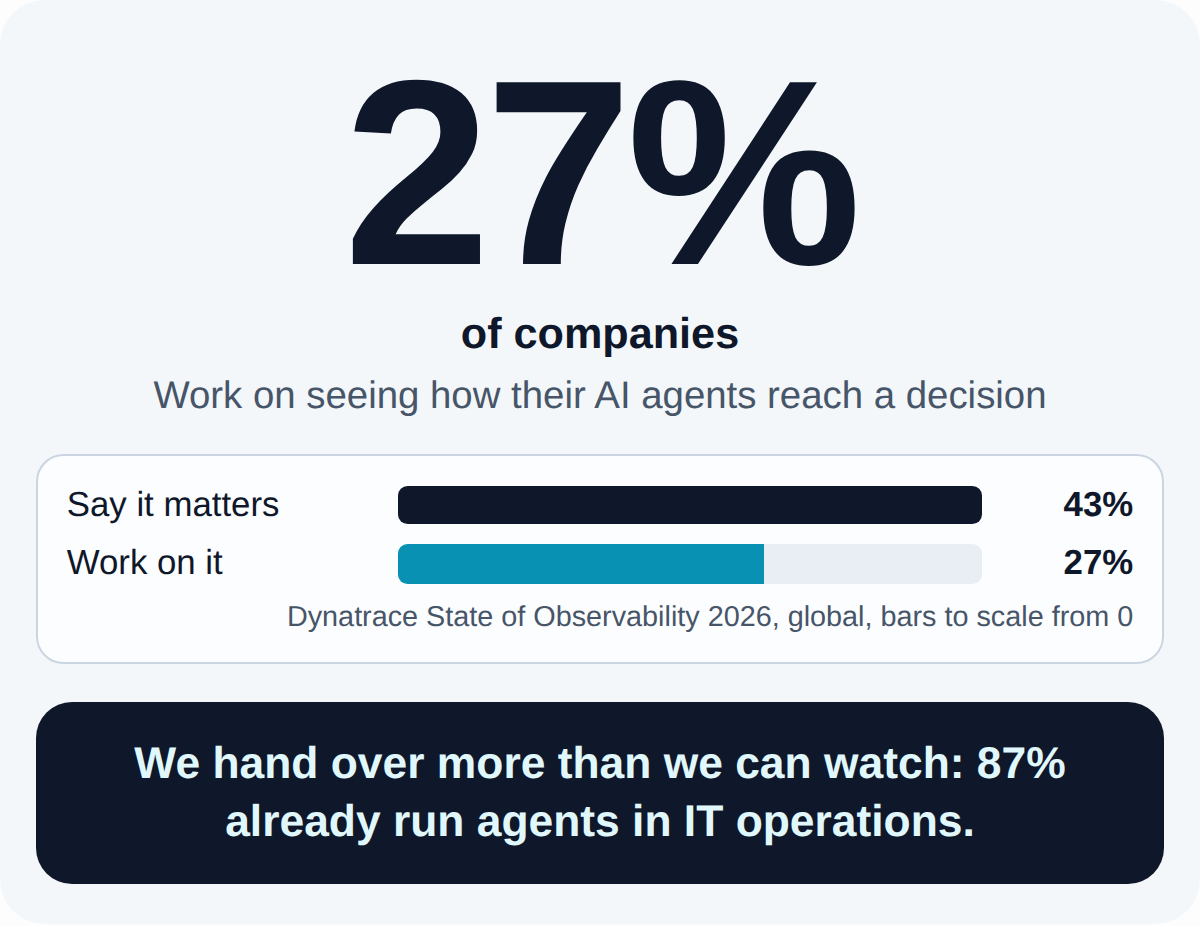
- 87% use AI agents moderately or extensively in observability and IT operations.
- 43% say understanding how agents reach decisions is important. 27% work on visibility into those decisions.
- Humans verify 66% of AI-powered decisions, on average.
- 12% have fully autonomous operations today. 44% want that inside five years.
- 81% report higher compute and infrastructure spending because of AI workloads.
Dynatrace is also buying its way into the gap it just measured. Its second-quarter earnings call on 3 November recorded a completed acquisition of Arize, which watches how models behave, a $246 million share buyback and a log management partnership with CrowdStrike. Three weeks earlier, Revenium went to the channel with AI cost control, selling against the same blind spot from the invoice side.
Checking two thirds of what a machine decides is not oversight, it is a second job nobody hired for, and it is the first thing dropped when a quarter gets tight. So the 27% tells me more than the 87% does: the watching is the part being skipped, not the adoption. I would put the renewal conversation there, on where an agent's decision gets written down and how long it stays readable, well before the seat count.
Advertisement
Your TV budget belongs on the big screen.

Not in a middleman's pocket.
Universal Ads is a self-serve TV ads platform with zero platform fees or hidden markups, advertising across 20+ premium publishers. New advertisers: use code UALAUNCH26 at sign-up to get $2,500 in matched ad credits when you spend $2,500.
3. Databricks' new Genie works while nobody is looking
The second generation of Genie runs continuously in the background on its own compute, tracks long tasks, hands work to sub-agents and surfaces its decisions in a priority inbox or by email. It went out on Wednesday, a day after Anthropic put Claude into sheets and meetings.
Genie Agents connect to Slack and can be reached from ChatGPT, Claude, Microsoft Copilot for Work and Grok, with permissions and audit trails running through Unity Catalog. Genie Search reaches past the lakehouse into Google Drive, Jira and Confluence through more than 100 connectors. Chief executive Ali Ghodsi said Genie has made him a “10x more productive CEO” and that he uses it every day. Databricks did not disclose pricing.
Databricks put its own announcement up on 11 November, and Genie had already shown up as an app inside Asana on 4 November. On 6 November a trade piece argued that what makes a data agent trustworthy is context, not the model.
The priority inbox is the piece I distrust most. A list of decisions arriving by email is a feed, and a feed gets read by whoever has time that morning. The audit trail next to it in Unity Catalog is the part that will actually sell this into a regulated buyer, not the autonomy. My expectation: the first serious complaint about background agents will not be a wrong answer, it will be nobody being able to say which agent did it.
Two rounds closed on the two halves of the view you do not have
Nobody put these two together. Nebuly raised a $21 million Series A led by Planven to measure what AI at work actually produced: time saved, tasks finished, revenue influenced by customer-facing assistants, pulled out of Claude, ChatGPT and Copilot, with the analysis able to run on-premises. Customers named include Oura, Iveco Group, CNH and Zeiss. The same day, Bay came out with $50 million, a $37 million Series A led by Battery Ventures on top of a $13 million seed, for software that judges each agent action locally in milliseconds and decides whether to allow it. Micron, Peloton, ClickUp and Wix are already on it.
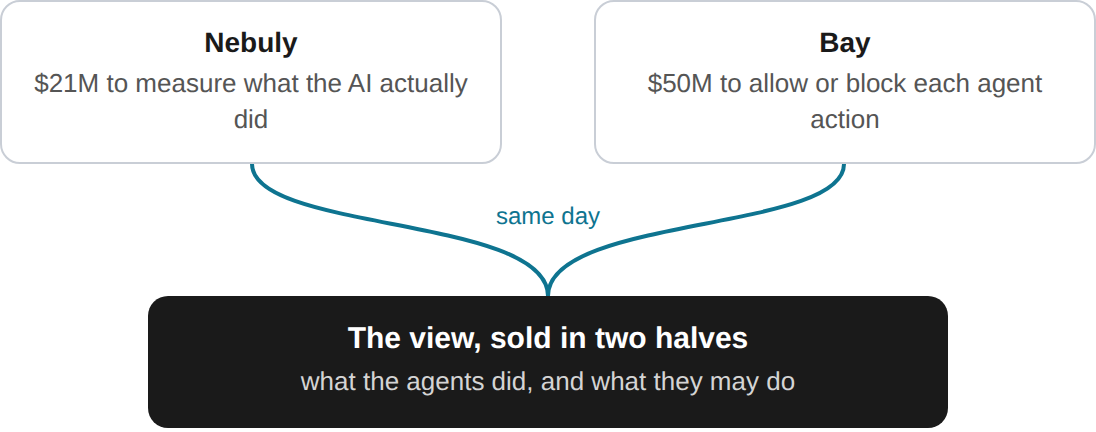
Both rounds are bets that you will not build this yourself.
Names to watch
Seen this week by Ins7ghts, our research platform: a knowledge graph of the data and AI news we read every day.
- geniosAI · $19.1 million for analysis that shows where every answer came from
Provenance. It raised on 9 November and announced a partnership with FactSet the same day, putting FactSet's financial data inside its platform. - Blackletter · a $6 million seed to expand an AI-powered law firm
Ownership. Lerer Hippeau led the round on 9 November, and two days later EvenUp's personal injury law firm business passed $150 million.
Companies that later raised money had been in the news about twice as often in the quarter before. Worth a second look in three months.
Advertisement
A long video plus clips won't cut it anymore

Creators and brands who achieve mindshare post full episodes, highlights, low-fi yapper videos and thought leadership shorts, every week. OpusClip 4.0 turns your raw footage into the formats and volume to stay top of mind. For a limited time, get 40% off your first month of Pro Plan.
Today's context on 7wData
- Disney names Adobe its AI innovation partner, with Firefly models trained on Disney's own properties Adobe and Disney announced a multi-year alliance at Adobe MAX on 9 November 2026: Disney will build generative AI models on its own properties with Adobe Firefly Foundry, and Imagineering already uses two of them; no money terms were given.
- AMD agrees to buy $2.5 billion of Anthropic stock at the IPO price AMD has agreed to buy $2.5 billion of Anthropic's non-voting stock at the IPO price, one of seven partners in a $26 billion placement, and the IPO is not priced yet.
- AvePoint expands Microsoft partnership to govern AI agents in Copilot On 10 November AvePoint announced an expanded strategic partnership with Microsoft to govern the AI agents organisations run across Microsoft Copilot and related services, with no contract value disclosed.
Also today
- Anthropic launched Claude for Manufacturing. (3 min read)
- Luminal raised a $25 million Series A to cut AI inference costs beyond Nvidia GPUs. (2 min read)
- Vanta bought Pillar Security for $150 million. (2 min read)
The ScoreboardThe six that came due this week
Six calls written in May reached their deadline this week, and all six missed.
0 right 29 wrong 7 not a real call 0 still open
The sharpest miss is the one from 8 May. We said the first major pharma would publish an OpenBind-trained baseline against its own closed-vendor binding model within one to two quarters. OpenBind's trail stops at its May data release, and no pharma has put that comparison in a deck or a paper. The call asked a company to publish the benchmark that makes its paid model look replaceable, which is the one document nobody volunteers.
Which of your own 2026 forecasts had a date on it that has already passed?
If you can pull up what one of your own agents decided last Tuesday, and who approved it, hit reply and tell me where that record lives.
Yves
Tomorrow, The Long Read: one theme through the whole week, from three sources.
Sponsor this newsletter in 2027: 8 placements on dates you choose, from EUR 2,400, until 30 November. Book: 7wdata.be/sponsor-2027
Ins7ghts Daily is published by 7wData.