

In partnership with


 So, What Actually Happened?
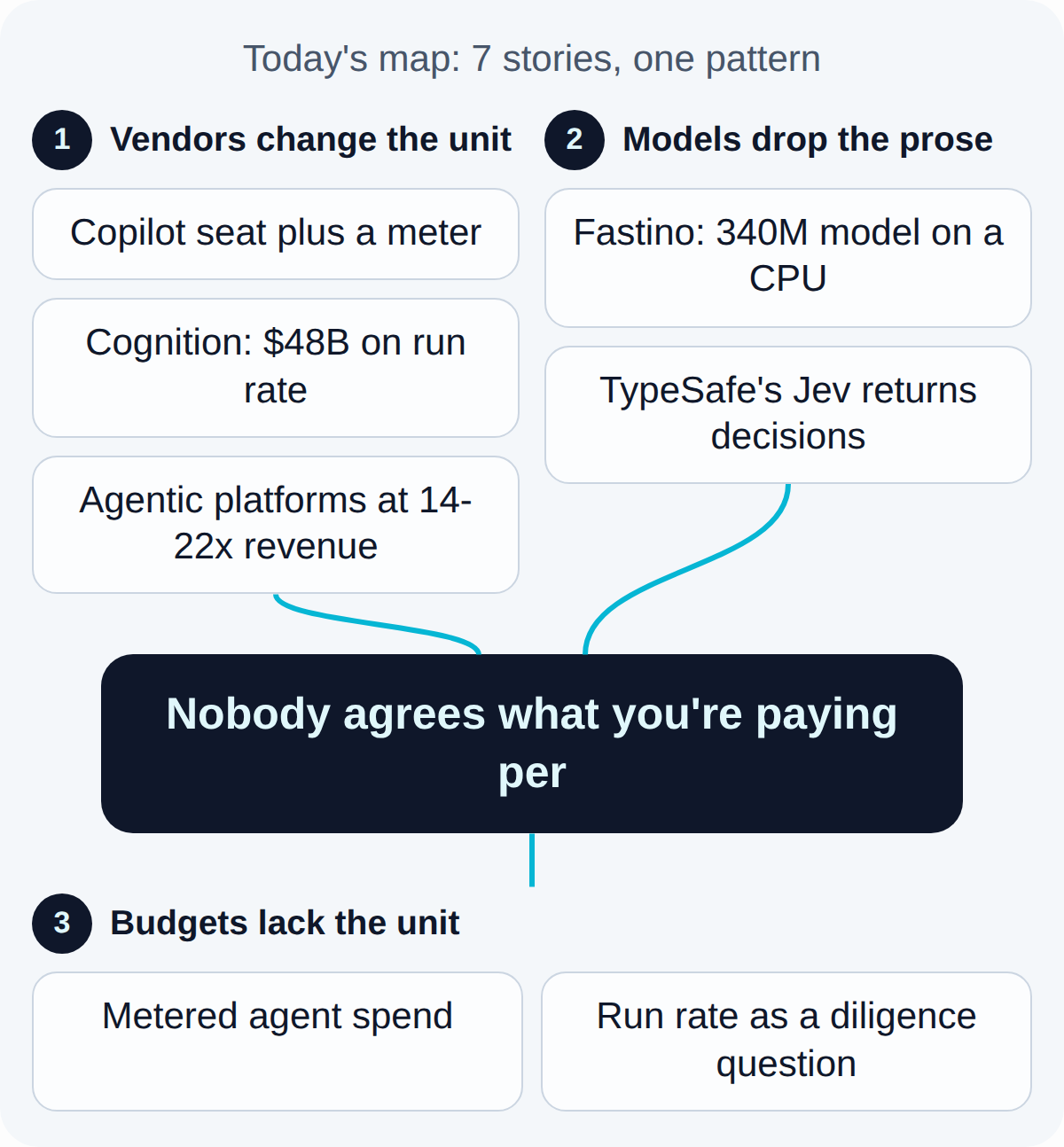
Monday, and the thing I keep turning over is a pricing footnote nobody put in a headline. Microsoft is putting a meter on the Copilot seat, which reads like an accounting detail until you notice fewer than 7% of its 450 million commercial seats ever took the licence. So the seat did not sell, and the answer is a meter. We scanned 190,000 articles this week so you don't have to. In the same window two labs shipped models that refuse to write prose at all and hand back a decision instead, which is a different meter again. And Cognition raised $2 billion at $48 billion on an annualised run rate, a number that quietly excludes time. Three bills, three units, no agreement anywhere.
The Bottom Line: Every AI price you get quoted this quarter is denominated in a unit the vendor chose, and you have not agreed to a single one of them.
 | Yves' take |
AI hype is still in full swing: vendors take one good month and sell it as future revenue. Meanwhile, specialised models like Jev, which give deterministic answers instead of AI slop, are finding their way in. Trust in numbers and results becomes the AI denominator.
Advertisement
AI made PMs faster. Multiplayer mode is still broken.

A PM can summarize research, draft a PRD, and mock up a prototype before lunch. The hard part starts when the team has to decide what actually gets built.
Jira Product Discovery gives product teams one place to capture insights, prioritize ideas with consistent frameworks, and build living roadmaps stakeholders can rally around.
And because it’s connected to Jira, the context behind every decision stays with the work—so developers and their agents know not just what to build, but why.
AI helps PMs move faster. Jira Product Discovery helps the whole team build with confidence.
 The Tracks That Matter
1. The $30 Seat Licence Just Grew A Meter
Microsoft is adding usage-based billing for Copilot's Home, Code and Autopilot features on top of the existing $30-per-seat licence, and the number underneath it is the story: fewer than 7% of 450 million commercial Office 365 seats carry a Copilot licence today. Seats were never going to get there, so the meter arrives. Anthropic, OpenAI and Google already price enterprise usage this way, which makes this the moment the last big seat-based vendor gave up on seats for agent work. Tellingly, the same release added cost-management tooling so employees can see what their own AI usage costs, and gave the Autopilot agent its own identity in the company directory. You do not build a spend dashboard for a flat fee.
Here's what works: Ask your finance lead what your AI line looks like if usage triples. If that number does not exist, you have a licence, not a budget.
2. Two Labs Shipped Models That Refuse To Write
Fastino released GLiNER2.5-Decide, a 340-million-parameter decision model under Apache 2.0 that runs on an ordinary CPU, deploys air-gapped with no hosted API, and returns a deterministic classification rather than a paragraph. Separately, TypeSafe AI's Jev hands back typed decisions instead of text, and a security shop spent this weekend working out what that means for cyber defence, where a nondeterministic answer is worse than no answer. Both attack the same waste. If what you need is a yes, a no, or a category, every token spent phrasing it politely is money burned. And with memory prices up roughly sevenfold this year, the cost of the talking stopped being rounding.
Here's what works: List the AI calls in your stack whose output is a label or a routing choice. Those do not need a language model at all.
3. Cognition's $48 Billion Rests On A Unit That Excludes Time
Cognition closed a $2 billion Series E at a $48 billion valuation led by Andreessen Horowitz and Accel, priced off an annualised run rate. Run rate takes a good month and multiplies it by twelve, which is a forecast wearing a metric's clothes. That is defensible for a subscription business where last month genuinely predicts next month. It is a much bigger assumption for a coding agent sold into teams still running pilots, where usage can move in either direction fast and nobody has a renewal history yet. The valuation is not the interesting part. The unit is, because the same unit is about to show up in your vendor's renewal conversation as evidence of momentum.
Here's what works: When a vendor quotes run rate, ask for the trailing twelve months and the net retention. If only one of the three exists, you know which one flatters them.
Quick hits:
- CISA named four enterprise flaws already being exploited. SharePoint, WSO2 and Adobe Commerce bugs went onto the must-patch list, which means these are not theoretical and your window closed before you read this.
- Helix opened 550,000 clinicogenomic records to researchers. The partnership with Databricks turns a genomics archive into a queryable asset, and the access model, not the model architecture, is what makes it useful.
- India put ₹20,000 crore behind a frontier AI fund. The sovereign compute bet buys capacity rather than models, which is the cheaper half of the stack and the half that does not go obsolete in nine months.
Advertisement
Hire anyone, anywhere — compliant in under 3 days

Found the right hire, but no entity in their country? Remote becomes the legal employer — with contracts, benefits, and tax setup handled, plus direct access to the same in-house team that runs payroll locally.
Your Turn
Which of today's three reads do you think is wrong?
One tap. No wrong answers.
 Signal vs. Noise
🟢 Signal: agentic AI just got a price tag. It gained more hold on everything else moving this week than anything else we track, and the reason is not a new capability. It is that agents stopped being a demo line and became a metered line item, with Microsoft, Anthropic, OpenAI and Google all now charging by what the thing does. Most coverage still files this under product launch instead of under budget.
🔴 Noise: ”data security” as a phrase. It was one of the most-written-about terms of the week and lost ground on the rest of the story at the same time. The week's actual data security event was a federal agency naming four specific products already being broken into. One of those is a patch ticket with a deadline. The other is a webinar title.
 From the 190K
We scanned 190,000 articles this week. Here's what no one's talking about:
A new AI Evaluator Forum convened by the model makers themselves, a router publishing head-to-head model comparison pages, and a site quietly scoring products out of 36 for how agentic they really are, all appeared in the same few days.
Read alone, each is filler. A trade body is a press release. A comparison page is search bait. A scoring rubric is somebody's side project. Read together, they are a measurement industry standing itself up in public, without a standard, a regulator or a single agreed definition of what is being measured. And the most credible-sounding of the three, the forum, is convened by the companies whose products it would grade. That matters because the unit problem in today's tracks is the same problem one layer down: when the seller picks the yardstick, the reading is a marketing decision. Somebody is going to win the job of scoring agents, and right now the applicants are the vendors and the SEO pages.
What changes Tuesday: before you cite any AI benchmark or agent score in a decision, find out who funded the scoring. If the answer is the thing being scored, you have a brochure.
Advertisement
Is Your Training Data Actually Model-Ready?

DNSMOS gives you a score, not whether that data fits your model. Treat it as pass/fail and you'll train on audio that looks clean but hurts performance, while tossing good data for no reason. Voices' CTO DJ Jalali just published a white paper with the four-step framework the team uses to set internal thresholds instead.
 By The Numbers
- Fewer than 7% of 450 million commercial Office 365 seats carry a Copilot licence — after two years of selling, which is why the $30 seat now has a meter bolted to it.
- Cognition raised $2 billion at a $48 billion valuation — priced off an annualised run rate, a unit that turns one good month into a year.
- A 340-million-parameter model now does decision work on a plain CPU — Apache 2.0, air-gapped, no hosted API, and 38 to 47 milliseconds when you do give it a GPU.
- Memory costs rose roughly sevenfold in 2026 — with RAM now up to 60% of a device's bill of materials, per Intel's CEO, which is what makes small models a finance story.
- 550,000 clinicogenomic records opened to researchers — the dataset existed before this week; the access path is the new part.
- See what's rising across AI and data this week →
 Deep Dive: What Are You Actually Paying Per?
On a call with the project manager, a salesman from the implementation side said about me: ”You never stay long.” I answered: ”I don't need that long to fix things, as you guys do.” He was not questioning my commitment. He was defending his unit. He billed by the hour, so hours were the product, and I kept making them fewer.
The unit decides the behaviour, not the contract
Nobody in that room was dishonest. The billing unit simply rewarded a pace, and the work drifted to match it. Every pricing model does this. Per seat rewards signing people up and forgetting them. Per use rewards making the thing run more often, whether or not it needed to.
Nobody priced the talking
For three years the unit has been the token, so we have all been paying for prose. Fastino and TypeSafe both noticed that a routing decision does not need a sentence around it. Strip the language and the same job runs on a CPU. That is not a model breakthrough. It is somebody finally reading the invoice.
The seller picks the yardstick
Run rate, seats, tokens, agenticness out of 36: every one of these was chosen by the party being measured. A good mix sounds different in the booth than on the floor, and the only person who can tell you which is which is standing on the floor. That is you, at renewal, with the usage report.
What Actually Works
- Name your unit before the demo: decide what you are willing to pay per (resolved ticket, approved document, correct routing) and make the vendor quote in it.
- Model the meter at 3x: any usage-priced contract needs a ceiling, an alert and a named owner before signature, not after the first surprise invoice.
- Separate the decisions from the prose: audit which AI calls return a label or a choice. Those belong on a small model, and the saving is immediate.
- Check who paid for the score: benchmarks, agent ratings and vendor run rates all have an author. Find them before you quote the number in a board pack.
Every venue pays the DJ differently, by the hour, by the door, by the night. Ask any of them which one they get paid on and you can predict exactly how the set will go.
 What's Coming
Seat Licences Get Meters Across The Board
Usage billing on top of a seat fee is now the reference deal, and the rest of enterprise software reads those filings closely. Expect hybrid seat-plus-usage pricing in your next three renewals, and expect the base fee to stay exactly where it is.
Small Decision Models Take The Regulated Work
An air-gapped model with no hosted API solves a procurement problem, not just a latency one. Defence, health and public-sector buyers who could never clear a hosted frontier model now have something that fits the rules, and the first reference deals will be unglamorous classification work.
Run Rate Becomes A Diligence Question
When a $48 billion valuation rests on annualised revenue, the next down round will be blamed on the metric. Watch for limited partners asking for trailing twelve-month figures and net retention alongside run rate by the next reporting cycle.
 For Your Team
Tuesday's meeting prompt: ”For each AI tool we pay for, what exactly are we charged per, and who here would notice first if that number doubled?”
Share-worthy stat: Fewer than 7% of 450 million commercial Office 365 seats ever took a Copilot licence. That is not slow adoption, that is a rejected pricing model, and the vendor's answer was to stop selling seats and start selling usage. Every software contract you hold is about to be renegotiated in a unit you did not pick.
Go deeper: Track where AI pricing and AI money are actually moving →
 The Track of the Day
”AI-native agentic platforms clear 14x to 22x revenue, with private rounds at 20x to 30x,” while legacy standalone RPA trades at just 2.5x to 5x.
Windsor Drake analyst note, cited in Deepexi's results release
A multiple of revenue. Which revenue, measured over what, counted by whom? The gap between 5x and 30x is not a gap in quality. It is a gap in whose definition won.
We scanned 190,000 articles this week so you don't have to. Data Pains → Business Gains.
Published: September 28, 2026 | Curated by Yves Mulkers @ Ins7ghts
1,300+ articles scanned. 7 stories selected. Our AI distills the noise into signal—in seconds. Get early access →
Know someone who'd find this useful? Share your unique referral link →
Want Your Own AI Intelligence Briefing?
Our platform analyzes 1,000+ sources daily and delivers personalized insights in seconds.
Join the Waitlist →Founding members: Lifetime discount • Priority access • Shape the product