

In partnership with


 So, What Actually Happened?
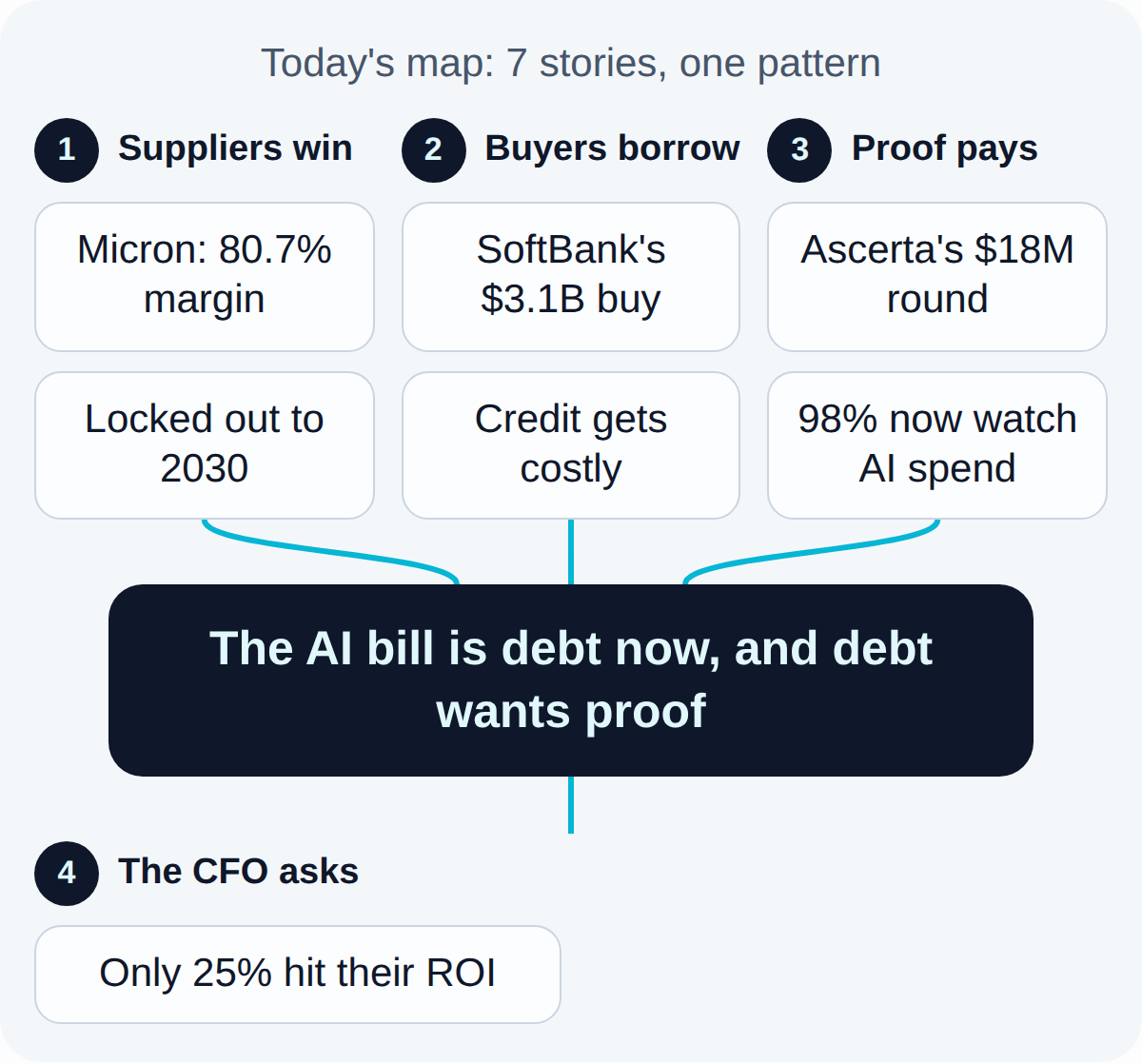
Friday, and I keep coming back to one number that was buried inside a funding announcement nobody read. Twenty-five percent. That is the share of AI initiatives that returned what they promised, out of two thousand chief executives IBM asked. We scanned 190,000 articles this week so you don't have to. In the same forty-eight hours Micron posted an 80.7% operating margin selling memory into the buildout, SoftBank closed its $3.1 billion DigitalBridge purchase, and AI borrowers hit resistance in the riskier corners of the US credit market. So the suppliers are taking the margin, the buyers are borrowing to pay them, and three quarters of the projects are not returning what they were sold on. That used to be a slide problem.
The Bottom Line: Equity never asked when the money comes back. Debt always does, and most AI programmes have no answer written down.
 | Yves' take |
AI is maturing into business valuation. Playtime is over. Remember big data and data science, 16 years ago? Big Data teams experimented for 2-3 years with nothing in production. Then investors and executives got nervous. The same pattern is showing up right now for AI. The same foundational data issues show up again. It's "show me the money"-time.
Advertisement
AI research, explained in one morning email

Most of what shapes AI next year is sitting in a research paper today. Keeping up with them is a full-time job, and the abstracts don't help.
TLDR AI is the newsletter that does the translating. Each morning you get the handful of papers worth knowing about, curated by Anthropic and ex-Google engineers, with a plain-English summary of what they found and why it matters.
You come away smarter about AI research in the time it takes to finish your coffee.
Free, and delivered to 1.1M+ inboxes every morning.
 The Tracks That Matter
1. Micron Made 80 Cents On The Dollar And The Shares Went Flat
Micron's fourth quarter landed at $54.23 billion of revenue with operating profit up 1,097% year on year to $43.75 billion, an 80.7% operating margin. Read that margin for what it is: the memory supplier is capturing most of the value created by everyone else's AI ambition. Then look past the headline at the part that actually binds you. Its long-term supply contracts went from sixteen to twenty-six and now cover over 35% of projected revenue through 2030, and analysts working through the quarter say visibility now extends to 2028 with supply tighter than this year. The shares went flat after hours anyway. The market has already priced the boom. The supplier has already priced your next four years.
Here's what works: Check whether your compute and memory pricing is contracted or spot. The firms locking multi-year supply now are buying certainty you will pay a premium for later.
2. The Buildout Is On Credit, And The Lenders Just Got Picky
SoftBank completed its $3.1 billion purchase of DigitalBridge, adding a data-centre investment manager to a balance sheet already carrying its Stargate commitments. In the same window AI borrowers found a tough sell in the riskier parts of the US credit market, where the people lending at high yield want to know how much cash is coming, when, and what the odds are that it does not arrive. That is a different question from the one equity asked for three years. Equity bought the story. Credit buys the schedule. The effect lands on you one step downstream: when your vendor's capital gets more expensive, the price of the thing you buy from them stops being a negotiation and becomes a pass-through.
Here's what works: Ask your AI vendors how their buildout is financed and when that debt matures. A vendor refinancing next year is a vendor repricing your contract next year.
3. Someone Raised $18 Million Just To Prove AI Spend Pays Off
Ascerta, founded in 2024 by three former Microsoft engineers, raised an $18 million Series A led by Dell Technologies Capital, with Hitachi Ventures, BGV and Wipro Ventures in the round. The product does one unglamorous thing: tie AI spending to a business number. That round only makes sense next to a statistic in the same announcement, which is that the FinOps Foundation found the share of practitioners managing AI spend went from 31% in 2024 to 98% this year. IBM's own research puts the transformation case on the CFO's desk. Nobody funds a proof layer while the money is still easy. They fund it the quarter after someone senior asks what the last two years bought.
Here's what works: Write down the one business number your AI programme is meant to move, and the person who owns it. If no name fits, you have a pilot, not a programme.
Quick hits:
- The Senate picked up AI liability. The argument over who pays when a model causes harm reached the Senate the same day a new frontier model shipped, so your indemnity clause is about to be rewritten by statute instead of by your lawyers.
- AI infrastructure is now in retirement money. Morningstar flagged AI infrastructure entering retirement portfolios through private funds, which moves the buildout's downside onto people who never chose the risk.
- A lab watermarked something alive. Google DeepMind watermarked an AI-generated protein while its chief scientist called biosecurity the urgent problem of the era: provenance tracking, applied where your lineage tools cannot reach.
Advertisement
When Postgres analytics slow down, most teams add a second database. Then comes sync lag and drift. TimescaleDB extends Postgres instead: analytics on live data, no pipeline. Get $1000 to start.
Your Turn
Which of today's three reads do you think is wrong?
One tap. No wrong answers.
 Signal vs. Noise
🟢 Signal: the risk desk joined the AI purchase. Risk management and risk assessment both gained real weight across the industry this week, and the concrete version is lenders demanding a cash-flow schedule from AI borrowers while CFOs take the return case off the CIO. Most coverage filed both as finance stories and missed that they are now procurement gates.
🔴 Noise: ”agentic AI” as a label. It pulled some of the heaviest volume of the week while its grip on everything else that moved slipped. Teams still buying against the word, rather than against a named workflow with a named owner, are shopping with last year's vocabulary.
 From the 190K
We scanned 190,000 articles this week. Here's what no one's talking about:
Armadin raised $255.5 million to hunt software flaws with swarms of agents, Ascerta raised $18 million to prove which AI spend pays off, and an outside evaluator called Vals appeared for the first time inside the launch coverage of Google's newest frontier model, all inside one 24-hour window.
The security press reads the first as a funding round. The enterprise-tech desk reads the second as cost tooling. The model watchers barely register the third, because an evaluator's name in a launch write-up looks like a footnote. Read them on the same morning and they are one market: capital is moving into the business of checking a claim rather than making one. Three companies, three different claims, and one buyer sitting behind all of them, which is whoever has to sign.
On Monday, find out who verifies your largest AI vendor's performance claim. If the answer is the vendor, that is not a verification, it is a brochure.
Advertisement
For product teams moving at AI speed.

AI makes it easier to ship anything, even bad ideas. The hard part is knowing which ideas are worth building.
Jira Product Discovery brings your ideas, customer insights, and priorities into one place, so your team can decide what to ship and move forward with confidence.
Capture ideas, prioritize with evidence, and build living roadmaps your team can rally around—all while staying connected to delivery in Jira, so everyone can see what’s being built and why.
Better product decisions in the AI era.
 By The Numbers
- Only 25% of AI initiatives delivered the expected return — IBM asked 2,000 chief executives about the last three years, which leaves three quarters of the spend unproven rather than merely slow.
- Micron's operating profit rose 1,097% to $43.75 billion — an 80.7% operating margin on $54.23 billion of revenue, and the shares still went flat after hours.
- FinOps practitioners managing AI spend went from 31% to 98% in two years — the FinOps Foundation's 2026 survey, which is what a cost problem looks like once it stops being optional.
- Armadin raised $255.5 million for agent swarms that find vulnerabilities — Andreessen Horowitz and Accel led, with Kleiner Perkins and Menlo Ventures in the round.
- SoftBank completed a $3.1 billion acquisition of DigitalBridge — a data-centre investment manager bought outright, which shows where the next tranche of buildout capital is being assembled.
- ElevenLabs reached a $22 billion valuation in a $300 million employee tender — a secondary sale rather than a primary round, so that number is what insiders will actually transact at.
- See what's rising across AI and data this week →
 Deep Dive: When The Money Starts Asking Questions
Years back, on a programme I was working, the salesman from the implementation side announced he had landed a unique sales channel agreement with the technology vendor. I had known that vendor far longer, and at that moment I held the same agreement myself, with my own access to their partner portal. When he said they were unique, I laughed. The claim cost nothing to make and thirty seconds to check, and nobody in that room had checked it.
Equity funds a story, debt funds a schedule
For three years the money behind AI was equity, and equity is patient by design. It buys the narrative and waits. Debt is not patient. It has a coupon date, so the lender asks how much cash is coming and when. Once the funding mix shifts, the question your vendor gets asked changes, and shortly after that, so does yours.
The proof layer is being built by somebody else
Twenty-six long-term supply contracts at a memory maker. Eighteen million dollars to tie AI spend to a business number. A quarter of a billion for agents that audit software. Every one of those is an instrument for making a claim checkable, and not one was funded by the people making the claims. That is the most useful thing about them.
Three quarters is the real number
Only a quarter of initiatives returned what they promised. That is less an AI problem than a specification problem: most of those programmes never named the number they were supposed to move, so there was nothing to measure against. A project with no target cannot fail, which is exactly why it keeps getting renewed and never shows up as a win.
What Actually Works
- Name the number before the tool: one business metric per AI programme, written down, with a named owner. Unnamed targets are why three quarters read as misses.
- Check the financing behind the price: ask every AI vendor how the buildout is funded and when the debt matures. That date is your repricing date.
- Buy verification you control: an evaluation or an audit trail you can run yourself. A vendor dashboard is not evidence you can produce.
- Contract the supply, not the enthusiasm: where compute or memory is load bearing, get multi-year pricing while the supplier still wants your logo.
Anybody can claim they have the best sound system in the country. You find out at the first bass drop, and by then you have already sold the tickets.
 What's Coming
Metadata Becomes The Bottleneck Nobody Budgeted For
The execution gap is a metadata gap argues that AI programmes stall on the absence of description around the data, not on the models. Which means the next slice of AI budget goes to something no board finds exciting, and the teams who quietly did it in 2025 will look like geniuses in 2027.
Data Foundations Turn Into A Duty Of Care
Asset managers are being told to strengthen their AI data foundations, which in a regulated firm is not an IT recommendation. It is the opening move in a fiduciary argument. Expect the same framing in insurance and pensions inside two quarters.
Frontier Models Start Competing On Price
A new Google model undercut OpenAI and Anthropic on price. Once frontier capability competes on price rather than on benchmark position, model choice becomes a procurement decision, and your switching cost becomes the only number that matters.
 For Your Team
Monday's meeting prompt: ”If a lender asked us today how much cash our AI programme will produce and when, what exactly would we hand them?”
Share-worthy stat: IBM asked 2,000 chief executives, and only 25% of their AI initiatives returned what was promised. Over the same two years, the share of finance people managing AI spend went from 31% to 98%. The auditors arrived before the returns did.
 The Track of the Day
”High yield people like to know how much cash flow is coming, when that cash flow is coming, and what the probability that the cash flow doesn't come.”
Larry Holzenthaler, on why AI borrowers are paying up
Three clauses, one question, asked by somebody who gets paid to be right about it. Equity clapped for two years. The lender just asked for the setlist.
We scanned 190,000 articles this week so you don't have to. Data Pains → Business Gains.
Published: October 2, 2026 | Curated by Yves Mulkers @ Ins7ghts
1,300+ articles scanned. 7 stories selected. Our AI distills the noise into signal—in seconds. Get early access →
Know someone who'd find this useful? Share your unique referral link →
Want Your Own AI Intelligence Briefing?
Our platform analyzes 1,000+ sources daily and delivers personalized insights in seconds.
Join the Waitlist →Founding members: Lifetime discount • Priority access • Shape the product