

Sponsored by

The expensive part is not the model.
Monday gave me three things and none of them is a model. One chip company put $115 billion of its own shares on optical parts. Another gave away the layer that tells an agent what your tables mean. A third is selling more of the plain server processor than it can keep up with.
Advertisement
A CRM so smart, it updates itself.

HubSpot's CRM is so smart, it now updates itself. Calls get logged and summarized the moment they end. New leads get researched and a first outreach drafted, automatically. Deals move forward on their own, with next steps flagged before you have to ask.
Even the one repetitive task you've been meaning to fix can now run itself, no code required. Customers using it are already seeing the difference.
This isn't the CRM you have to work hard to figure out. It's the one already working before you log in.
1. Marvell is paying $115 billion in shares for the light between the racks
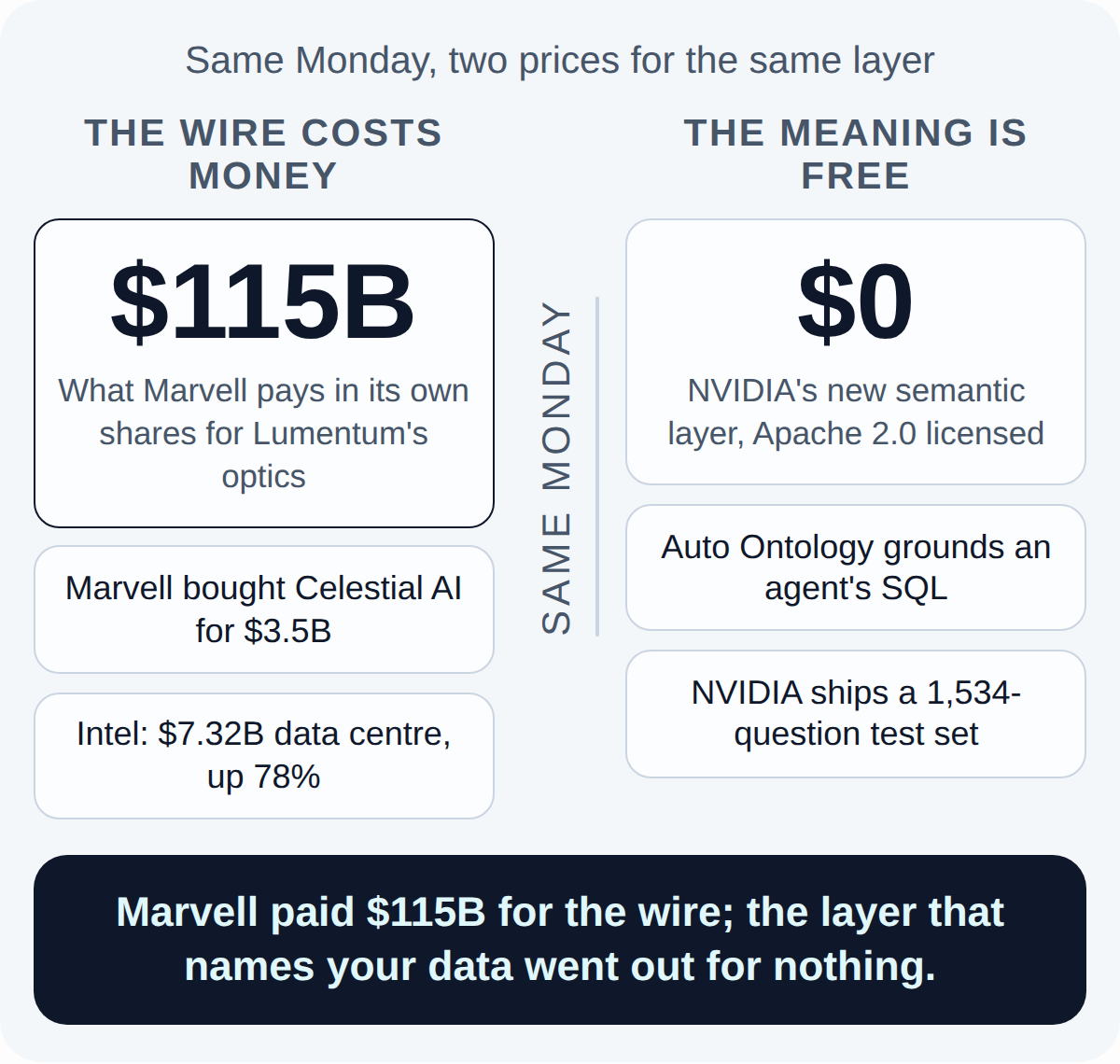
Marvell has a definitive agreement to buy Lumentum, the optical components maker, in an all-stock transaction worth about $115 billion including debt. It runs at a fixed ratio, Marvell shares handed over for Lumentum shares, at an implied enterprise value of $115 billion. The two describe what comes out of it as a category leader in AI connectivity.
No cash leaves the building. All of it is paid in Marvell stock.
Marvell has been collecting this layer for a month. A deal report on 22 October has it announcing a $3.5 billion acquisition of Celestial AI, and a write-up on 28 October has that company's photonic fabric and co-packaged optics folded in, next to a warrant-backed partnership with Google. The Lumentum talks were reported as advanced on 31 October.
What I keep looking at is the payment method. Handing over paper in a week when AI-linked shares were being marked down says Marvell expects the squeeze on moving data between racks to outlast the market's nerves, and on that I think it is right. The part that lands on buyers is different: when one company owns the switch silicon and the optics on both sides of it, getting data across a hall stops being something you can put out to tender. I would start asking now what interconnect assumption sits behind a 2027 capacity quote, rather than after the quote arrives.
2. NVIDIA gave away the layer that tells an agent what your data means
NVIDIA released Auto Ontology, an open library under the Apache 2.0 licence. It reads enterprise metadata and builds a semantic layer out of it, so an agent generating SQL lands on certified business definitions instead of guessing from column names.
It arrives with its own exam attached. The evaluation harness bundles:
- BIRD Dev, 1,534 questions across 11 databases
- Mini-Dev, 500 questions
- FDABench-Lite, 169 questions
- a 100-question sample from BEAVER
So the most generous vendor in your data stack turns out to be a chip company. The part I do not buy is that the SQL was ever the hard bit. Deriving a definition from metadata is cheap. What eats months is arguing over which definition of “active customer” finance will put its name to. Hand that to a generator and you get confident answers to questions nobody has settled, which is the kind of wrong that reads as fine for two quarters. I would keep the ontology and drop the word certified from it until a person with a budget has signed each definition.
Advertisement
Your GTM Has a Weak Spot. Find It.

Your go-to-market feels stuck. Most of the time, nothing is broken. One or two things are just quietly costing you momentum.
Drop your URL. The free GTM Audit reads your site, pricing, and competitors, scores four dimensions, and hands you a 90-day fix list.
10 minutes. No guessing.
3. Intel's dull chip is the one it cannot make fast enough
Intel's third quarter came in at $16.51 billion, up 21% on the year, with the data centre and AI line at $7.32 billion, up 78%, and foundry at $6.70 billion, up 58%. The title over those numbers is the finding: Xeon demand is testing what Intel can supply.
The other half of the same release is grim. Intel guided the current quarter to $15 to 16 billion, about 9.1% under the $17.05 billion analysts carried, expects industry PC units to fall around 10% in 2027, and puts the Fab 28 shutdown at roughly $300 million of revenue and 200 basis points of gross margin.
That demand is being tied up before it reaches anyone's purchase order. On 27 October Intel and Oracle announced a multiyear collaboration to expand Xeon-based computing on Oracle Cloud Infrastructure, and the same partnership is repeated inside the quarterly release. Two weeks before that, at the Open Compute Project summit, it showed Xeon rack designs and a GPU D-series for inference.
Every conversation I have about AI capacity is about accelerators, and then the project slips on the ordinary server that has to sit beside them. Intel's two halves say that out loud: a server line growing 78% with supply as its constraint, against a PC business it expects to shrink. By early 2027 I think people will be complaining about lead times on plain compute instead of GPU allocation. Go look at your own 2027 plan: if it assumes a refresh nobody has ordered, you are in the group that gets caught.
Advertisement
Unlock up to $2 million licensing your company data

Have a business larger than 20 people that lives on Slack and is older than a year? Companies like Micro1 want to pay $100k - $2 million to license your data. They anonymize it and then use it to train the next set of frontier AI models.
Also today
- Fox Corporation picked Databricks as the strategic partner for its next data and AI platform. (3 min read)
- A malicious Claude Code extension was served through Cursor in a supply chain attack. (1 min read)
- Google put a $250,000 reward on a root-level break-in of its cloud. (1 min read)
First MoveThe layer everybody treats as wallpaper
Some nights did not work, and it was not the records. I had been hired as “a DJ”, which in practice meant wallpaper: a jukebox with a human attached, there to hold the room at a pleasant volume. Other nights ended on the owner or a neighbour complaining about that volume.
The parts of a data centre that only matter when they run out don't get written about, they get treated like wallpaper. Marvell just paid $115 billion for one of those parts, a month after paying $3.5 billion for the piece that makes the number defensible.
Which of your suppliers is being treated as wallpaper, and what breaks in your plan if somebody buys it?
My call: before 31 March 2027, another optical or interconnect supplier is taken off the market by a chip or networking company, and it gets paid for in shares rather than cash.
If the expensive part of your own stack turned out to be something other than the model, hit reply and tell me.
Yves
Tomorrow, Reality Check: a claim everyone repeats, held against what actually happened.
Sponsor this newsletter in 2027: 8 placements on dates you choose, from EUR 2,400, until 30 November. Book: 7wdata.be/sponsor-2027
Ins7ghts Daily is published by 7wData.