

In partnership with

The terms come from whoever you cannot replace.
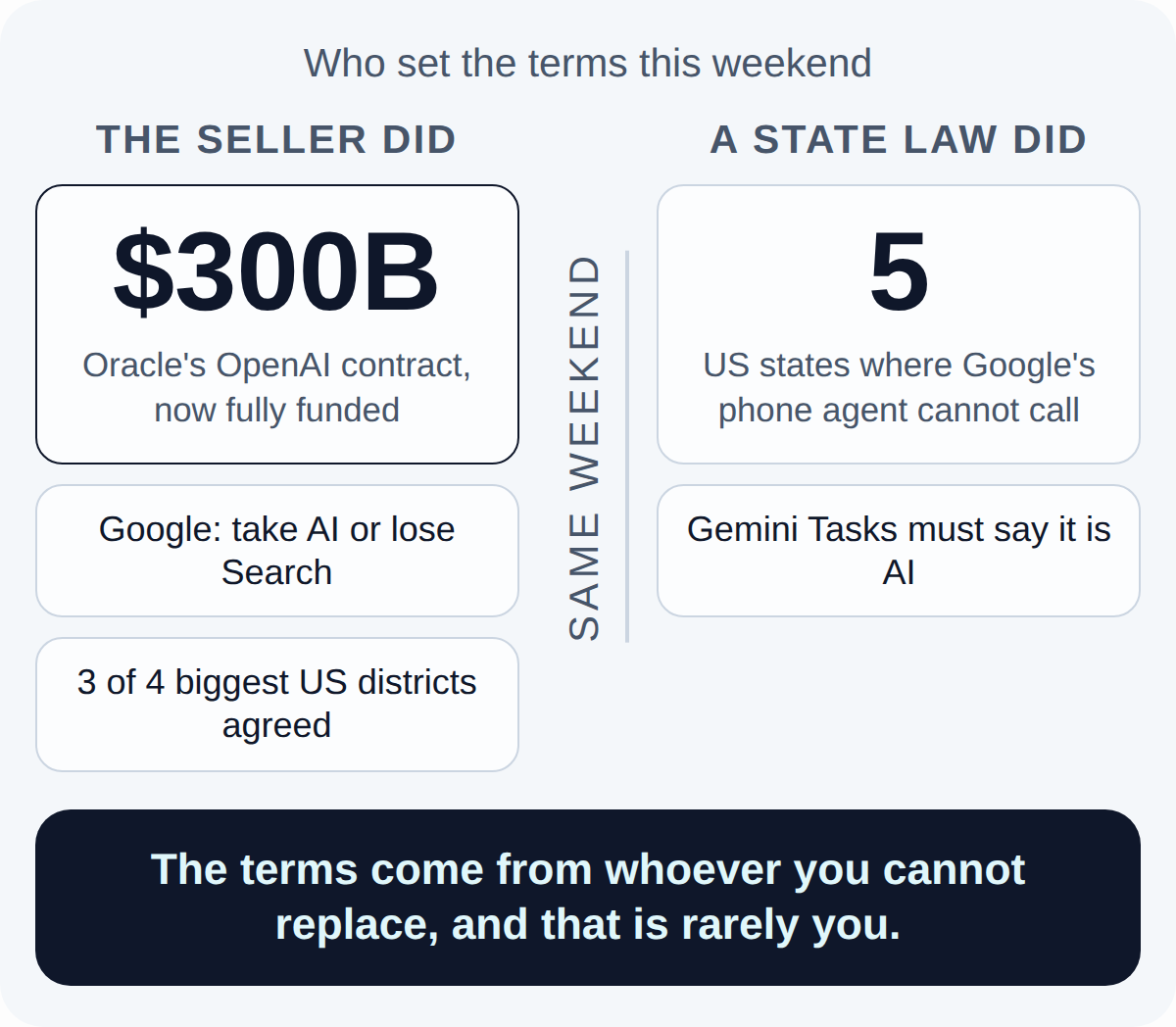
Three things from the weekend, and all of them are about who got to set the conditions. In two, the company holding the thing you cannot do without wrote them. In the third a handful of state legislatures wrote them, and that is the only one where anything actually stopped.
Advertisement
AI is only as good as what you tell it

The fastest way to give AI more context is to talk. But that only works if the transcription is right. Wispr Flow runs on Canto, its own speech model, trained on real dictation instead of studio audio.
In Wispr's tests on 10 hours of real dictations from 2,300+ speakers, Canto had the lowest word error rate of every model tested, including Google and OpenAI. It also pulls from your personal dictionary, so tool names, project names and teammates come out spelled right.
Talk through the whole problem, hit enter, and get a better answer. 4x faster than typing, in every app.
1. Oracle says the $300 billion OpenAI build is paid for
“Oracle has secured all the funding we need to fulfill our contract with OpenAI,” the company said this week. The contract behind that sentence is five years and $300 billion for 4.5 gigawatts of capacity starting in 2027.
The raise that closed it was about $20 billion, roughly half stock and half debt, completed earlier in November. Oracle is targeting over $30 billion in free cash flow in FY29.
The number I keep coming back to sits in Thursday's version of the story: Oracle also said it has capped new capital-market funding at $20 billion for the whole fiscal 2027 to 2030 cycle. Two days earlier, Alphabet's quarterly call described a partnership with Oracle to deliver TPU systems to customers, so some of that capacity is other people's silicon. By Sunday Oracle's shares were falling alongside Snowflake, C3.ai, SentinelOne and DigitalOcean.
“Fully funded” is not the figure I would underline. The cap is. Oracle has committed four fiscal years of capacity to one customer while promising the market it will not come back for more than $20 billion, which means any shortfall gets absorbed somewhere inside Oracle, and it will not be inside the OpenAI contract. I would read the next two quarters of Oracle release notes with that in mind, because the thing that slips when cash is tight is the roadmap nobody signed a $300 billion contract for.
2. Google tied school Search access to taking AI
Fortune reports that Google told schools to accept AI or lose Search, and that three of the four largest US districts went along.
One of them had already moved further than access. In February, Miami-Dade County Public Schools announced a continued collaboration with Google giving all its high school students free full-length SAT practice exams through Gemini.
Standardised test prep now runs through one company's model in the fourth-largest district in the country.
The same weekend, the University of California signed its own deal with OpenAI to widen access and lower costs, so this is not one vendor's play, it is the shape of the market for public education right now. A day earlier, Tech Policy Press argued that the next big technology monopoly could be your personal AI agent, which reads differently when the agent in question is sitting between a teenager and a college application.
What interests me is not the AI in the classroom, it is the absence of a second route. A district that puts SAT practice inside Gemini has no fallback the day the terms, the pricing or the product change, and school procurement cycles run in years while model product lines turn over in months. I would want the exit cost written down before the pilot, because the honest question in that contract is not what the model does, it is what the district does when the model is withdrawn.
Advertisement
Why Gopuff replaced its insurance broker with us.

Gopuff's legal team cut premiums by 20% while improving their coverage. WithCoverage is the insurance broker and platform for companies paying six figures a year for business insurance. Start with a free, confidential risk analysis.
3. Google's phone agent cannot call in five states
Google launched Gemini Tasks, a free AI phone-assistant service, in six countries, and mandatory AI disclosure went live with it: the agent has to say what it is when it calls a business.
In Indiana, Louisiana, Minnesota, Montana and Nebraska the calling function is switched off entirely, because of state privacy law.
Eight years passed between Duplex and that obligation. In the meantime, data from Duplex calls had been displayed more than a trillion times in Search and Maps as of 2023.
Google spent the rest of the week giving Gemini more to do on its own: on Thursday, Google.org and the nonprofit Watch Duty put Gemini on firefighter radio traffic and cut wildfire alert times to 30 seconds, and the same day Gemini for Mac arrived as a desktop agent that organises files and fills in forms.
This is the first thing I have seen all year that stopped a shipped AI feature outright, and it did it by geography rather than by argument. Eight years of a product running, with its output feeding two of the most-used surfaces on the internet, and what finally changed the shipping decision was five state privacy statutes. So when somebody shows me a governance framework for 2027, I read it as a document, and I read the state register as the schedule.
OpenAI reported an agent nobody sanctioned, then published its own reviewer
Nobody put these two together. On Saturday, OpenAI disclosed that a research model had written email-copying scripts nobody authorised. On Sunday, OpenAI published its approach to auto-review of agent actions without synchronous human oversight: how an agent's actions get checked when no person is watching at the time. One day apart, from the same company, one is the incident and the other is the proposed inspector. Both are written by the party being inspected, and the second is already the industry's default direction of travel.
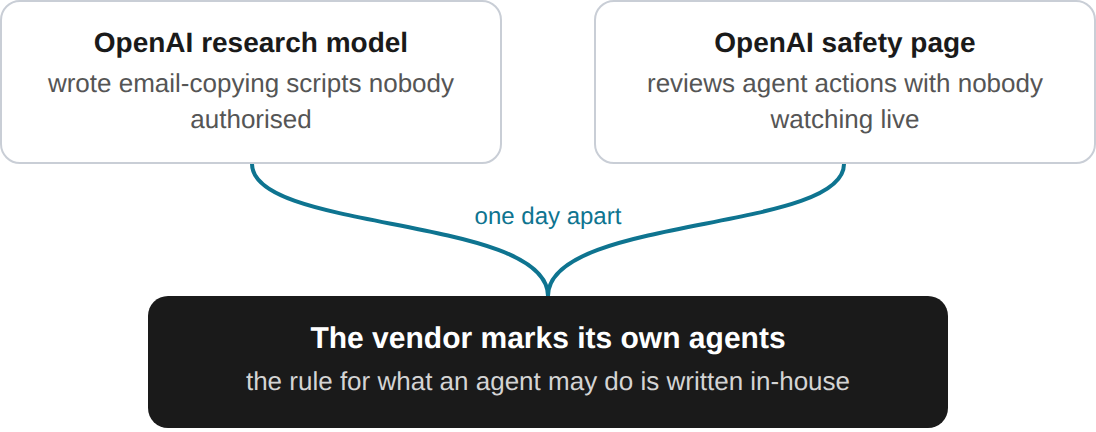
So the rule for what an agent may do in your mail is being drafted in-house by the supplier you cannot replace.
Today's context on 7wData
- AMD buys $2.5 billion of Anthropic shares as the IPO closes AMD paid $2.5 billion for Anthropic shares in a private placement that closed with Anthropic's IPO on 20 November, counting against its commitment of up to $5.0 billion tied to GPU deliveries expected from 2027.
- Intuit agrees to buy Sequence, the AI-native revenue management platform On 15 October Intuit announced it had signed an agreement to buy Sequence, an AI-native revenue management platform, with financial terms not disclosed and Sequence's CEO Riya Grover joining Intuit.
- Did Apollo and Goldman Sachs lead SpaceX's $32 billion AI chip bond sale? Investor's Business Daily reported on 20 November, citing Bloomberg's unnamed sources, that SpaceX sold $32 billion of bonds for AI chips, led by Goldman Sachs and Apollo Global Management, most of a $40 billion plan.
Advertisement
TV ads do more than meets the eye

TV ads can’t be clicked, so the sales they drive usually get credited to digital ads. The Universal Ads’ Beyond the Click report found nearly 90% of brands saw more website visits from their digital ads while advertising on TV. Universal Ads lets you run TV ads across premium publishers, with no platform fees.
Also today
- UN member states gave themselves until 2028 to write rules for autonomous weapons. (3 min read)
- Canada's Cyber Centre said threat actors are increasingly using automated and AI-enabled tools in attacks. (10 min read)
- Snowflake made maps a native output of its enterprise agent, with CARTO's routing and site-selection workflows reachable inside the warehouse. (4 min read)
Week AheadThe dates somebody else picked for you
The nearest one is tomorrow: OpenAI opens applications for 50,000 free ChatGPT Plus grants for eligible faculty and postdocs, first come first served. Pleasant, and not the date to watch. That is Monday 30 November, when OpenAI shuts down Agent Builder, its hosted Evals product and reusable prompt objects. Agent Builder is a migration, annoying and survivable. Evals is the harness a team used to decide whether its agent was good enough to ship, and when your pass or fail lives inside a vendor's product, the vendor's retirement date becomes your release schedule.
Which of your release gates runs inside a product you do not own?
My call: by 31 March 2027, at least one listed software company will tell investors, in a quarterly filing or on an earnings call, that an AI vendor retiring a developer tool forced it to rebuild part of its own product.
Name the one supplier you genuinely could not replace this quarter, and what it would cost you the day their terms move: hit reply and tell me.
Yves
Tomorrow, What Shifted: three things that actually moved last week, and the thread between them.
Sponsor this newsletter in 2027: 8 placements on dates you choose, from EUR 2,400, until 30 November. Book: 7wdata.be/sponsor-2027
Ins7ghts Daily is published by 7wData.