

Sponsored by

Almost nobody owns the machine they run on.
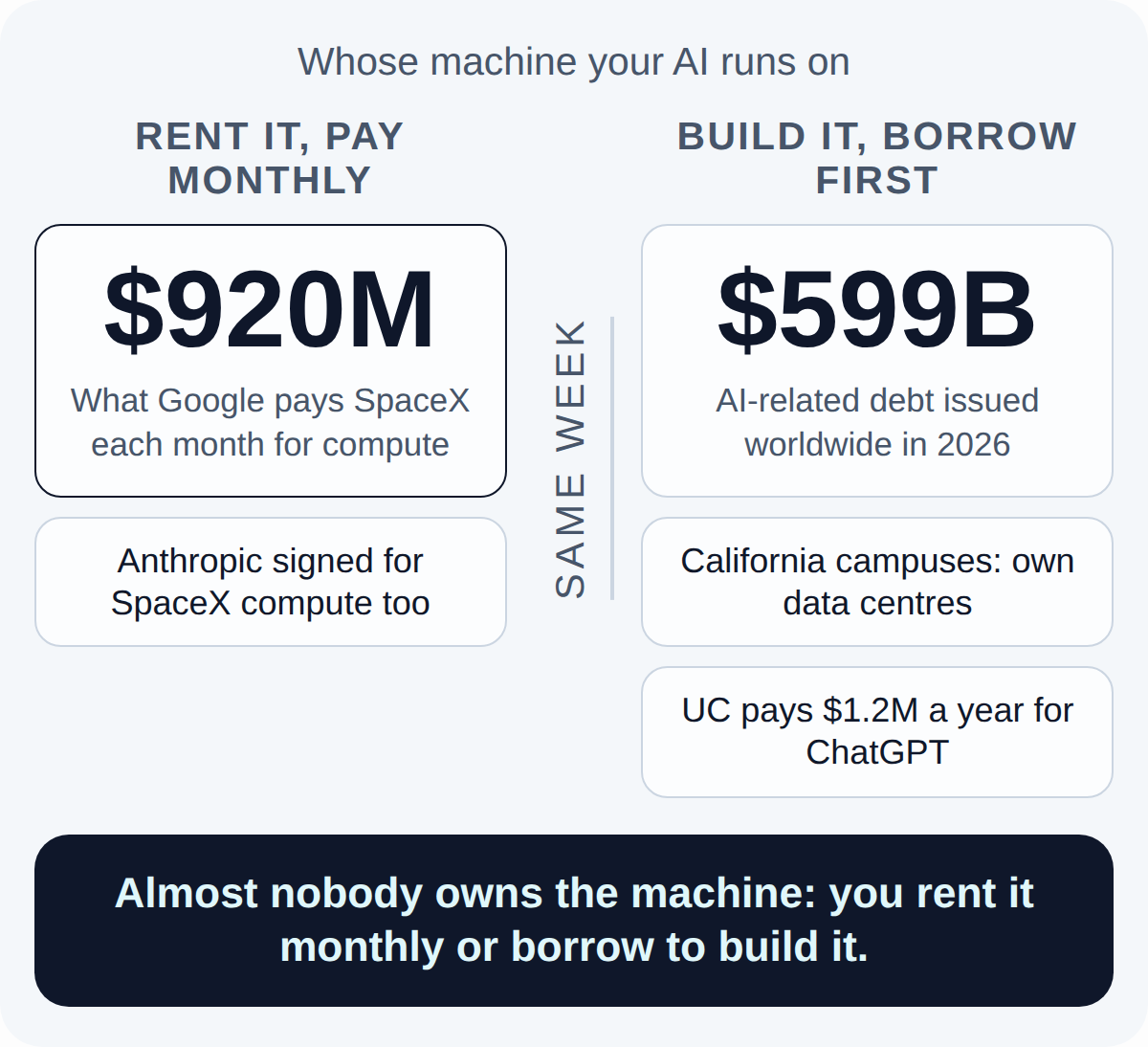
Three pieces from yesterday sit on one question: whose machine is your AI actually running on. Google's answer turns out to be Musk's, at $920 million a month. California's public universities, after a month of arguing about a vendor contract, answered it by going and building.
Advertisement
A CRM so smart, it updates itself.

HubSpot's CRM is so smart, it now updates itself. Calls get logged and summarized the moment they end. New leads get researched and a first outreach drafted, automatically. Deals move forward on their own, with next steps flagged before you have to ask.
Even the one repetitive task you've been meaning to fix can now run itself, no code required. Customers using it are already seeing the difference.
This isn't the CRM you have to work hard to figure out. It's the one already working before you log in.
1. Google pays SpaceX $920 million a month for compute
Elon Musk said on Friday that Google has expressed interest in renting more AI computing power from SpaceX (The Hill).
Underneath all of that a deal is already running: Google pays SpaceX around $920 million a month for compute capacity, on a multi-year cloud services agreement. Anthropic reached a deal for SpaceX compute as well (CNBC).
What SpaceX has to rent out got a good deal larger this week. On 26 November the United States authorised SpaceX to deploy up to a million satellites carrying AI data centres (CNN). We wrote on 21 November about Google's own plan to put AI hardware in orbit.
That payment keeps nagging at me. Nine hundred and twenty million dollars a month is rent, and rent is set by whoever owns the building. Google can carry that number without blinking. The morning the terms move, though, it has no way to price that, and neither does anyone buying capacity two layers below it. Sizing a compute commitment this quarter, I would spend less time on the per-hour rate and more on the notice period, because the exit is the only part of this arrangement a buyer actually owns.
2. AI borrowing hit a record $599 billion this year
Global AI-related debt issuance has reached $599 billion so far in 2026, more than double the full-year record set in 2025. In 2023 the figure was about $130 billion, roughly a fifth of this year's (Crypto Briefing).
The buy side is writing down how to read it. T. Rowe Price published a framework for evaluating data centre bonds on 28 November (T. Rowe Price), and on 25 November CNBC was already asking what the debt load does to Big Tech's spending plans (CNBC). We wrote on 26 November that JPMorgan expects around $450 billion of AI-related issuance in 2027. This year's figure landed first, and it is bigger.
Debt is the one part of this build that comes with a calendar. Interest is due whether or not the agent you shipped in March is earning anything, and the only place a lender's schedule can be recovered is in what tenants pay. So I expect the squeeze to show up as a packaging change on somebody's cloud invoice well before it shows up as a story about a lender in trouble. What I would check, on cost control, is which AI line items sit on terms that can be repriced inside the year.
Advertisement
When Postgres analytics slows down, most teams add a second database. TimescaleDB keeps it all in Postgres: same SQL, same tools, no second database to feed. Get $1000 credit.
3. California's campuses are building their own AI data centres
California's public universities are setting up AI data centres of their own. About twenty community college districts, along with University of California and Cal State campuses, already reach shared AI computing through CalREN, the network the systems run between themselves.
In the same report: roughly 4,000 people, faculty included, have signed a petition asking Cal State chancellor Mildred García to end the system's contract with OpenAI, citing reliability and source verification in ChatGPT Edu (Davis Enterprise).
The contract they are objecting to has been in local coverage all month. On 21 November the $1.2 million-a-year OpenAI partnership was reported (New York Post), on 23 November faculty called the deal unwise (LAist), and on 25 November the annual spend was set against that opposition (University Herald).
The compute came first and the argument about the contract came second, and a campus that can hand a researcher its own hardware has room to argue about whose model sits in front of a student. That is ownership, and they paid for it out of capital spending, which is slow and out of fashion. Over four years it is still cheaper than a renewal you cannot get out of. I think more public buyers land in the same place during 2027, and the ones that do not will find their AI policy written in a supplier's release notes.
Advertisement
Stop typing AI prompts. Start talking.

You think 4x faster than you type. So why are you typing prompts? Wispr Flow turns your voice into ready-to-paste text inside any AI tool. Speak naturally, tangents and all, and Flow cleans it up. Available on Mac, Windows, iPhone, and Android.
Also today
- Portland is considering a yearlong moratorium on new AI software across city government (OPB). (2 min read)
- Data centre investment across Asia Pacific is slowing under US chip control pressure (ETCIO). (2 min read)
- Amazon agreed to acquire Decart's AI technology in a deal reported at $7.5 billion (Latin Times). (5 min read)
Week AheadThree dates nobody at your company chose
Tomorrow is the nearest one. OpenAI shuts down Agent Builder, its hosted Evals product and reusable prompt objects, a date we wrote about on 22 November. What is new since is pressure on retirement dates themselves: on OpenAI's own forum, paying users are asking it to restore GPT-5.5 and keep GPT-5.6 available for demanding professional work, so the thing to watch on Monday is whether a published shutdown date holds when the customers who paid for it push back.
Which of next week's dates did a supplier pick for you, and when did you find out?
My call: by 30 June 2027, at least one of the five largest enterprise software vendors will publish a list price per agent, separate from its price per user.
If you know what your AI stack would cost you to leave, not to run, hit reply and tell me.
Yves
Tomorrow, What Shifted: three things that actually moved last week, and the thread between them.
Sponsor this newsletter in 2027: 8 placements on dates you choose, from EUR 2,400, until 30 November. Book: 7wdata.be/sponsor-2027
Ins7ghts Daily is published by 7wData.