

Sponsored by

The money moved from the model to the room it runs in.
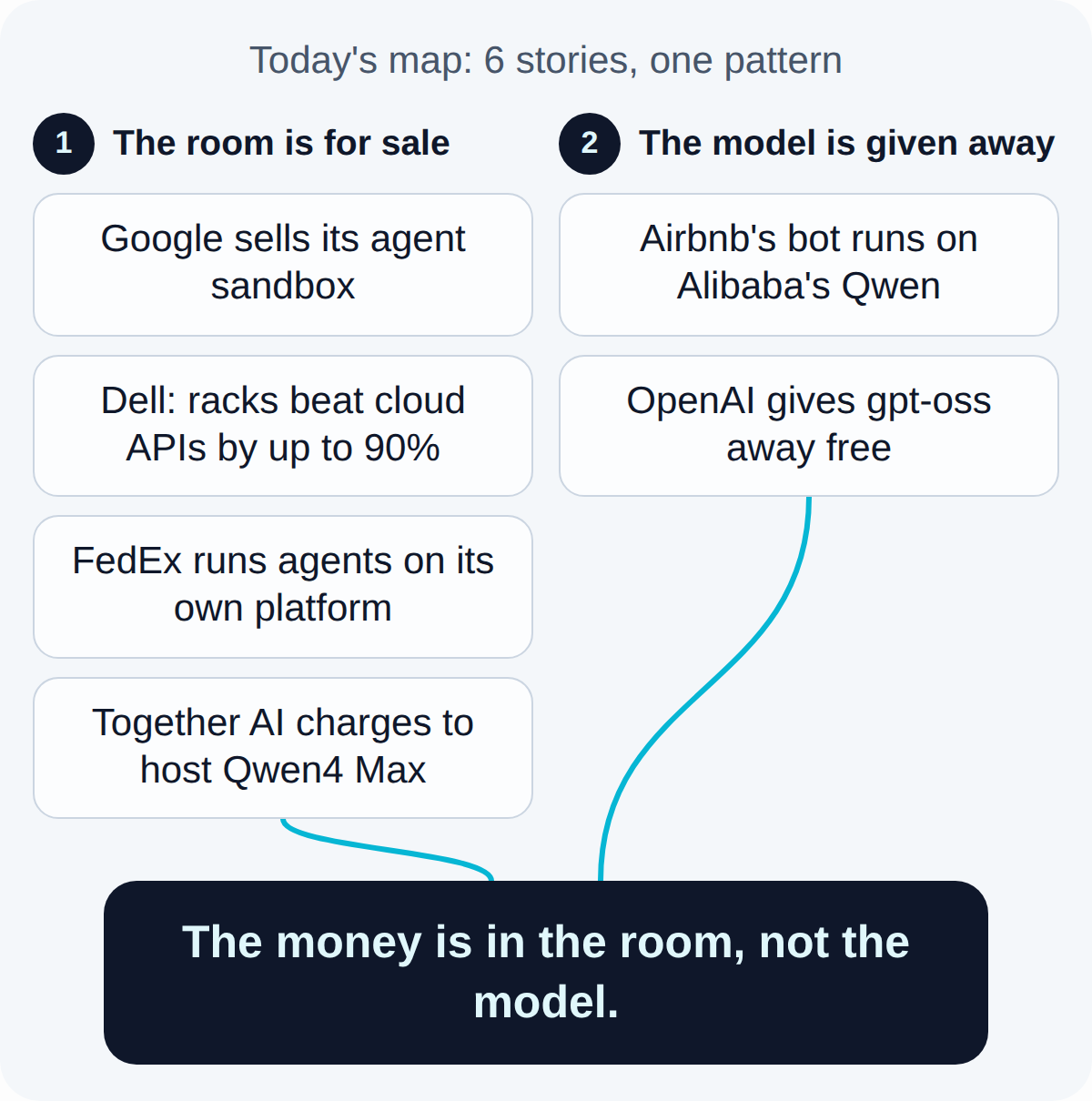
Three things landed over the weekend and none of them is about a model getting better. Google put the runtime it uses for Gemini on sale. Dell published a two-year cost case for running the same agent work on hardware you own. And an Asia Times piece pointed out that Airbnb's support bot answers on a model Alibaba gives away for nothing.
Advertisement
A CRM so smart, it updates itself.

HubSpot's CRM is so smart, it now updates itself. Calls get logged and summarized the moment they end. New leads get researched and a first outreach drafted, automatically. Deals move forward on their own, with next steps flagged before you have to ask.
Even the one repetitive task you've been meaning to fix can now run itself, no code required. Customers using it are already seeing the difference.
This isn't the CRM you have to work hard to figure out. It's the one already working before you log in.
1. Google is selling the box it runs Gemini in
Google announced Agent Compute Engine, a managed service that runs AI agents in isolated microVMs and checkpoints them, so an idle agent gets suspended and restored instead of kept warm.
The part that matters is where the secrets live. Credentials, API keys and OAuth refresh tokens never enter the sandbox. An Agent Gateway outside it authenticates the request and injects what is needed. The orchestration harness sits outside too, so the untrusted guest only runs the commands it is handed and streams output back.
Four pieces carry the governance:
- Agent Gateway, traffic control and policy
- Agent Registry, the list of approved agents and tools
- Agent Identity, built on SPIFFE, for authentication and auditing
- observability that speaks OpenTelemetry
Google runs Gemini, Gemini for Business and its own Antigravity platform on it. AWS and Azure sell comparable isolated runtimes as Bedrock AgentCore and Foundry Agent Service.
Harel Asaf, an AI specialist at Elementor, pointed out that the published boot time, price and density numbers belong to the open project, not to the managed service.
Google donated that open runtime, Agent Substrate, to the Cloud Native Computing Foundation in an announcement written up on 13 November. At KubeCon on 17 November Solo.io made its own enterprise build generally available, with a gateway enforcing identity and policy on agent traffic, and on 10 November NVIDIA and Google tied OpenShell into the same substrate.
The sandbox is not the product. Google gave it away and Solo.io is already selling a supported build of it. What a team cannot put together itself in a quarter is the registry and the identity layer, the list of which agents are allowed to exist and the record of which one did the thing. I expect the isolation to end up free and the audit trail to be the invoice line, which is an odd place for a security budget to land.
2. Dell put a two-year price on running agents yourself
Dell claims up to 90% lower total cost of ownership over two years for agentic AI workloads on PowerEdge XE9780 servers with NVIDIA HGX, measured against cloud API pricing.
What it is actually selling is Dell Private Cloud for Azure Local on those servers, with Microsoft Foundry Local models running inside the customer's own environment.
One customer line in the piece does more work than the cost case. FedEx requires every AI agent to run on its own platform, registered and auditable, because its board wants an explanation ready when a regulator or a customer asks for one.
MIT Sloan Management Review's 2025 global executive survey of more than 2,000 respondents found 35% had adopted agentic AI within two years, with another 44% planning deployment in the near term.
On 19 November Microsoft said Azure Local would support NVIDIA RTX PRO 6000 Blackwell GPUs for on-premises deployments, and on 20 November Citrix said its desktop service would add private AI data protection alongside a higher desktop count per Azure subscription.
Dell's number is a two-year total measured against cloud list prices, which is the comparison that flatters Dell most, and it says nothing about the two people you now need reachable at three in the morning. The FedEx line is the one I would put in front of a board instead. Every agent on its own platform, registered, explainable on demand. That is not a cost argument, it is a custody argument, and custody is what makes owning the racks worth the trouble.
Advertisement
50 Excel Hacks That Make Spreadsheets Work For You

Most Excel users waste hours on tasks that take experts minutes. The difference is not talent. It is knowing the right shortcuts. These 50 Excel hacks from Kenji Explains cover the functions, formulas, and workflows that make spreadsheets work for you instead of against you.
Each one comes with step-by-step instructions and ready-to-use templates. Subscribe to Marketing Against the Grain and get all 50 free.
Here's what you'll get:
Time-saving shortcuts that eliminate the most common formula frustrations
Interface essentials most users never discover on their own
Game-changing functions for data analysis, automation, and visualization
Guided practice template so you can apply every hack immediately
The people who are fast in Excel are not smarter. They just stopped fighting the tool.
Get 50 Excel Hacks free when you subscribe to Marketing Against the Grain today.
3. Airbnb's support bot answers on a Chinese model
Airbnb runs its customer-service bot on Alibaba's Qwen, and it is not alone. Models from DeepSeek, Alibaba and Moonshot AI are picking up work inside US companies that want something cheaper than the American labs.
The piece says it straight out: Chinese developers give the weights away to build market share, and American cloud providers charge for the infrastructure you need to run them. OpenAI's own gpt-oss models are downloadable under Apache 2.0, so the giving away runs in both directions.
Alibaba released Qwen4 Max, a 2.4-trillion-parameter model, and Together AI put it straight onto its own serverless inference platform at an introductory rate. On 20 November Apple and Alibaba announced Qwen going into Apple Intelligence for users in China, and the same day a US House select committee published a joint investigation report arguing that China is working to make American companies dependent on Chinese models.
If the weights are free and swappable, nothing in the model layer is yours, and the question turns around: what in your stack would a competitor have to rebuild rather than download? For most teams I talk to the honest answer is the data and the evaluation set, never the model and never the prompt. That committee reads the same facts and calls it a dependency problem. For me it is a margin problem. Both of those can be true at the same time.
Today's context on 7wData
- FuriosaAI raises $620 million Series D at a $2.9 billion valuation FuriosaAI, the Korean AI inference chip maker, announced a $620 million Series D on 28 October, valuing it at $2.9 billion after the investment, with Korea's National Growth Fund as its largest investor.
- Thinking Machines Lab launches Inkling 2 Mini, an open AI model for laptops On 20 November Thinking Machines Lab, the AI lab led by Mira Murati, released Inkling 2 Mini, an open-weights AI model that runs on a 32GB Mac, while its reported $5 billion round remains unconfirmed.
- Proofpoint agrees to buy Varonis for $6.3 billion Proofpoint has signed a definitive agreement to buy Varonis, the data security company, in a deal reported at about $6.3 billion, and it is not closed yet: closing is expected in the first half of 2027.
Advertisement
Advertising in newsletters? TLDR reaches 8 million tech professionals with a 41%+ average open rate. See why marketers are taking a second look.
Also today
- An Anthropic mathematician says he has proved the Riemann hypothesis with help from Claude. (2 min read)
- Danaher and Microsoft agreed to build agent-enabled lab instruments, with the first of them planned for 2027. (2 min read)
- UBS puts global AI investment at $1.4 trillion in 2027, against $1 trillion this year. (1 min read)
What ShiftedThree rooms that set your AI bill last week
Years ago I had a residency. One night the house sound system had a broken channel and the room sounded bad enough that people complained. Early in the evening I asked the boss to call in the sound engineer. He told me to fix it myself. There was nothing to fix, it was his system. I played to the end, the night was blamed on my performance, and I lost the residency.
Last week three rooms I do not sit in decided what AI will cost me next year.
Which part of your 2027 AI budget is actually yours to decide?
My call: before the end of June 2027, at least one listed European manufacturer will state in published results that an export licence delayed an AI or data centre project.
If you moved agent work off a metered API and into your own racks this year, what actually changed on the bill? Hit reply and tell me.
Yves
Tomorrow, First Move: the company in the news, and the one right behind it that nobody covers.
Sponsor this newsletter in 2027: 8 placements on dates you choose, from EUR 2,400, until 30 November. Book: 7wdata.be/sponsor-2027
Ins7ghts Daily is published by 7wData.