

In partnership with


 So, What Actually Happened?
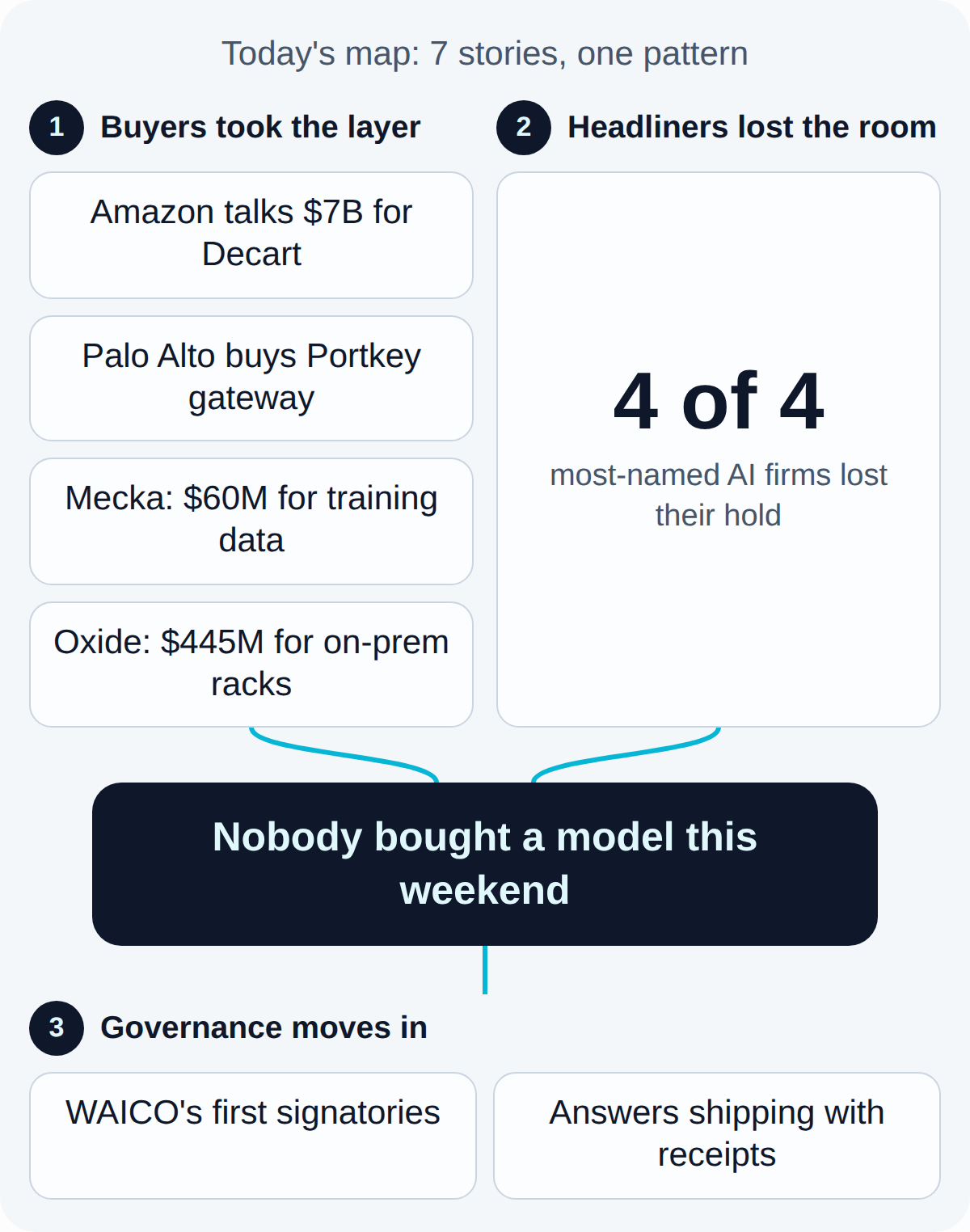
Monday, and I keep circling four deals that have nothing to do with each other. Amazon is in talks to buy Decart at around $7 billion. Palo Alto Networks bought Portkey's model gateway and folded it into a security product. Sequoia led $60 million into Mecka, which makes training data for robots. We scanned 190,000 articles this week so you don't have to. Not one of those is a model. Every one of them is a piece of the floor a model stands on. And in the same window, the four company names people say when they mean ”AI” all lost their hold on everything else moving, on falling coverage rather than rising. So the buying and the talking have come apart. The money went shopping one layer down from where everyone is pointing.
The Bottom Line: Every buyer this weekend skipped the model and paid for the thing underneath it.
 | Yves' take |
Two years ago AI models were impressive generating video, content, and fake analysis. Then we learned they hallucinate. This drove me to develop ins7ghts, focused on anti-hallucination from what is discussed online and what is moving in the AI industry. Big guys are investing in these layers because they feed model consumption.
Advertisement
Most prompting advice stops at "be specific."

What’s the key to maintaining brand integrity at scale? A lot goes into it, but the teams that get it right have one thing in common: they know how to talk to AI models.
As teams speed up and the required creative volume balloons, communication matters more than ever— both with LLMs, and with the people around you. Creative teams need to focus on ideas, concepts, craft, while technology augments their manual execution demands.
Join our discussion on this evolution with Ari Murray, Chief Digital Officer at Salt and Stone, and get 5 tips for expert LLM prompting with ready to run prompts.
 The Tracks That Matter
1. Three Buyers Put Three Prices On Decart In Ten Weeks
Amazon is in talks to buy Decart for around $7 billion, per the Wall Street Journal report Reuters picked up on Sunday. Hold that next to August, when the Tel Aviv trade press was explaining why Anthropic would pay $6 billion for the same company, and next to the $300 million Decart closed in early October with Nvidia on the cap table. Three separate parties, three price tags, one asset, ten weeks. And the asset is not a frontier model. Decart builds real-time video and world models, the kind of component that sits under somebody else's product rather than being the product. When a hyperscaler, a lab and a growth round all converge on one supplier inside a quarter, the scarce thing is not the model.
Here's what works: Sort your AI vendors into layer owners and model owners. The layer owners are the ones about to get bought and repriced around you.
2. Palo Alto Networks Bought The Pipe Your Models Talk Through
This one got written up inside a platform comparison rather than on a front page: Palo Alto Networks acquired Portkey, pulling its model gateway into the AI security portfolio. A gateway is unglamorous plumbing, and it is also the only place in your stack where every prompt, every key and every token of spend passes through one door you control. The enterprise gateway market has been accelerating on exactly that logic, and the driver is as much finance as safety: the standing advice on controlling AI token costs always ends at a chokepoint. A security vendor buying that chokepoint is how an architecture preference becomes a line in next year's questionnaire.
Here's what works: Find out this week whether your model traffic runs through one gateway or forty SDKs. Forty is not an architecture, it is a bill nobody can read.
3. Four Rivals Funded The Same Robot Data Factory
Sequoia led $60 million into Mecka at a $500 million valuation, and the cap table is the story: Nvidia, Microsoft's venture arm M12, Qualcomm Ventures and Samsung, all in one round. Those four compete on silicon and platforms nearly everywhere else. Mecka does not build robots, and it does not build robot models. It makes the training data robots learn from. The round had already appeared in a mid-week funding tally before anyone looked at who was in it. When four companies that agree on almost nothing write cheques to the same supplier, they are not betting on a winner. They are insuring access to an input each of them decided they cannot make in-house.
Here's what works: Name the one input your AI roadmap cannot buy from a second supplier. That is your actual single point of failure, and it is never the model.
Quick hits:
- The AI order got a second address. Brazil and three other Latin American states signed on as founding members of WAICO, a new World Artificial Intelligence Cooperation Organization, which means anyone selling into those markets now has two rulebooks to satisfy instead of one.
- DeepMind's own scientist downgraded its most famous result. Pushmeet Kohli said plainly that AlphaFold did not solve protein folding, a sentence worth keeping in your pocket for the next vendor who tells you a benchmark closed a problem.
- On-prem got funded at cloud prices. Oxide Computer raised $445 million at a $6 billion valuation, which is serious money for racks you own outright, and a signal about where regulated buyers want their models physically sitting.
Advertisement

Want to get the most out of ChatGPT?
ChatGPT is a superpower if you know how to use it correctly.
Discover how HubSpot's guide to AI can elevate both your productivity and creativity to get more things done.
Learn to automate tasks, enhance decision-making, and foster innovation with the power of AI.
Your Turn
Which of today's three reads matters most to your work?
 Signal vs. Noise
🟢 Signal: who has to answer for the output. Governance of AI gained more real ground this weekend than almost anything else we track, and it did it on barely more coverage than the week before, which is usually the shape that comes before a buying cycle rather than after one. The backing arrived inside 48 hours: a security vendor bought the gateway that logs model traffic, and a new international body signed its first members. Most coverage is still counting model launches.
🔴 Noise: the four names that stand in for the whole industry. Microsoft, OpenAI, Anthropic and Nvidia all lost their hold on the rest of the story this weekend, and all of them on falling coverage, not rising. The week's actual money went to a gateway, a data supplier and a rack. Reading this market as a four-horse race means reading the marquee instead of the contracts.
 From the 190K
We scanned 190,000 articles this week. Here's what no one's talking about:
A healthcare startup, an oil-and-gas advisory and a martech comparison site all shipped the same feature this weekend: an answer that arrives with its receipt attached.
Read separately they are three unrelated trade stories. One desk covers Flahy building on knowledge graphs so a clinical answer can be walked back through the records it came from. An energy consultancy describes AssureLens turning scattered drilling records into ranked, source-linked insights, with an accountability check written into the workflow before anything reaches a planner. A martech catalogue comparing 77 vendors notes almost in passing that 183 of its 184 capability claims point at the vendor's own documentation.
Nobody in those three rooms reads the other two. Put them on one morning and the shape is hard to miss: across three industries with nothing in common, the deliverable stopped being the answer and became the answer plus where it came from. That is not a compliance checkbox. It is a product decision, made independently, by people who worked out that an unsourced answer costs more to defend than it saves to produce.
On Tuesday, open the one AI output your team already shows to a customer or a regulator and ask whether a reader can get from the claim back to the record. If they can't, you are still shipping the part three other industries just stopped shipping.
Advertisement
Blu Dot surpasses 2,000% ROAS with self-serve CTV ads

Blu Dot used Roku Ads Manager to drive incredible results for its furniture sales event. Its strategy hinged on custom audiences and retargeting, where intent was strongest.
“Roku has been a top performer,” said Blu Dot’s Claire Folkestad. “We have seen…CPMs lower than any other CTV partner we've worked with.”
 By The Numbers
- Amazon in talks to buy Decart for around $7 billion — the WSJ report landed Sunday, and it prices a component company above most of the model startups that get written about daily.
- Uber agreed to buy ezCater for $2.3 billion in cash — all cash, no stock, which is what conviction looks like written onto a term sheet.
- Mecka raised $60 million at a $500 million valuation — Nvidia, M12, Qualcomm Ventures and Samsung in a single round, for robot training data rather than robots.
- Oxide Computer raised $445 million at a $6 billion valuation — on-premises racks, funded at a number the cloud decade said was no longer possible.
- 96 vendors now treat business intelligence as a core capability, with 88 more offering it on the side — 184 vendors crowding one layer, while the conversation stays fixed on models.
- See what's rising across AI and data this week →
 Deep Dive: Nobody Buys A Ticket For The PA System
Walk into any festival and look at what people photograph. The stage, the headliner, the lights. Nobody photographs the line array hanging above them, and nobody has ever bought a ticket because of the amplifier rack backstage. Take the rack out, though, and there is no show, just a few thousand people watching somebody mime. The headliner is what gets sold. The rack is what gets booked first.
The weekend's receipts all point downward
A hyperscaler bidding around $7 billion for the video layer under other people's products. A security vendor buying the gateway that model traffic passes through. Four silicon rivals funding one robot data supplier. On-premises hardware priced at $6 billion. Four unrelated transactions, and every single one of them bought a layer rather than a model.
The headliners lost the room in the same window
The four companies whose names stand in for the entire industry all loosened their hold on the rest of the story, and they did it while coverage of them fell rather than grew. The names did not get smaller. The story simply stopped running through them. That is what a maturing category looks like: the brand stays loud, the dependencies quietly relocate.
Which is why governance climbed at the same moment
Governance of AI gained more ground this weekend than almost anything we track, and that sits next to the deals for a reason. Once the value moves into gateways, data supply and racks, the live question stops being which model is best and becomes who answers for what passed through. That second question has an owner, a log and a liability attached.
What Actually Works
- Inventory by layer, not by vendor: write your AI stack out as model, gateway, data supply, compute, power. Most teams can name the model and go quiet after that.
- Put one chokepoint in front of model traffic: a single gateway gives you spend control, an audit trail and a kill switch in one place. Forty SDKs give you none of the three.
- Price your single-supplier layers: for each layer, name the second supplier. Where the name is missing, you have a negotiation problem wearing a technology costume.
- Ship the receipt with the answer: any AI output a customer or regulator sees should trace back to a record. Three industries started treating that as table stakes this weekend.
The headliner is still the only thing on the poster. The money went backstage.
 What's Coming
Benchmarks Stop Counting As Proof
Pushmeet Kohli, who runs science at DeepMind, said that AlphaFold did not solve protein folding. When the person behind the field's most-cited win says the underlying problem is still open, every vendor claim that a benchmark closed something gets a much shorter shelf life. That sentence will turn up in procurement questions within a quarter.
The Gateway Becomes A Budget Line
The enterprise gateway market is accelerating well ahead of most buyers realising they need one. Now that a security vendor owns one, it stops being an engineering preference and starts arriving pre-specified in security reviews. Budget for it before somebody else chooses yours.
Two Rulebooks Instead Of One
Latin American states are picking sides between competing AI orders, with Brazil and three neighbours signing on as WAICO founders. Anyone selling AI into those markets is about to find that ”compliant” is a question with two different answers, and that the cheaper answer is not reliably the safer one.
 For Your Team
Tuesday's meeting prompt: ”Draw our AI stack as five layers: model, gateway, data supply, compute, power. For each one, name our supplier and our second supplier. Where is the blank, and what does that blank cost us in a renewal?”
Share-worthy stat: Three different buyers put three different prices on one company inside ten weeks. A lab was reported willing to pay $6 billion for Decart in August, a growth round closed $300 million in early October, and Amazon is now talking around $7 billion. Decart does not make a frontier model. It makes a layer that sits underneath other people's products.
 The Track of the Day
”AI can fabricate citations and misrepresent findings.”
Office of Research Integrity, University of Illinois System, in written guidance to its own researchers
A university telling its own scientists that the machine will invent its sources, published the same weekend three unrelated industries started shipping answers with the receipt attached. The institutions that have to defend an answer in public are solving this first. Everybody else is still photographing the headliner.
We scanned 190,000 articles this week so you don't have to. Data Pains → Business Gains.
Published: October 12, 2026 | Curated by Yves Mulkers @ Ins7ghts
1,300+ articles scanned. 7 stories selected. Our AI distills the noise into signal—in seconds. Get early access →
Know someone who'd find this useful? Share your unique referral link →
Want Your Own AI Intelligence Briefing?
Our platform analyzes 1,000+ sources daily and delivers personalized insights in seconds.
Join the Waitlist →Founding members: Lifetime discount • Priority access • Shape the product