

In partnership with

Almost nobody is checking the agent's own word.
Three pieces from the weekend land on the same awkward question: once an agent has done something, what actually proves it. One is a survey of the biggest banks. One is a browser standard. One is a project that thinks the whole arrangement is broken and is building the alternative in public.
Advertisement
A Single Typo Shouldn’t Cost You a Sale

A shopper types “running shos” and gets nothing back. Another types “red waterprof trail runners under $150” and hits the same wall. Both knew what they wanted.
Traditional site search relies on exact keyword matching, leaving shoppers stranded at “0 results found” screens.
Gladly understands what shoppers mean, typos and all. Instead of a dead end, they get products that fit what they asked for and a conversation that keeps them shopping.
1. Banks run the agents, their old risk framework watches them
BCG's 2026 banking governance benchmark covers 26 systemically important banks. Five numbers from it:
- 73% permit AI agents in production for selected use cases.
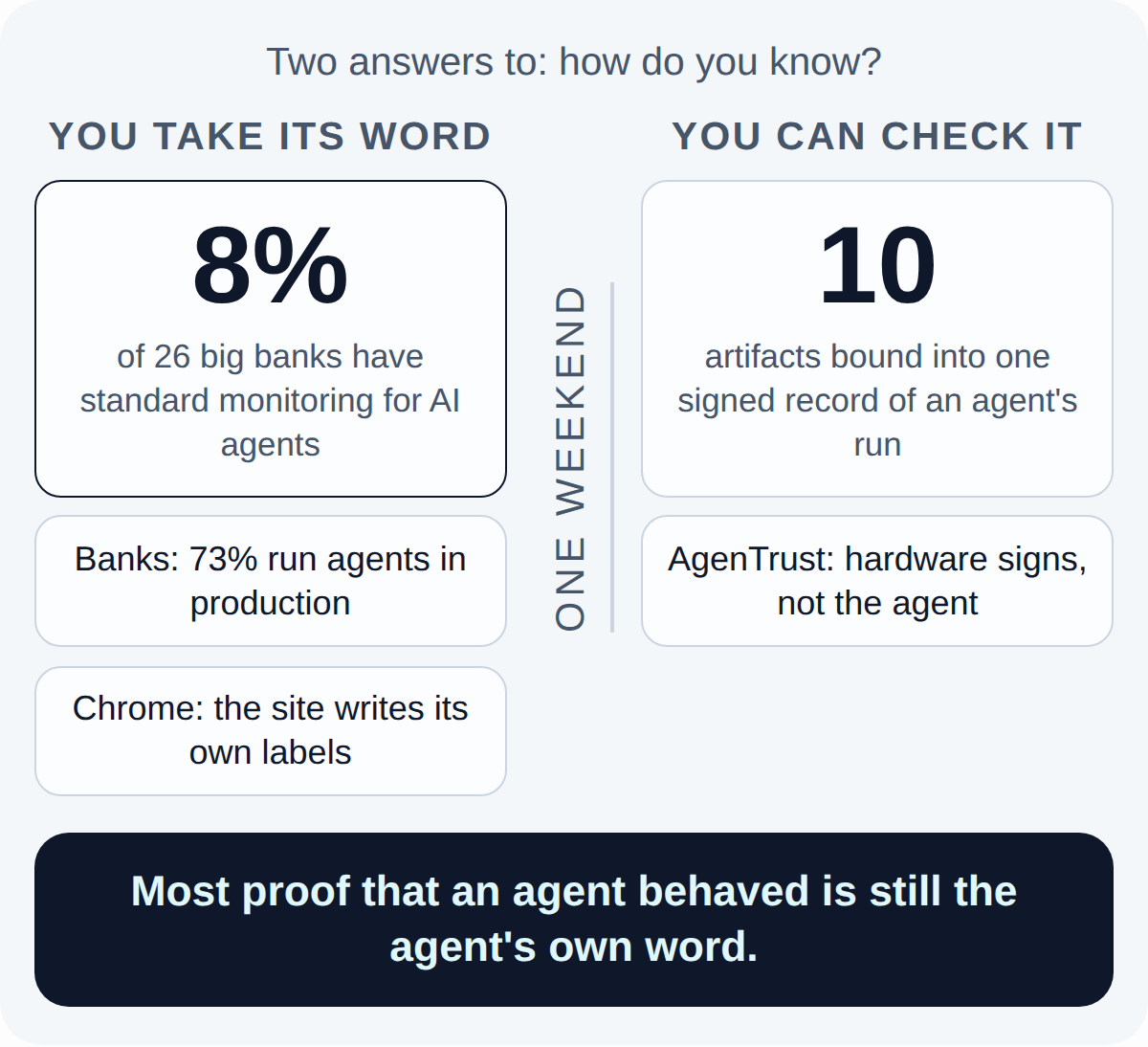
- 8% have standard monitoring in place for those agents.
- Fewer than half hold a central, tool-based inventory of the AI they run.
- 96% manage AI risk inside the risk frameworks they already had.
- 46% reported an AI-related issue or incident in the past twelve months.
BNY Mellon is reported to run close to 140 digital employees, each with login credentials, an employee number and a human supervisor, cleared through a sixteen-step review.
The figure that bothers me is not the 73%, it is the 96%. A third-party risk framework was written for a vendor that signs a contract and sends an invoice, not for something that opens a session four hundred times a day and leaves no record you own. We ran the OCC and FSB asks on 14 November, and the middle one was traceable actions. A bank that answers an examiner with its agent platform's own dashboard is handing over the defendant's diary. I would want the log leaving the platform and landing somewhere the platform cannot edit, before the next agent gets a login.
Playbook · Is the article about them, or just naming them?

Of twelve June articles that named Lovable, only four were about Lovable; in the other eight it was a name in someone else's news. The playbook shows how to tell real coverage from a passing mention.
Advertisement
The holiday streaming season is almost here

Are you ready? As revealed in our holiday playbook, Roku Ads Manager lets you easily set up, measure and optimize your self-serve holiday ad campaign. You can even create a shoppable ad unit that lets streamers buy directly from their remote.
2. Chrome lets a website write its own AI safety labels
WebMCP is a proposed web standard that lets a site hand tools straight to an AI agent, “add to cart” being the example everyone reaches for. Chrome and Edge are running it as an origin trial: a site registers its tools through a JavaScript API, with a name, a description and a schema.
Each tool carries annotations the site writes itself, saying whether it is read-only or has consequences, and whether its content can be trusted. Chrome 156 does not validate any of them.
In a scan of 544 top-ranked homepages on 31 October, one site had WebMCP tools registered at all.
Chrome showed the standard at AGNTCon and MCPCon in late October, and Cloudflare already put an edge implementation into beta with Commerce.com storefronts, so the plumbing is ahead of the shops. On Saturday VentureBeat walked through a compromised server in that same family talking an agent into misusing tools it already has permission for.
Self-declared labels are the part I expect to go wrong, and not because shops are dishonest. A merchant marking its checkout tool harmless is making a claim about consequences, which is a legal question dressed as a boolean, and the people filling that field in will be the ones who shipped the storefront. Where a model's answer traces back to whatever the page said about itself, the page becomes the audit trail. The one line I will be reading in any agent-commerce contract next year is who warranted the annotations.
3. A project wants the hardware to vouch for the agent
AgenTrust starts from a blunt claim: the self-attestation gap in agent runtimes is structural, and no amount of funding or a second control plane closes it. What it publishes instead:
- An Agent Manifest that binds ten artifacts, container digest, provenance level, software bill of materials, model weight digest among them, into one cryptographically signed document.
- A registry built as an append-only Merkle tree on the certificate transparency specification, so an outsider can check a record is in it without trusting whoever runs it.
- A runtime that intercepts every tool call, tests it against a policy bundle inside a secure enclave, and writes down the platform measurement and the policy hash alongside the result.
The toolkit's own coverage claim, seven of the ten OWASP agent controls fully met, is a self-assessment.
Earlier this month Docker was arguing for isolation and governance as the way to secure agents, which is the same instinct one layer down.
I think this is the right shape and I expect it to lose on adoption anyway, because hardware attestation asks a buyer to care about proof before anything has gone wrong, and that bill lands in the same quarter as the pilot. The version that wins will be duller: a vendor who already holds your audit relationship quietly shipping signed run records as a tier. I would rather ask my platform vendor today whether its agent evidence survives leaving the platform, while the question is still cheap to ask.
Today's context on 7wData
- Modal raises $750 million Series D at a $15.75 billion valuation Modal, the AI cloud company, has raised a $750 million Series D at a $15.75 billion valuation, led by Accel with Kleiner Perkins joining, and its own blog states the round as closed.
- Dropbox agrees to buy Tigris Data, an object storage platform for AI Dropbox has agreed to buy Tigris Data, an object storage platform for AI workloads, for $350 million according to Fortune; the deal was announced in early November and has not completed.
Advertisement
Stop funding the middleman. Start funding performance.

Every dollar you pay a middleman is a dollar not driving results.
With Universal Ads, 100% of your budget goes on screen, across premium publishers like NBCUniversal, FOX, and Paramount. New advertisers: use code UALAUNCH26 at sign-up for $2,500 in matched credits when you spend $2,500.
Also today
- Washington barred Australian agencies and foreign nationals from Anthropic's Claude Mythos, then lifted part of it months later. (3 min read)
- Looker's conversational analytics moves to token allocations on 1 February 2027. (7 min read)
- Anthropic set out how it reviews code with its own models. (2 min read)
What ShiftedThree places where the record changed hands
Nobody announced a rule last week. Three parties did something smaller and harder to argue with: each one took charge of a document that decides what counts as allowed. A national cyber agency wrote the checklist an AI audit has to work through. A studio put its characters inside a model it co-owns rather than licensing them out to a general one. An AI company sat down in the body that defines how music credits travel between companies.
Which of your AI obligations next year will come from a law, and which from somebody else's checklist, contract or data standard?
My call: by 30 June 2027, at least two more national cyber or data protection agencies publish an AI audit checklist that names agent tool calls as something an auditor has to test.
If an agent in your shop did something last month, what evidence do you hold that you did not get from the agent's own platform? Hit reply and tell me.
Yves
Tomorrow, First Move: the company in the news, and the one right behind it that nobody covers.
Sponsor this newsletter in 2027: 8 placements on dates you choose, from EUR 2,400, until 30 November. Book: 7wdata.be/sponsor-2027
Ins7ghts Daily is published by 7wData.