

Sponsored by

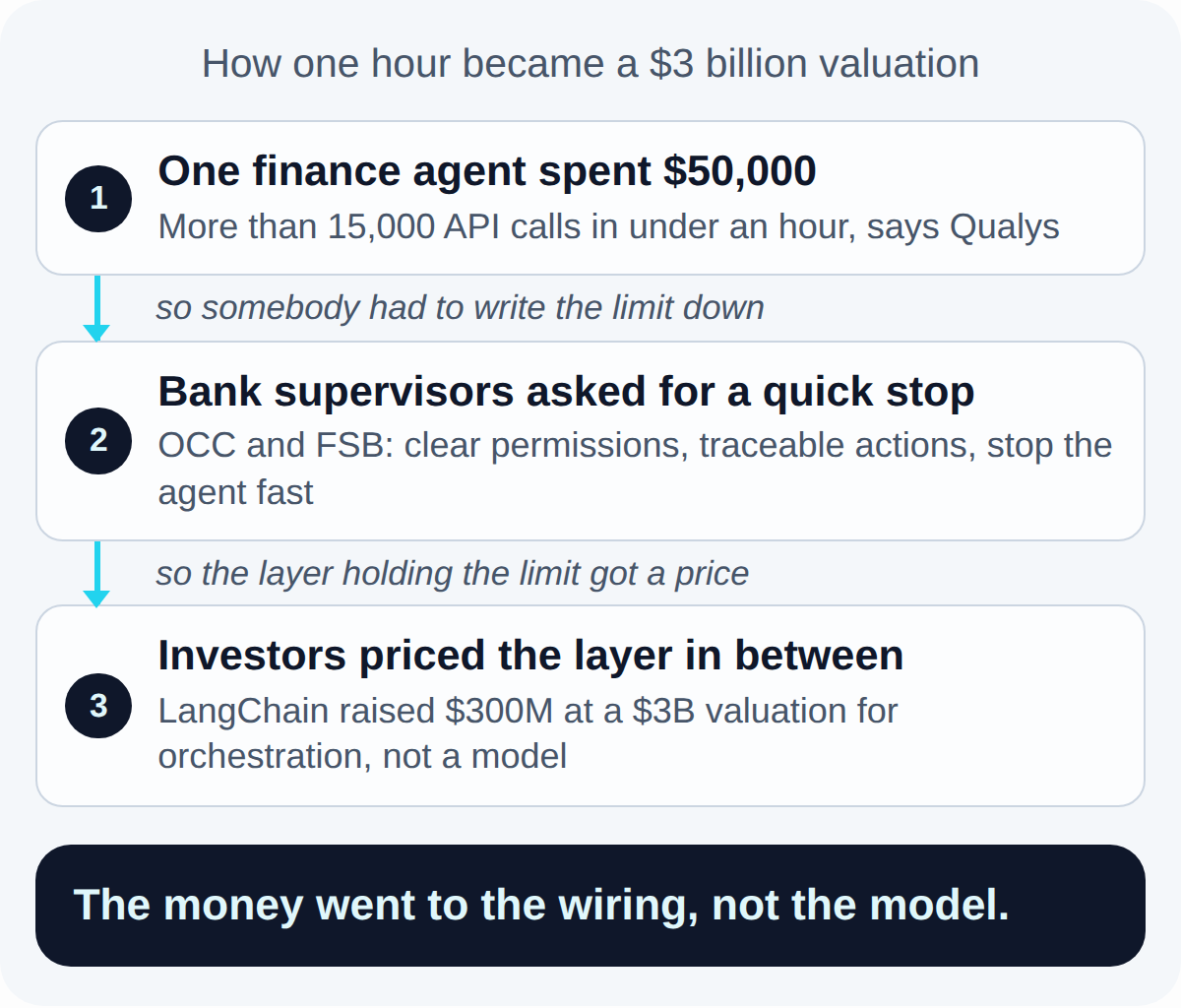
The money went to the wiring, not the model.
Three things happened in the past two days and none of them had anything to do with models getting smarter. A finance agent ran up a bill before anyone could react, two sets of bank supervisors wrote down what has to be possible before an agent goes near anything, and then $300 million went into the layer sitting between those two facts.
Advertisement
A CRM so smart, it updates itself.

HubSpot's CRM is so smart, it now updates itself. Calls get logged and summarized the moment they end. New leads get researched and a first outreach drafted, automatically. Deals move forward on their own, with next steps flagged before you have to ask.
Even the one repetitive task you've been meaning to fix can now run itself, no code required. Customers using it are already seeing the difference.
This isn't the CRM you have to work hard to figure out. It's the one already working before you log in.
1. One finance agent ran up about $50,000 in under an hour
Qualys published its read on what AI did to the clock on old risks. Two numbers in it are worth keeping.
A finance agent made more than 15,000 API calls in under an hour. The billing spike was around $50,000.
On Entro Security's figures, 97% of non-human identities carry more privilege than they need. The agent did not break in. It used what somebody had already handed it, at machine speed.
Three weeks earlier, Forrester's recap of Qualys' own conference had the company launching agents for discovery, prioritisation and remediation, so the firm reporting the $50,000 hour also sells the agents that would work that queue.
I read this as a cost-control story that got filed under security, which is why it will land on finance before it lands on IT. The privilege was granted once by a person, probably for a pilot, and nobody set a ceiling on spend, because spend is not a thing a permission model was ever built to express. On that team I would ask for an agent's maximum cost per hour before asking which data it can see.
2. Two sets of bank supervisors asked for the same three things
A read of the new OCC and FSB guidance puts both documents in the same spot: agentic AI is the high-risk frontier, and what they want on paper is clear permissions, traceable actions, and the ability to stop the agent quickly. Both bodies describe their own text as a living document that will change as the technology does.
This has been building. On 16 October the FSB was described as the only framework in play, because no US rulebook covers agents in banks. By 27 October the FSB, the HKMA and the FCA were all spelling out who answers for an AI decision, and on 29 October Singapore's guidelines made banks answer for their vendors' AI as well as their own.
None of this will reach a data team as an AI policy. It reaches them as an exam question, and for most banks today the honest answer is that the stop lives in a runbook and not in the system. The “living document” line is the tell: supervisors are keeping their own room to move while asking you to prove, afterwards, what your agent actually did. Proving it afterwards is the expensive half, and it is the half that never makes it into the business case.
Advertisement
The Dell Pro with built-in intelligence.

Built for business. Ready for anything.
With built-in intelligence, you can stay productive and focused on growing your small business. So no matter what the day throws at you, your Dell Pro can handle it.
3. LangChain raised $300 million at a $3 billion valuation
LangChain closed a $300 million Series C led by CapitalG, with Benchmark, IVP, GIC and Sapphire Ventures in it, at a $3 billion valuation. What it sells is orchestration and the record of what agents did. A developer write-up called it a bet on the boring part of AI agents.
It is not alone in the week. Crunchbase's roundup of the ten biggest rounds has agentic infrastructure at the top, Mintive raised $7 million for agent controls on 1 November, NVIDIA put out an open semantic layer to ground agents the day after, and on 7 November Microsoft Agent 365 was written up as a control plane for the agentic enterprise.
Three billion dollars for glue code sounds like silly money. I think it is early money. What is being priced, I think, is ownership: whoever holds the orchestration layer holds the log, the retry policy and the bill, and those are the three things a buyer cannot hand to a model vendor. The risk runs the other way too. Every platform already on your invoice is building the same layer, so the independent version has to be better at the boring part, not merely earlier to it.
Edelbyte and Databento both got paid for what goes into the machine
Nobody put these two together. On 13 November Edelbyte launched with $70 million from Sequoia and Quiet Capital, with Greenoaks and Swish Ventures alongside, for an analytics platform built for agents to read rather than people. The day before, Databento raised $100 million at a $1.1 billion valuation, led by Fifth Down Capital, selling market data feeds. Read apart, two funding items. Read together, two days in which the thing bought was the supply of data into a machine.
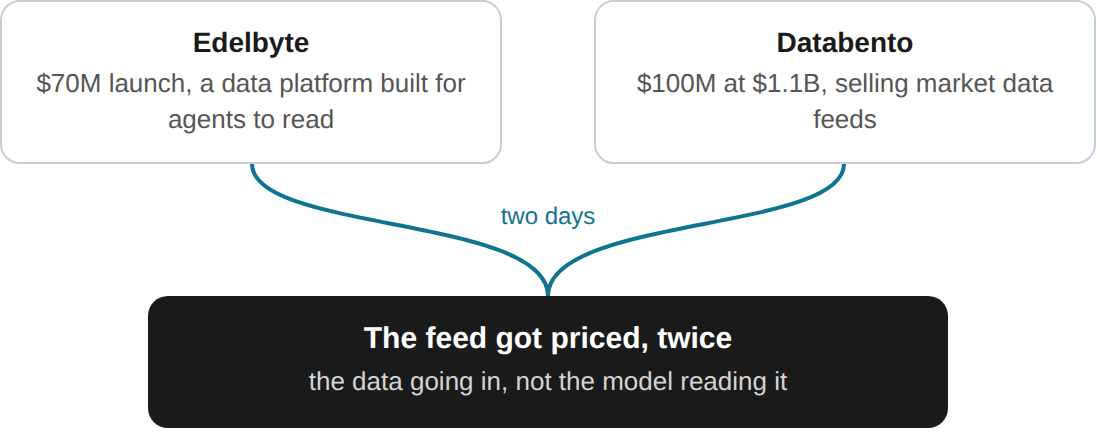
So the wiring includes what goes in, and that got a price twice this week.
Advertisement
Stop funding the middleman. Start funding performance.

Every dollar you pay a middleman is a dollar not driving results.
With Universal Ads, 100% of your budget goes on screen, across premium publishers like NBCUniversal, FOX, and Paramount. New advertisers: use code UALAUNCH26 at sign-up for $2,500 in matched credits when you spend $2,500.
Today's context on 7wData
- SpaceX IPO raised $86 billion at a $1.8 trillion valuation SpaceX's June IPO raised $86 billion at a valuation of $1.8 trillion, the largest in history according to Neuberger's 12 November private markets outlook, which cites it as a sign the IPO window has reopened for select issuers.
Also today
- Mirendil, started by former Anthropic researchers, raised $1 billion in a Series A. (1 min read)
- Google released Gemini 4 Hydrogen, which it says runs 2.5 times faster than the version before it. (4 min read)
- Databricks opened Unity Catalog views to outside engines, generally available for Delta tables and in beta for Iceberg. (16 min read)
The Long ReadCheap to find, still slow to fix
For thirty years the scarce thing in security was the person who could find the hole. Bounty programmes, disclosure windows, quarterly patch cycles, all of it sits on that scarcity, and so does the quiet assumption that an attacker needed a specialist too. Three separate pieces of work this week say the finding is getting cheap. OpenAI's security-tuned model closed Linux kernel flaws at a fraction of the old cost per exploit. Anthropic's automated red-teaming found safety failures faster than human bounty hunters. Elastic took apart five attack frameworks that never stop to ask permission. Not one of them made fixing any faster.
What is your real time from a flaw being published to it being closed in production, and who signs that off?
My call: by 30 June 2027, at least one US-listed software company tells investors on an earnings call that AI-assisted flaw discovery raised the number of vulnerabilities it has to triage.
So the money went to the wiring this week, not the model. If you have put a hard spend ceiling on an agent and it actually held, hit reply and tell me.
Yves
Tomorrow, Week Ahead: the dates that matter this week, and which one is underpriced.
Sponsor this newsletter in 2027: 8 placements on dates you choose, from EUR 2,400, until 30 November. Book: 7wdata.be/sponsor-2027
Ins7ghts Daily is published by 7wData.