

Sponsored by

Somebody automated the approval, not the check.
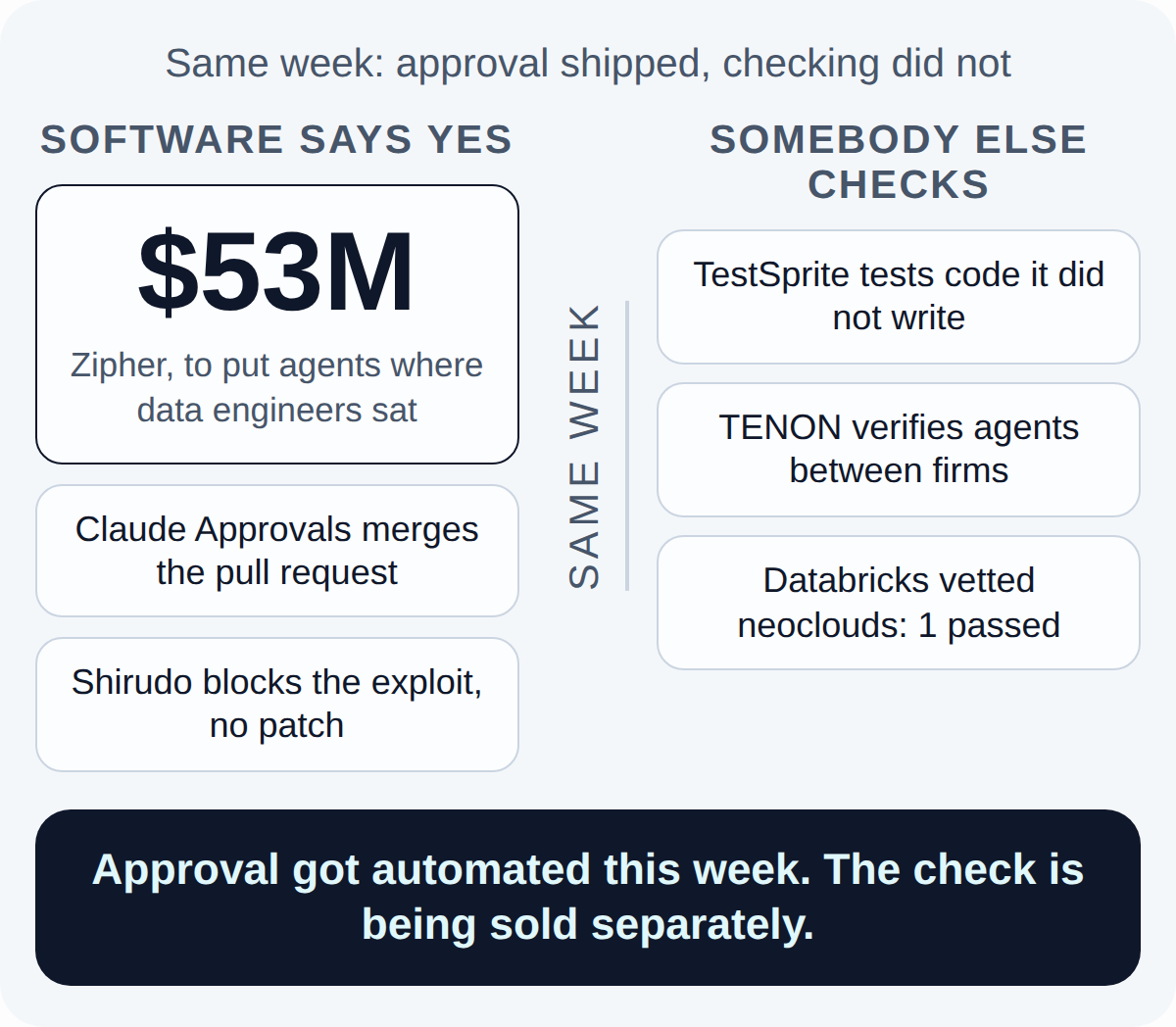
Three launches landed between Monday and Tuesday and they are all the same move. A step that used to end with a person saying yes now ends with software saying it: the merge, the pipeline, the exploit on a live box. What stayed with me, reading them next to each other, is that none of the three ships the other half.
Advertisement
A CRM so smart, it updates itself.

HubSpot's CRM is so smart, it now updates itself. Calls get logged and summarized the moment they end. New leads get researched and a first outreach drafted, automatically. Deals move forward on their own, with next steps flagged before you have to ask.
Even the one repetitive task you've been meaning to fix can now run itself, no code required. Customers using it are already seeing the difference.
This isn't the CRM you have to work hard to figure out. It's the one already working before you log in.
1. Anthropic shipped the agent that approves the merge
Anthropic launched Claude Ship, which takes Claude Code past reviewing a pull request to fixing it and signing it off. Two agents are in beta: PR Steward, which shepherds the request, and Claude Approvals, which approves changes against rules the team defines. It runs on GitHub for customers on the Team and Enterprise plans, billed on tokens.
The judgment moves into a rules file that your team writes.
The same day, Anthropic also let people install Claude-built tools as desktop apps on Mac and Windows, so software an agent wrote now reaches a laptop without anyone packaging it.
My doubt sits on that rules file. In most teams a document like that gets written in one afternoon by whoever has time, and is then inherited by people who were not in the room, which is exactly where database access rules have always rotted. I would ask who owns the file by name and when it next gets read out loud, long before I would ask anything about the model doing the approving.
2. Zipher raised $53 million to take engineers off the pipelines
Zipher came out of Tel Aviv and New York with $53 million, backed by Glilot Capital Partners, TLV Partners and Maor Investments, to hand data workloads to agents rather than data engineers. The founders come out of Unit 8200. The numbers in the announcement are customer numbers: Hertz reported compute costs down 25% to 40% while holding performance through seasonal peaks, and Zipher's customers report cost-efficiency gains of 40% to 60% and service-level adherence up to 80%.
That Hertz figure reads to me like the oldest finding in our trade. A quarter to two fifths of a compute bill was sitting in workloads nobody had time to look at, and something that looks at them continuously is worth the money. The part I do not buy is the headline, where the engineer disappears. Cost control is the easy half of running pipelines. The hard half arrives the morning an agent tunes a job that quietly feeds a regulatory report, and the person who can tell that it did is the one who just got reassigned.
Advertisement
Beginner's Guide to AI Agents

AI agents don't just answer questions. They run tasks, trigger workflows, and work autonomously.
If you haven't started yet, this free guide covers everything: what they are, how they work, and how to set one up. Free when you subscribe to Mindstream.
3. OpenAI and Cisco put a shield where the patch goes
OpenAI and Cisco released Shirudo, an open-source project that uses eBPF shields to block an exploit on a running Linux system with no patch and no restart. Their demonstration holds off Java4Shell while the team writes the permanent fix.
The two companies announced it a day earlier under a wider frame, safeguarding agentic AI, before the Linux detail travelled.
The honest word in Shirudo is “while”, and that word has a long career ahead of it. The shield holds, the ticket ages, and a year later nobody remembers that the machine is running on a block instead of a fix. I would keep the shields in a list with an expiry date against each one, because the question you eventually get asked is not whether you were protected, it is what was actually running on that estate on a given Tuesday.
A trust network and a data control arrived four days apart
Nobody put these two together. On 20 November Terminal 3 and Affinidi launched TENON, a public network that verifies, governs and secures the work of AI agents across organisations, assembled from Agent Gateway, Agent Command and Agent Stream and built on W3C and Decentralized Identity Foundation groundwork. On 24 November Bedrock Data added intent-aware data-loss prevention to its agent governance, so the control reads what an agent is trying to do with data instead of only which record it touched. One sits between companies, the other inside one. Neither is sold by anybody who builds the agents being watched.
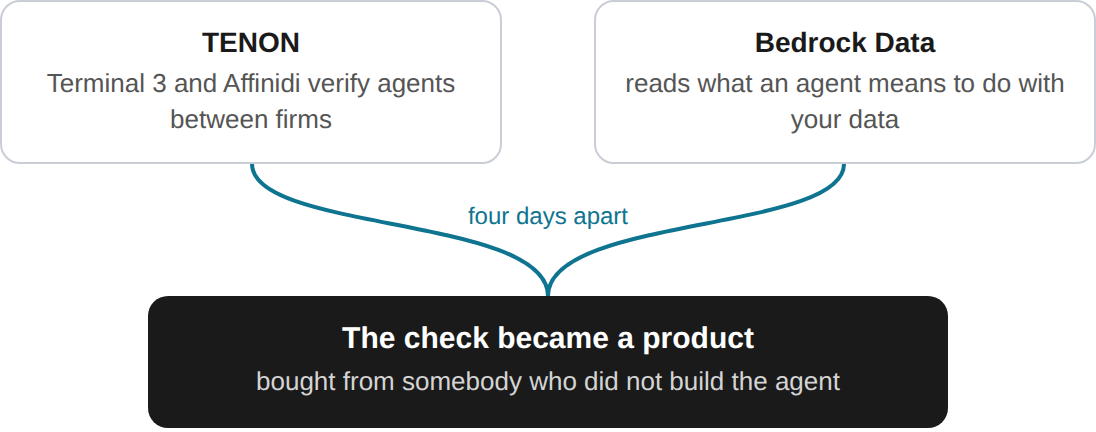
So the yes ships with the product, and the check turns up later as a separate purchase, from a vendor you have not met yet.
Names to watch
Seen this week by Ins7ghts, our research platform: a knowledge graph of the data and AI news we read every day.
- Rubiq · a customer knowledge graph, now owned by Base
Grounding. Base announced the acquisition on 20 November and is folding Rubiq's customer history into its Orbit platform for post-sale engagement.
Companies that later raised money had been in the news about twice as often in the quarter before. Worth a second look in three months.
Today's context on 7wData
- CrowdStrike agrees to buy Zscaler for $43.9 billion On 23 November CrowdStrike signed a definitive agreement to buy Zscaler in an all-stock deal valuing Zscaler at about $43.9 billion, agreed but not yet completed.
- Is Intel buying Classiq for $2.3 billion? On 23 November Team8, the venture fund that helped build Classiq, wrote in a press release that Intel is acquiring the quantum computing company for $2.3 billion; no word from Intel or Classiq appears in these sources.
- Deutsche Telekom invests €100 million in Mistral AI's Series D Deutsche Telekom has invested €100 million in Mistral AI's Series D round through its T.Capital Tech Fund, and the two companies plan a strategic partnership for German businesses and public institutions that is not yet formed.
Advertisement
Wispr Flow Notetaker is now on iPhone

Record in-person conversations and get a clean summary and transcript afterward. Notetaker keeps recording even with your phone locked.
Also today
- Databricks co-founder Patrick Wendell said that of the top neoclouds he examined, one had safeguards strong enough for Databricks to put customer workloads on it. (4 min read)
- IBM and Microsoft made IBM's Spectrum LSF and Spectrum Collective plug-ins generally available on Azure Compute Fleet, for HPC, AI and analytics jobs across hybrid clouds. (3 min read)
- Google DeepMind said its Gemini agents cut estimated quantum simulation costs by up to 11.8 times. (3 min read)
Reality CheckWhat the 79% counts
When I started bringing a PC along to play MP3s, there was a night the machine did not boot. I played it on the vinyl I had carried in with me, and after that the crate came with me whether the PC needed it or not.
The number everybody will quote this week is Salesforce's: merged pull requests up 79%, incidents down 5%, with AI coding agents doing the writing. Both are real and both are theirs, counted their way. In the same week, two companies shipped things that only make sense if nobody trusts the check that comes built in.
Which approvals in your shop now happen without a person, and who finds out when one of them was wrong?
My call: by 30 June 2027, at least one listed company will state in a public filing or a published incident report that an automated code approval let through a change that caused an outage.
If an automated approval in your shop has already let something through, I want to know who ended up unpicking it: hit reply and tell me.
Yves
Tomorrow, The Argument: one position, argued with the best case against it.
Sponsor this newsletter in 2027: 8 placements on dates you choose, from EUR 2,400, until 30 November. Book: 7wdata.be/sponsor-2027
Ins7ghts Daily is published by 7wData.