

In partnership with


 So, What Actually Happened?
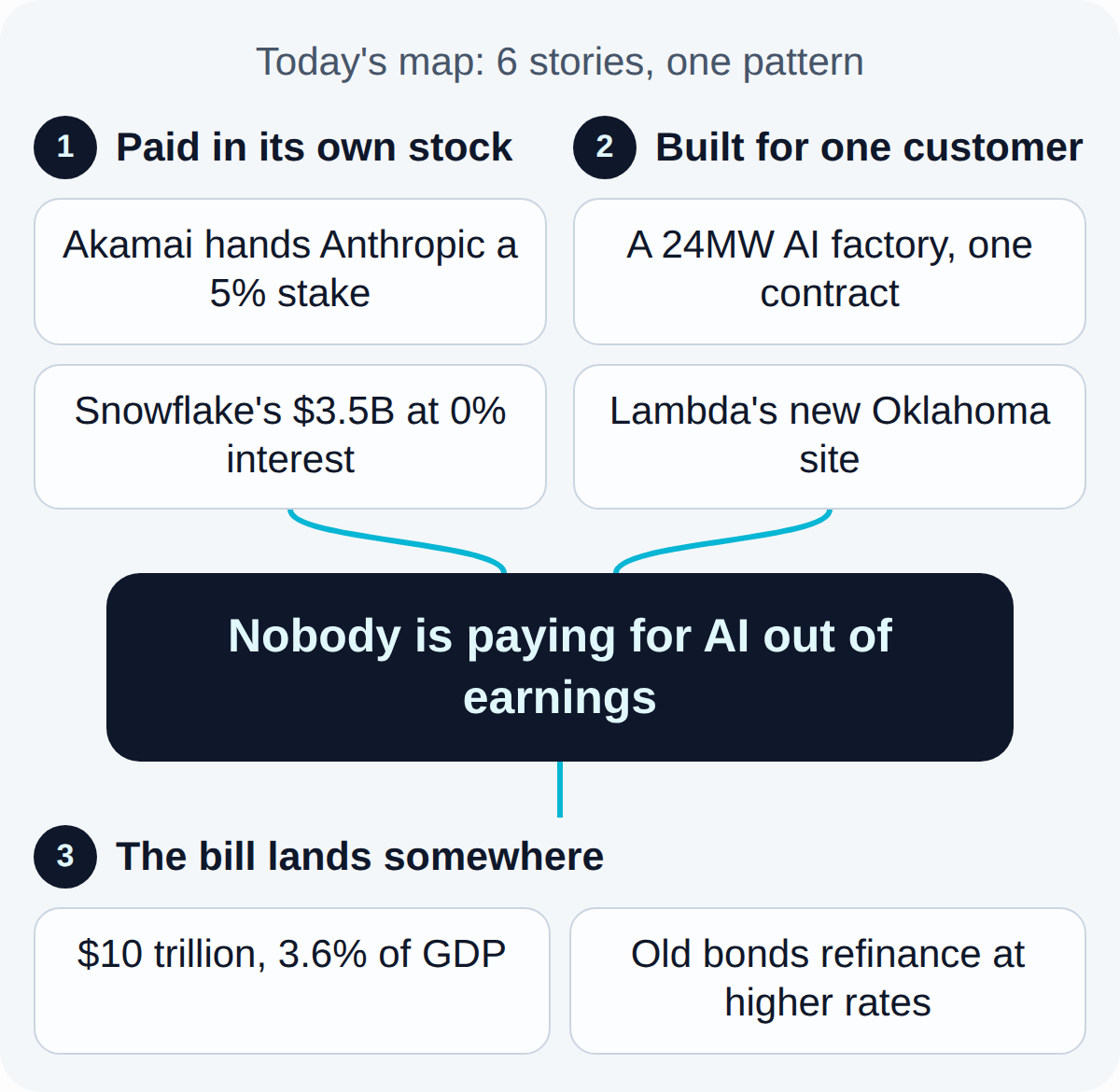
Tuesday, and I keep going back to a line in a press release nobody bolded. Akamai signed the largest contract in its history, $11.6 billion of AI infrastructure, and the way it closed was to hand the customer five percent of the company. We scanned 190,000 articles this week so you don't have to. In the same forty-eight hours Snowflake went out to place $3.5 billion of notes at zero interest, and somebody finally sized the whole thing: $10 trillion of buildout heading toward 3.6% of GDP. Three deals, three currencies, and cash was not one of them.
The Bottom Line: The AI buildout stopped being paid for out of earnings, which means the people carrying it now are lenders and shareholders, not customers.
 | Yves' take |
Have a shiny object that looks very valuable. Then money comes easy. When will the AI bubble burst?
Advertisement
You're Running Three Databases. You Only Need One.

Events go in a metrics store. Embeddings go in a vector database. Analytics get their own warehouse… Now you're running three systems, three sets of tooling, and pipelines to keep them in sync, all for one app.
TimescaleDB collapses that back into the Postgres you already run. Hypertables handle events at scale. pgvector and pgvectorscale handle embeddings. Continuous aggregates handle real-time analytics. It’s the same SQL, same tools, and only one system to operate. The sync jobs disappear. The drift disappears. The second and third databases disappear.
It's still Postgres, so nothing about your workflow changes except how much you have to maintain. Start on Tiger Cloud and get $1000 in credits.
 The Tracks That Matter
1. Akamai Bought Its Biggest Contract With Its Own Stock
Akamai's $11.6 billion deal is the largest it has ever signed, and Anthropic walks away from the table with a 5% stake in its supplier. Read that twice, because the direction is backwards from how infrastructure normally sells: the seller paid the buyer to sign. It is also not an isolated structure. Over in the GPU clouds a 24-megawatt Kansas City facility with more than 10,000 Blackwell Ultra chips runs on one multi-year customer contract, which means the building exists because a single counterparty said yes. Revenue that is partly funded by your own equity is not the same quality of revenue, and neither is capacity with one name on it.
Here's what works: For every AI vendor you depend on, find out what share of their revenue comes from their single largest customer. One answer changes your renewal position.
2. Snowflake Is Borrowing $3.5 Billion At Zero Percent
Snowflake is placing $3.5 billion of convertible senior notes at 0.00%. Nobody lends $3.5 billion for nothing, so read what the buyers are actually taking: no coupon at all, in exchange for the right to convert into shares later. The company gets AI capacity today and pays for it in dilution tomorrow, and the dilution only bites if the stock cooperates, which is exactly what the bull case assumes. For a customer, that is not an abstraction. Your platform's next capacity expansion is being financed against a share price, and share prices are the one input your contract cannot hedge.
Here's what works: Before your next multi-year data platform commitment, read the vendor's last financing. Capacity funded by converts is capacity with a condition attached.
3. The $10 Trillion Bill Still Has No Name On It
The buildout now has a number: $10 trillion, about 3.6% of GDP, and the honest part of that piece is the question mark at the end of it. Follow the money and it is going into land, power and steel rather than models, with new sites like Lambda's build in Mayes County, Oklahoma landing every week and capital quietly rotating toward the physical layer. Meanwhile the weather changed: advanced economies are refinancing low-rate bonds at higher rates. Debt taken cheaply in 2021 is being replaced expensively in 2026, and that cost does not stay in the finance department. It arrives in your compute quote.
Here's what works: Ask your cloud or GPU vendor what their reserved-capacity pricing assumes about financing cost. If nobody can answer, that risk sits with you.
Quick hits:
- Nvidia shipped a product for agents that go off the rails. The new software platform to stop AI agents misbehaving arrives the same week Australian bank risk officers said rogue agents are what keeps them awake, which tells you who the buyer is.
- Two NetScaler zero-days are already being exploited. Palo Alto's team published the threat brief on CVE-2026-88771 and its sibling, so this is a patch ticket with a deadline, not a reading item.
- A personal AI agent startup raised $1 billion at $10 billion. Instinct's round prices a consumer agent above most enterprise software companies, which tells you where the risk appetite still is.
Advertisement
A deal has two sides. Your stack only sees one.

Aligned shows you the other half. See what buyers actually do between meeting. See what they open, revisit, and share; so you know the exact next step to move things forward. And your champion gets everything they need to win internally when you're not in the room.
Your Turn
Which of today's three reads do you think is wrong?
One tap. No wrong answers.
 Signal vs. Noise
🟢 Signal: who owns data governance. Collibra closed at a $5.25 billion valuation and swallowed a data-access governance startup in the same stretch, while Forrester told supply-chain teams to build a minimum viable data framework before letting agents near the stock ledger. The buying shifted from the teams deploying agents to the teams who answer for them. Most coverage still files this under compliance instead of under budget.
🔴 Noise: ”agentic AI” as a label. It is still one of the most-written-about phrases of the week, and its hold on everything else moving slipped badly at the same time. The money this week went into restricting agents, not releasing them. Anyone tracking ”agentic AI” as one signal is reading from a frame that stopped describing the market.
 From the 190K
We scanned 190,000 articles this week. Here's what no one's talking about:
Modulate raised $25 million for models that listen rather than generate, a marketing-ops tool shipped as ”read-only AI coworkers”, and enterprise agent platforms started selling permission scoping as a headline feature instead of a footnote.
Read alone, each is filler. An audio AI round is a funding brief. A read-only assistant is a product note. A vendor page is a vendor page. Read together, they say something the autonomy debate is missing entirely: the agent products attracting money and shipping this week are the ones with the permissions turned down. One platform's own selling line is that ”the same agent can carry a different permission set on each surface”, which is a sentence about liability, not about capability. That is what gets built when capital is expensive and the blame for a mistake lands on the buyer, not the vendor. The loud half of the market is arguing about how much an agent can do. The paying half is specifying what it may not touch.
What changes Wednesday: when a vendor demos an agent, stop asking what it can do and ask what it is structurally prevented from doing. The second answer is the one you will need in an incident review.
Advertisement
What’s still sitting on your to-do list?

You don’t need an AI team to build an AI agent. With Skydive, the person who knows the work can create the agent to do it.
Start an agent off with a role, teach them how your team operates, connect your tools, and put them to work.
 By The Numbers
- Akamai signed $11.6 billion and handed over a 5% stake — its largest contract ever, closed by giving the customer equity in the supplier.
- Snowflake is placing $3.5 billion of notes that pay 0.00% — no coupon at all, so the lenders are paid only if the shares climb.
- The buildout is heading for $10 trillion, roughly 3.6% of GDP — a number that big normally has a named payer attached, and this one does not.
- An H100 hour costs $98 at a hyperscaler and $34 at a specialist cloud — Uptime Intelligence figures for the same silicon, roughly two-thirds cheaper off the big three.
- A 24-megawatt AI factory runs on one customer contract — over 10,000 Blackwell Ultra chips in Kansas City, underwritten by a single multi-year deal.
- See what's rising across AI and data this week →
 Deep Dive: Who Is Actually Paying For This?
A promoter who books a headline act on a guarantee pays the fee whether or not anybody buys a ticket. The act gets paid either way. The risk did not evaporate, it moved to whoever signed the guarantee, and that person is almost never the one on stage.
The money stopped coming from customers
For three years the story was demand: buyers wanted AI, vendors sold it, revenue paid for capacity. This week the sequence broke in public. A supplier gave up equity to win a contract. A platform borrowed billions at no interest. A data centre got built against one signature. None of that is customer money.
Equity is the cheapest thing to hand over
Stock feels free when it is rising. A 5% stake costs nothing today and everything later; a zero-coupon convertible costs nothing this quarter and dilutes every holder if it works. Both are real payments, just deferred and denominated in something the finance team does not have to expense yet. That is why they are everywhere right now.
The rate on the world changed underneath it
Cheap debt from 2021 is being refinanced at 2026 prices, and the buildout still needs another few trillion. When the cost of money moves, deferred payments stop being cheap. That repricing does not stay in treasury; it reaches your reserved-capacity quote, your renewal, and the roadmap your vendor can still afford.
What Actually Works
- Ask who funded the capacity: for every AI commitment over a year, find out whether the supply behind it was paid for with revenue, debt or stock. The answer predicts pricing stability better than any SLA.
- Count the concentration: if one customer underwrites your vendor's facility, you are exposed to a contract you never signed. Ask for the top-customer share.
- Put a financing question in procurement: add one line to your vendor questionnaire about how the next capacity expansion is funded. Cheap to ask, expensive to skip.
- Budget governance as spend, not compliance: the control layer is where the money actually moved this week. Give it a line item before an incident gives it one for you.
Every festival looks fully funded from the dancefloor. You only find out who guaranteed the act when the rain comes and somebody still has to pay the band.
 What's Coming
Customer Equity Becomes A Standard Term Sheet Line
When the biggest infrastructure contract of the year closes with a 5% stake attached, every other supplier chasing an anchor AI customer now has a precedent to match. Expect equity-for-commitment structures in the next wave of compute and network deals, and expect the disclosure to arrive months after the announcement.
Zero-Coupon Paper Spreads Beyond The Chip Names
A software company raising $3.5 billion at no coupon tells other CFOs the window is open. Watch for the same instrument at data platforms and security vendors this quarter, and watch the conversion prices, because that is where the real assumption about AI demand is written down.
Agent Restriction Gets A Budget Before Agent Autonomy Does
With rogue agents now a named board-level worry at banks, the first agent line item most enterprises approve will be a control platform, not a deployment. The vendors selling permission boundaries will close faster than the ones selling capability through the end of the year.
 For Your Team
Wednesday's meeting prompt: ”For every AI supplier we depend on, do we know whether their capacity was paid for with revenue, debt, or their own stock, and which of those would show up first in our pricing?”
Share-worthy stat: Akamai signed the biggest contract in its history, $11.6 billion, and closed it by giving the customer 5% of the company. In the same week Snowflake went to market for $3.5 billion at zero interest. The AI buildout is not being funded by the people buying AI, and that gap is now a $10 trillion question sitting at 3.6% of GDP.
Go deeper: Track where AI money and AI capacity are actually moving →
 The Track of the Day
”The Kansas City AI Factory is a 24-megawatt facility that, at launch, houses more than 10,000 NVIDIA Blackwell Ultra GPUs dedicated to a single multi-year customer contract.”
From the Lambda Labs competitor rundown
Twenty-four megawatts, ten thousand chips, one signature. Somebody built a power station for an audience of one, and the whole industry is quietly doing the same arithmetic.
We scanned 190,000 articles this week so you don't have to. Data Pains → Business Gains.
Published: September 29, 2026 | Curated by Yves Mulkers @ Ins7ghts
1,300+ articles scanned. 7 stories selected. Our AI distills the noise into signal—in seconds. Get early access →
Know someone who'd find this useful? Share your unique referral link →
Want Your Own AI Intelligence Briefing?
Our platform analyzes 1,000+ sources daily and delivers personalized insights in seconds.
Join the Waitlist →Founding members: Lifetime discount • Priority access • Shape the product