
In partnership with

The AI build is now asking the public to pay for it.
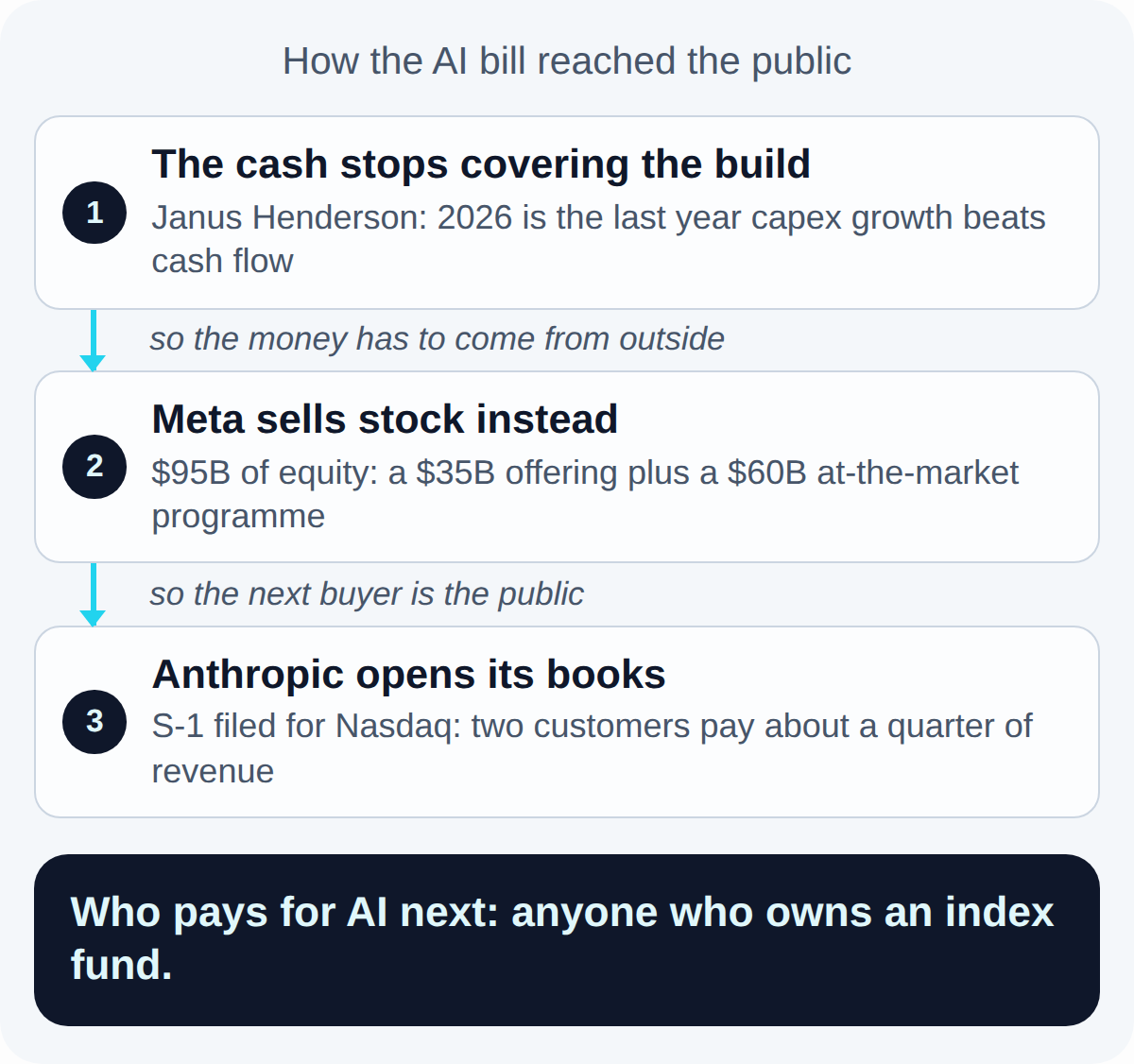
Three things landed inside a day and they are one thing seen from three sides. A fund manager published the arithmetic on when AI spending stops being covered by the cash coming in. Then Meta put up to $95 billion of stock on the market, and Anthropic filed to list on Nasdaq.
Advertisement
Your GTM Has a Weak Spot. Find It.

Your go-to-market feels stuck. Most of the time, nothing is broken. One or two things are just quietly costing you momentum.
Drop your URL. The free GTM Audit reads your site, pricing, and competitors, scores four dimensions, and hands you a 90-day fix list.
10 minutes. No guessing.
1. Two customers pay a quarter of Anthropic's revenue
Anthropic filed its S-1 with the SEC and intends to list on Nasdaq under the ticker ANT, with Reed Hastings named lead independent director. Revenue in the three months to 30 June grew 1,368% against the same period a year earlier.
The draft runs 261 pages and 80 of them are risk factors. Roughly a quarter of the revenue depends on two customers.
More than $600 billion is already committed to computing deals.
Amazon, Google and Microsoft hold $269 billion of those compute contracts, and the same three names are on the funding side: Amazon has put in at least $13 billion with up to $20 billion more agreed, Google up to $40 billion. On 11 October, two weeks before the paperwork, an Australian trade title was already writing about circular financing around this listing. The same week, a $9 billion junior tranche went out paying above 10%.
The growth rate is not the interesting number in that filing. Two customers paying a quarter of the bill is a supplier dependency, and here it points both ways, because those same customers are also the landlord selling the compute. I have sat in enough vendor reviews to know that a contract where your buyer is also your supplier does not get renegotiated in your favour. If I ran an agent platform on top of Claude, I would spend this week reading whose contract sits underneath mine, and what happens to my pricing when theirs moves.
2. Meta is selling up to $95 billion of its own stock
Meta is raising up to $95 billion of equity to fund its AI expansion, in two parts:
- $35 billion in an underwritten public offering, including 250 million depositary shares representing mandatory convertible preferred stock
- a $60 billion at-the-market programme of new Class C shares
The Wall Street Journal filed on the full $95 billion plan the same day. Also that day, SiliconANGLE wrote up Elon Musk predicting a shakeout among the smaller GPU clouds as credit for AI infrastructure dries up. On 6 October the Straits Times was already calling the sector's borrowing a binge rattling US markets.
Equity at this size says something the press release does not. Meta is choosing to hand over ownership rather than pay what AI debt costs right now, and a mandatory convertible is the instrument you reach for when you want the money without the rating agencies calling it borrowing. My reading is that the cheap-debt window for this buildout closed somewhere in October, and everything that follows gets priced off that. Watch whether the next three big capex announcements come with a share issue attached.
Advertisement
See what's really happening in every deal

Aligned shows you what buyers are doing between meetings inside your most important deals then surfaces the risks, openings, and next steps. No more guessing where a deal stands or finding out a champion went quiet too late. Just real visibility, so you can act before it's too late.
3. A fund manager put a date on when AI stops paying for itself
Janus Henderson published the arithmetic behind both of the above. In its read, 2026 is the last year AI capex growth can outpace operating cash flow growth at the hyperscalers, with AI capex topping $1 trillion in 2027 and approaching $2 trillion over the next decade.
On 26 October, 24/7 Wall St asked whether the money for AI data centres is drying up. Investing.com had put the same question to the debt side on 30 September, asking whether borrowing at AI companies is becoming a risk of its own.
What I find useful here is that an asset manager, not a critic, wrote the sentence. Cash flow covering your spend is the quiet form of cost control, and when it stops covering it, somebody outside the company starts setting your pace. For anyone buying AI capacity on a multi-year contract, that is the thing to price in: your supplier's 2027 budget may be decided by whoever is willing to buy its shares in 2026, and that buyer has no interest in your renewal.
Advertisement
Did you know companies can license their operational data to AI labs? Companies with 20+ employees that use Slack or Teams could be eligible. Bezel can help you explore the opportunity.
Also today
- The Bank of England and the FCA published their joint report on AI in UK financial services. (32 min read)
- A security startup called Cathedral reached sensitive Anthropic business systems within 12 hours using autonomous AI tools. (31 min read)
- Springer Nature and Google DeepMind are building a peer review assistant together. (2 min read)
First MoveThe box that keeps the lights on
In the days I spun, I played on Technics turntables and a solid Rodec mixer. The Technics still work, 30 years on. Hard to kill, both of them, and nobody ever wrote a feature about a mixer.
That is roughly where this week's money is going. While everyone read Meta's $95 billion, Reuters filed from the energy desk: EQT bought Scale Microgrids, which then bought Reload, and Vertiv closed a $2.6 billion purchase of Utility Innovation Group. Three deals in power equipment, nobody you follow talking about any of them.
Do you know who supplies the power for the AI capacity you have been promised in 2027?
My call: by the end of June 2027, at least one large AI capacity announcement slips in public over a power connection rather than over chips.
If you have ever gone looking for who actually pays your AI supplier's bills, and found out, hit reply and tell me.
Yves
Tomorrow, Reality Check: a claim everyone repeats, held against what actually happened.
Reach data and AI leaders in this inbox: book a placement.
Ins7ghts Daily is published by 7wData.