

In partnership with

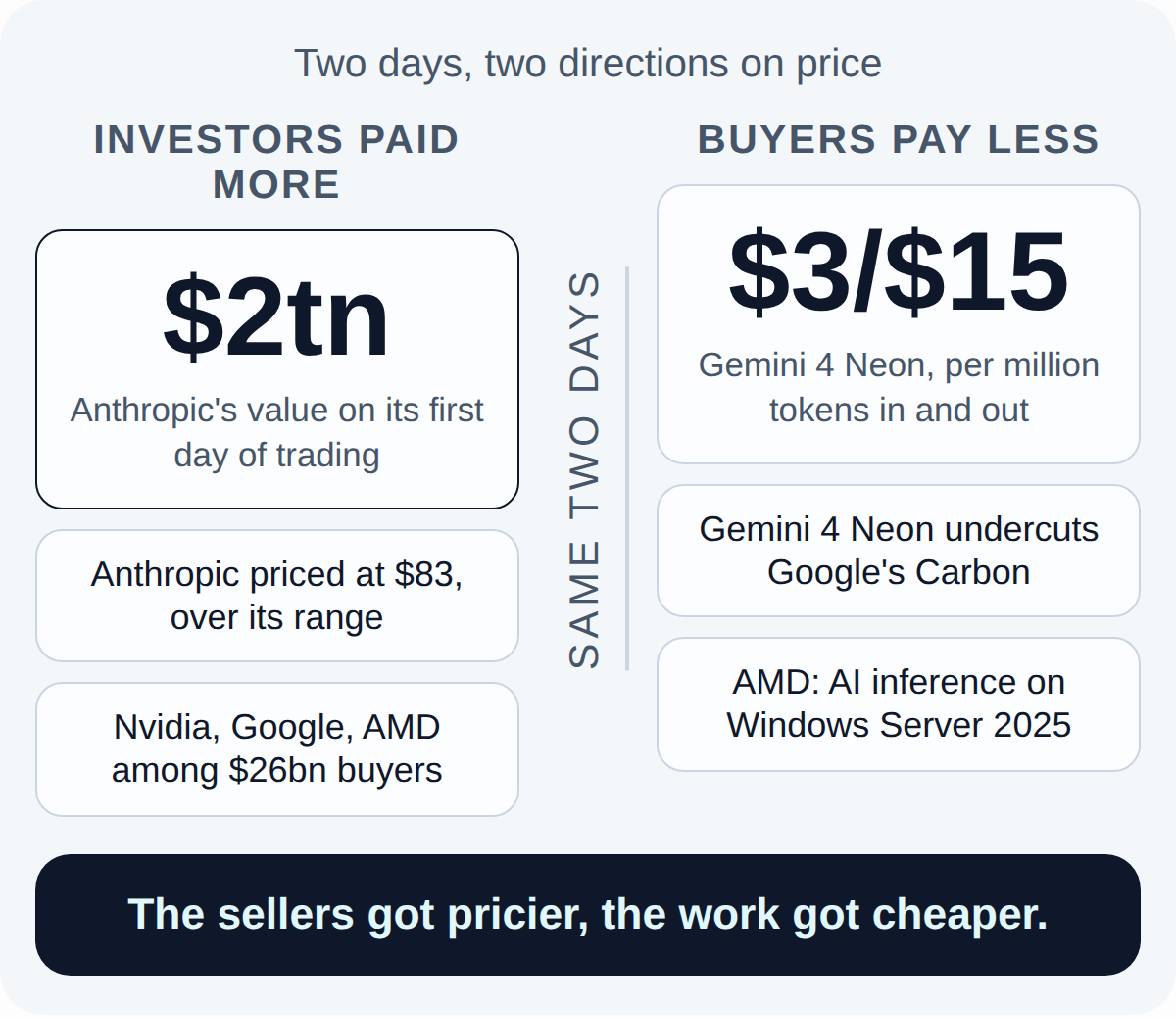
The sellers got pricier, the work got cheaper.
Two days, three pieces that point opposite ways. Anthropic opened on the Nasdaq and the market handed it more than $2 trillion. In the same forty-eight hours Google put a cheaper frontier-class model on its price list, and AMD put inference silicon inside Windows Server.
Advertisement
Product teams aren’t short on ideas. They’re missing a system.

Jira Product Discovery gives teams one place to capture customer feedback, prioritize ideas with consistent frameworks, and build living roadmaps everyone can align on. And when it’s time to build, those decisions connect directly to delivery in Jira, so everyone can see how the roadmap turns into real work.
1. Anthropic went past $2 trillion on its first day
Anthropic priced its offering at $83 a share on Wednesday, above the $70 to $78 range it had published. Trading opened on the Nasdaq on Thursday and the valuation went through $2 trillion, on a raise Reuters puts at $81.3 billion. ABC News has the same $83 price and reads the day as the first real test of the promise attached to it.
Alongside the offering, Anthropic sold another $26 billion of shares in a private placement.
Micron, Nvidia, Google, Microsoft, AMD, Taiwan Semiconductor and Broadcom were in that placement: the companies Anthropic buys chips and compute from.
Two things around the edge. GeekWire counted Amazon's $18 billion stake past $200 billion during the debut. On the same day, Oregon's state treasurer called for AI regulation and urged caution ahead of fast-entry index listings, which is the pension side of the same transaction: money that arrives because an index says so rather than because anyone chose. Nikkei, writing on 18 November, reports the offering sought up to $3.5 billion from Japanese investors.
I keep going back to the $26 billion rather than the $2 trillion. We had the $70 to $78 range in this letter on 11 November, and the final price came in above it, partly because the suppliers took stock in the customer. That is a tidy arrangement for everybody except the firm at the end of the chain paying the invoice, because nobody inside that circle is paid to argue about price. My own read is that the discipline has to come from being able to leave, so between now and renewal season I would make one real production workload portable and time how long the move actually takes.
Playbook · We ranked who is rising. It ranked who is big

Our ranking of rising companies had 34 giants like Microsoft, OpenAI and Google in its top 100. We wrote a test down first and ran it; the playbook shows how to rank who is rising without favouring the big names.
Advertisement
“Running shos” shouldn’t return zero results. Gladly understands what your shoppers mean, typos and all, and finds the right products.
2. Google put a cheaper frontier-class model on the price list
Google DeepMind released Gemini 4 Neon on 18 November. The numbers on its model card: $3 per million input tokens, $15 per million output, a one-million-token context window, sold in Google's own words as “frontier-level intelligence with fast end-to-end task completion”.
Crypto Briefing reads it as a cheaper alternative to Carbon, the model Google opened to developers earlier this month, and the Financial Express writes it up as aimed at coding, research and cyber defence rather than at chat.
The $15 is the number I would budget on, not the $3. An agent that plans, retries and writes its own notes produces far more tokens than it consumes, so a mid-tier price with a million-token window is an invitation to spend the saving on volume. I expect most enterprise traffic to settle on tiers like this one instead of the top model, and I expect the bills that go wrong next year to be output-heavy agent loops that nobody metered per task.
3. AMD's inference chips moved into Windows Server
AMD and Microsoft announced Instinct MI350P support for Windows Server 2025 and for the coming Windows Server 2028, which puts GPU-accelerated inference inside ordinary enterprise Windows estates.
The same chip appears in Dell's 16 November write-up of the MLPerf inference round, where inference performance gets measured by somebody other than the vendor selling the model.
What catches me here is the operating system, not the silicon. Plenty of regulated shops never moved inference out of a hosted API because the only servers their auditors trust run Windows, and that argument just lost its technical half. I do not think this shifts much volume in 2027, the drivers and the skills are not there yet, and I would still ask any vendor pitching a private deployment to show the cost per thousand requests on hardware already in the rack, not on a reference machine.
Names to watch
Seen this week by Ins7ghts, our research platform: a knowledge graph of the data and AI news we read every day.
- Dreamteam · $53 million to replace hand-typed sales records
Data quality. It raised on 16 November to have AI write the CRM entries sellers skip, and on 17 November OpenAI launched ChatGPT for Sales with a sales plugin and more than 30 partner apps, Salesforce and HubSpot among them. - AI Rudder · CALL-E, which lets an AI agent place a real phone call
Governance. It went live on 14 November for agents running in ChatGPT, Muse and OpenClaw, and again in trade coverage on 16 November; both write-ups put it beside the FCC's rules on AI voice calls and GDPR.
Companies that later raised money had been in the news about twice as often in the quarter before. Worth a second look in three months.
Today's context on 7wData
- IBM and Microsoft launch Imagine Enterprise, a platform for AI agents On 10 November IBM and Microsoft jointly announced Imagine Enterprise, a platform for building, running and governing AI agents, offered through IBM Consulting and starting in financial services, insurance and retail.
- Will GXO roll out up to 1,000 Apptronik humanoid robots? On 12 November GXO Logistics signed a letter of intent with Apptronik to expand trials of the Apollo humanoid robots, aiming at up to 1,000 over four years only if agreed KPIs are met.
- HPE appoints Jennifer Nason, former JPMorgan banker, to its board On 18 November HPE announced that Jennifer Nason, the former JPMorgan banker who advised it on the Juniper Networks acquisition, joined its Board of Directors, effective the same day.
Advertisement
Stop funding the middleman. Start funding performance.

Every dollar you pay a middleman is a dollar not driving results.
With Universal Ads, 100% of your budget goes on screen, across premium publishers like NBCUniversal, FOX, and Paramount. New advertisers: use code UALAUNCH26 at sign-up for $2,500 in matched credits when you spend $2,500.
Also today
- Starburst put Context Studio into private preview at its Launch Point event on 18 November, adding federated semantic context to its query engine (read it). (7 min read)
- Informatica's governance tooling moved into Microsoft Foundry and Fabric, with a Copilot and Teams integration (read it). (9 min read)
- Anthropic extended free Claude for Teachers for verified US K-12 educators to 30 July 2028, under a binding privacy agreement with the AFT and UFT (read it).
The ScoreboardWhat we said, and what came due
Three calls hit their deadline since the last board, all three written in May.
0 right 32 wrong 7 not a real call 0 still open
The sharpest miss is the one from 14 May. It needed a named top-five US health insurer, retail bank or wealth manager to ship a branded agent inside the GPT Store with a named compliance disclosure attached, by 14 November. Nothing of that shape turned up, and the reason reads plainly enough now: a regulated firm in that tier does not put its own brand on somebody else's storefront while the disclosure rules are still moving under it.
Which of your 2026 forecasts had a date on it?
If you have moved a production workload onto a cheaper model this year and actually measured what the move cost you, hit reply and tell me.
Yves
Tomorrow, The Long Read: one theme through the whole week, from three sources.
Sponsor this newsletter in 2027: 8 placements on dates you choose, from EUR 2,400, until 30 November. Book: 7wdata.be/sponsor-2027
Ins7ghts Daily is published by 7wData.