

Sponsored by

The meter runs, and somebody else reads it.
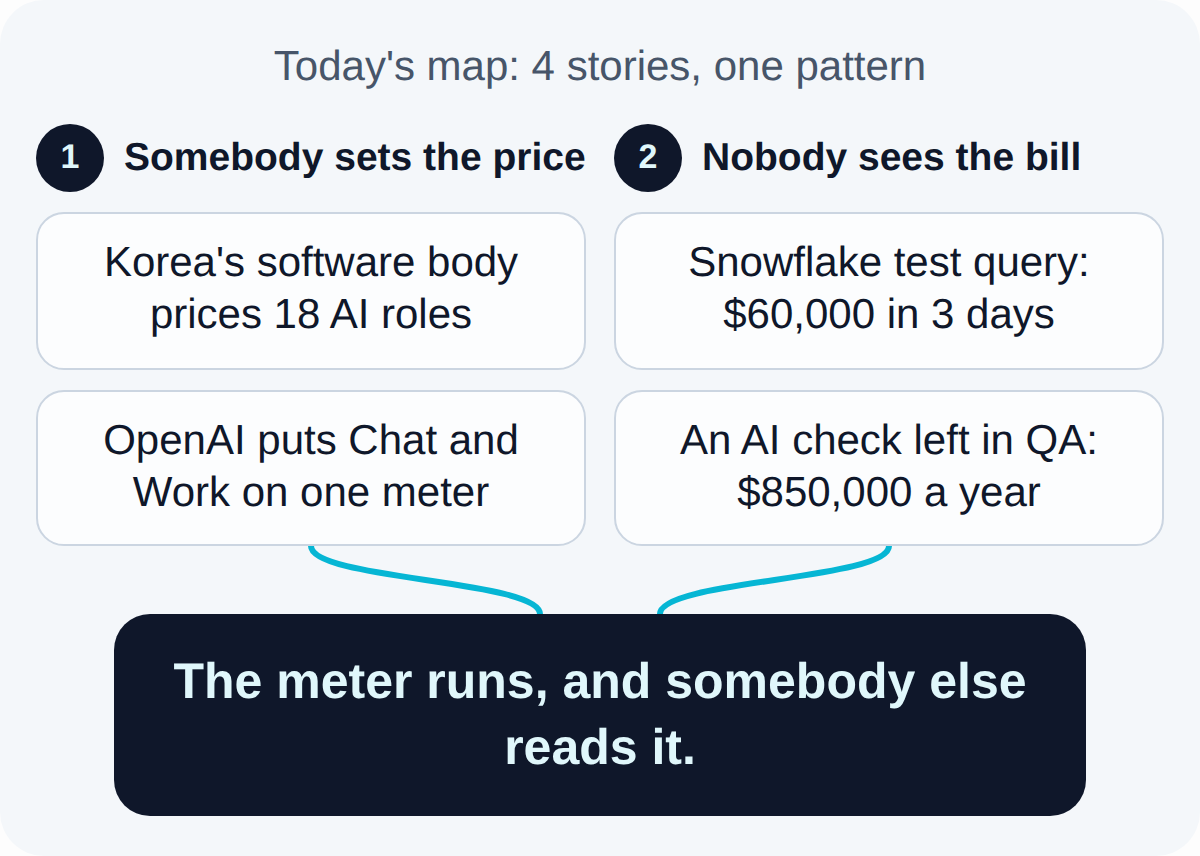
Three things from the last two days land on the same invoice. An industry body in Seoul, a cost engineer with receipts from a data warehouse, a product note from OpenAI. Those three never talk to each other.
Advertisement
A CRM so smart, it updates itself.

HubSpot's CRM is so smart, it now updates itself. Calls get logged and summarized the moment they end. New leads get researched and a first outreach drafted, automatically. Deals move forward on their own, with next steps flagged before you have to ask.
Even the one repetitive task you've been meaning to fix can now run itself, no code required. Customers using it are already seeing the difference.
This isn't the CRM you have to work hard to figure out. It's the one already working before you log in.
1. Korea's software industry wrote down what AI work costs
KOSA, the Korea Artificial Intelligence and Software Industry Association, published a pricing roadmap for AI build projects on 24 November. It splits a project's cost into five parts: service usage fees, customisation work, AI-specific technology elements, system development, and the infrastructure build.
It also defines 18 specialist roles, AI model architects and prompt engineers among them, and prices each one off existing software engineer wage averages rather than a benchmark of its own. Conventional software work keeps function points; the AI-specific work is counted in man-months.
Pilot application starts in 2027, full guidelines are targeted for 2028.
The reason given is blunt: there was effectively no standard for putting AI skills into a project cost, so firms the size of Samsung SDS and LG CNS had nothing concrete to point at in a contract negotiation. LG CNS, for its part, is not short of the work: it reported profit up 15% on AI, cloud and financial IT on 30 October.
I think the five-part split is the useful half and the wage mapping is the part that breaks first. Price a prompt engineer off a software engineer's average and you are wrong twice over, too generous where the skill is thin, insulting where it is rare. That gap ends up in the margin of whoever drafts the statement of work. Negotiating a build under this next year, I would want the man-month lines itemised on their own page, because that is where the entire argument will sit.
Our research · How to track a list of companies every month: October on 24 data and AI companies

We watched 24 data and AI companies through October and checked every item. For 21 of them we found at least one real launch, partnership, executive change or contract that is not on Crunchbase's event cards.
Advertisement
One Postgres for Metrics, Embeddings, and Dashboards

Metrics, embeddings, and dashboards often end up in three systems with sync jobs between them.
TimescaleDB runs all three, in one Postgres database. No sync jobs, no drift, no second database to feed.
Start a trial on us:
2. A test query ran up $60,000 in three days
Niall Woodward, CTO at SELECT by DoiT, put numbers on what AI is doing to data platform bills. One Snowflake customer spent $60,000 in three days on a Cortex AI query written as a test. Another found an AI function buried in a quality assurance job, costing $850,000 a year. Moving one job from hourly to daily cut its cost by about 96%.
He is less worried about the waste than about nobody seeing it. The bill gets put together after the fact out of thousands of queries, so the person setting a refresh interval never reads that as a budget decision. FinOps Foundation research in the same piece has 98% of FinOps professionals now managing AI spend, against 31% in 2024.
The traffic onto that meter keeps growing. On 25 November Attentive and Jedify put Model Context Protocol connectors on the Snowflake Marketplace, so marketing questions now reach the same warehouse that answers everything else.
The $850,000 line is the one I would hunt tomorrow morning. Not because it is large, but because somebody shipped it, it passed review, and it ran for a year inside a job whose whole purpose is checking that things are correct. That is a provenance problem showing up on the bill. Nobody could say which change created the charge. I would make one person able to answer that question for every AI call in the stack before I approved another agent on top of it.
Playbook · Thirteen articles, five announcements: count the announcements, not the articles

Thirteen articles about Progress Software in eight weeks looked like a busy company; read in full, they were five announcements, and seven of the thirteen covered one of them. The playbook shows how to count news about a company without counting the same story twice.
3. OpenAI put Chat and Work on one meter
OpenAI is merging the separate Chat and Work tabs into one interface with a single shared usage allowance. The rollout started in late November with a small group of Pro subscribers and widens in December. Conversations on the Instant model stay unlimited and sit outside the shared limit, so they remain available once the allowance is gone.
OpenAI told TechCrunch that most users are not expected to face more frequent usage resets, though “a small fraction of its heaviest users may hit their limits sooner”, and that it would keep improving efficiency so subscribers get more out of their plans.
That same Pro tier has been gaining parts all month. ChatGPT Wallet, a payment credential, landed on it on 10 November, and GPT-5.6 is due to retire on 23 December with GPT-6.2 Sol taking its place.
My position on this one is harder than it sounds: a subscription whose unit of account changes under you is not a price, it is an invitation to re-measure later. Nothing here is dishonest. The seat costs what it cost yesterday. What it buys got re-cut, and the people who feel it are exactly the ones who built a daily habit on the old shape. I am moving the work I actually depend on onto metered API calls where I can read the number myself, and leaving the subscription for the thinking out loud.
Boards are asking for the return, and nobody funded the repair
Nobody put these two together. Research on the process gap behind enterprise AI has boards that waved through the early investments now asking what the money bought, with process faults having sunk AI initiatives at an average of $1.55 million each, and usage-based pricing turning every clumsy workflow into a bigger bill. On the same two days, a survey of European asset managers has 90% of firms planning to raise AI investment over three years, 57% naming data quality as their main barrier, and 62% of the small firms still without a single live use case.
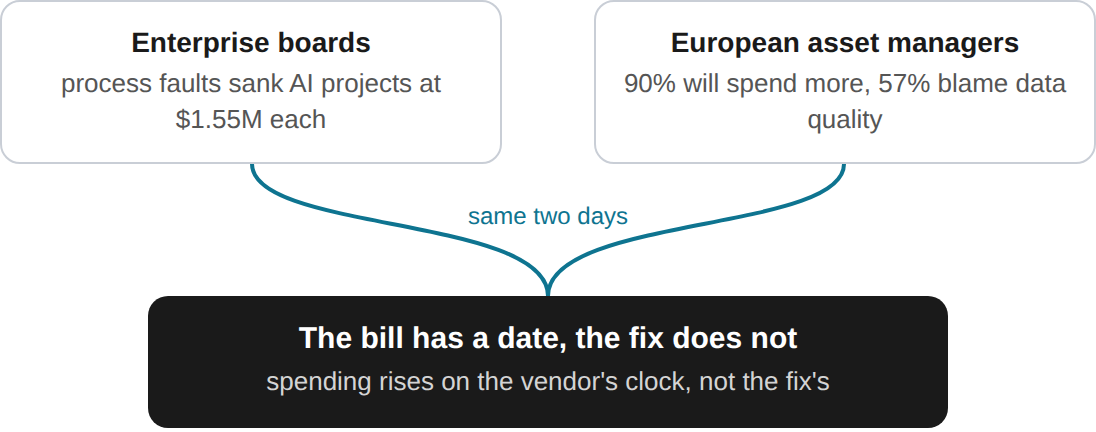
So the spending has a date on it and the repair does not. That is the gap the meter reads.
Today's context on 7wData
- Cohesity joins OpenAI's Daybreak Defense Network to test its own software On 24 November Cohesity, the AI and data security company, said it joined OpenAI's Daybreak Defense Network and plans to test its own identity security software with OpenAI's cyber AI models; testing has not started.
- Schneider Electric agrees to buy PTC for $22.6 billion, with Cognite still pending On 5 October 2026 Schneider Electric agreed to buy PTC for about $22.6 billion in cash, and its separate purchase of Cognite, the industrial data company, is agreed but still awaits regulatory approvals.
- Sierra says it is raising $1.75 billion at a $30 billion valuation On 23 November Sierra, the AI customer service company, said on its blog that it is raising $1.75 billion at a $30 billion valuation, led by Greenoaks and Lightspeed Venture Partners, with no close announced yet.
Advertisement
Run Your First ChatGPT Ad Test

ChatGPT has more than 1 billion weekly users. The free ChatGPT Ads for Startups guide covers how targeting works, how to write a card with about 16 characters of headline and 32 of copy, and five steps to launch a test you can track from click to pipeline.
Pick one high-intent topic. Launch. Measure.
Also today
- Agon raised $70 million at a $450 million valuation to build a European defence AI lab, with the UK's National Security Strategic Investment Fund and its Sovereign AI Fund both in the round. (3 min read)
- OpenAI says it has solved a 57-year-old problem in matrix multiplication, the operation underneath most AI computation. (4 min read)
- JPMorgan expects about $450 billion of AI-related debt issuance in 2027 before it plateaus. (2 min read)
The ArgumentAsk to be stopped, keep driving
This week the US vice president told the AI labs not to build a monster and then come to Washington asking for regulation. That line is uncomfortable for me, because I have spent most of this year arguing the opposite way around.
In the same days, Dario Amodei called publicly for a slowdown in AI development, and one of Anthropic's own researchers, Jacob Coxon, said he was leaving the industry because companies are racing toward systems nobody can control.
Any company that wants the race slowed is free to slow down. Asking the state to do it turns a decision you control into a petition you can lose.
Which of your AI suppliers has put a safety test into your contract rather than into a blog post?
My call: by 30 June 2027, at least one frontier AI lab will have a named pre-release safety test written as a binding term in a signed government or enterprise contract, reported publicly.
If you have a line on your own AI bill that nobody in the building could explain, hit reply and tell me.
Yves
Tomorrow, the Scoreboard: I grade my own calls of the past week, the misses included.
Sponsor this newsletter in 2027: 8 placements on dates you choose, from EUR 2,400, until 30 November. Book: 7wdata.be/sponsor-2027
Ins7ghts Daily is published by 7wData.