

In partnership with


 So, What Actually Happened?
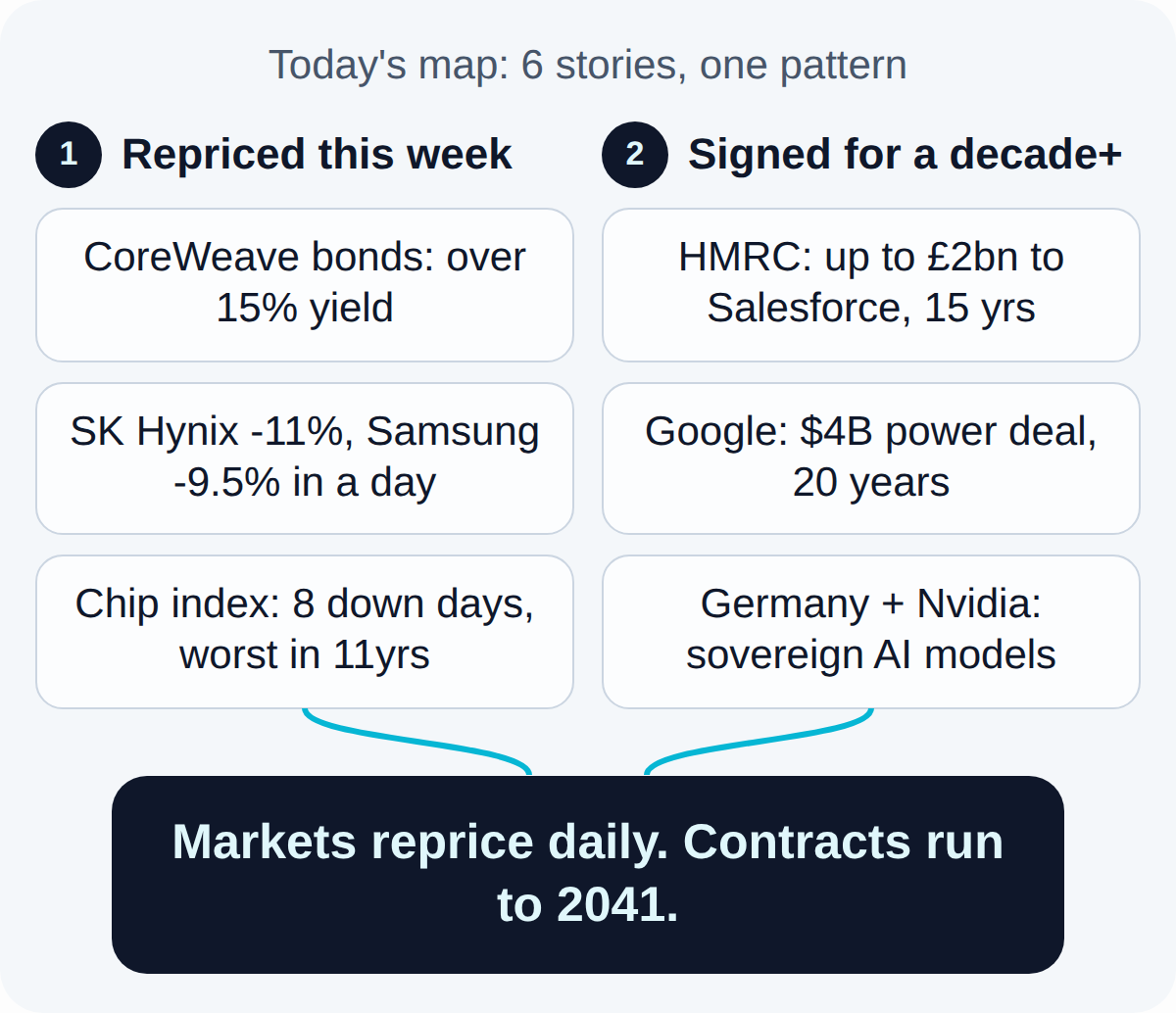
Saturday, and what I keep going back to is how fast a price can change its mind. Chip stocks closed an eighth straight losing day, the longest run in roughly eleven years, and some of CoreWeave's long-dated bonds are now yielding above 15%. We scanned 190,000 articles this week so you don't have to. In the same window, Britain's tax authority handed Salesforce up to £2 billion on an agreement that can run fifteen years, Google signed a twenty-year power contract for a $4 billion fuel-cell project in Wyoming, and Berlin lined up a sovereign-model deal with Nvidia. Four prices, two clocks. One set gets marked before lunch every morning. The other set is dated 2041 and nobody marks it at all.
The Bottom Line: The market repriced AI in eight sessions. The deals signed during those same eight sessions run to 2041.
Advertisement
Your AI prompts are leaving out 80% of what you're thinking.

When you type a prompt, you summarize. When you speak one, you explain. Wispr Flow captures your full reasoning (constraints, edge cases, examples, tone) and turns it into clean, structured text you paste into ChatGPT, Claude, or any AI tool. The difference shows up immediately. More context in, fewer follow-ups out.
Used by teams at Microsoft, Amazon, and Notion. Try Wispr Flow free on Mac, Windows, iPhone, and Android.
 The Tracks That Matter
1. Lenders Now Want 15% To Hold A GPU Cloud's Debt
The eight-day fall in the chip index is the headline, with SK Hynix off 11% and Samsung 9.5% in a single session and Nvidia about 9% below its early-October peak. The number underneath it is the one to keep. Yields on some of CoreWeave's long-term bonds have pushed above 15%, while the company still plans hundreds of billions of dollars of build-out through 2030. Reuters spent Friday on exactly that gap, asking whether CoreWeave's debt stress-tests the private-credit money funding the AI build. We ran the other half of this on 16 October: AI-related private loans priced a tenth of a point above everything else. Two markets, one borrower, and one of those two prices is now wrong.
Here's what works: Ask your GPU or inference supplier what it pays to borrow today, not what it charged you last quarter.
2. Britain's Tax Office Just Signed AI Agents Until 2041
HMRC named Salesforce its strategic customer-relationship supplier on an agreement worth up to £2 billion over as long as fifteen years, with Agentforce triaging taxpayer queries and Quantexa supplying live fraud scores to caseworkers. The population behind it is 34 million individuals and five million businesses, and the department wants 90% of routine contact handled digitally by 2030. Staff keep final authority on every taxpayer decision, which is the right sentence to have in a contract and the hardest one to audit in year nine. The term is what makes this your problem too. Fifteen years ties core citizen contact to one vendor's platform until roughly 2041, so data portability and exit terms stop being boilerplate and become the whole deal.
Here's what works: Pull your longest AI-adjacent contract and read two clauses only: how you leave, and in what format your data leaves with you.
3. Germany Is Buying Its AI Independence From Nvidia
Berlin is lining up a wide-ranging cooperation agreement with Nvidia worth hundreds of millions of euros, built around SOOFI, the Sovereign Open Source Foundation Models project it started in 2025. The stated purpose is physical AI: training robots, self-driving vehicles, high-performance models for German industry. It is expected to be announced at the Invest in Germany conference with Jensen Huang as a guest. The word sovereign is doing a lot of work in that sentence. The sovereignty on offer covers the models, and it is being bought from the company that controls the silicon the models have to run on. Taiwan spent the same week tightening its AI chip export controls, which is the far end of the same dependency.
Here's what works: For every sovereign or on-premises AI claim in your stack, name the single foreign supplier who still has to agree.
Quick hits:
- CERN went looking for a physics model, not a chatbot. CERN and Mistral agreed to build foundation models for scientific discovery, which puts a European lab and a European model vendor on the same side of a question American labs have been answering by themselves.
- Microsoft now has its own 2.8-trillion-parameter base model. Pre-training MAI-Base-2 means the company that distributes somebody else's frontier model has a foundation of its own to fall back on, and that changes every renewal conversation downstream of it.
- Google bought the power before it bought the compute. American Electric Power's $4 billion fuel-cell project in Wyoming runs on a twenty-year purchase agreement using Bloom Energy hardware, so the electricity behind your 2027 workloads was contracted this week.
Advertisement
Harvard Business Review Analytic Services on why fast AI answers create coordination gaps in B2B service. Read the briefing paper.
Your Turn
Which of today's three reads matters most to your work?
 Signal vs. Noise
🟢 Signal: compliance clauses. Compliance took a much firmer grip on everything else moving on Thursday than its volume suggests, and HMRC shows why. What will decide that programme is the exit term and the data-export format, not the agent demo. Most coverage still files compliance under paperwork and misses that it is now where the money gets negotiated.
🔴 Noise: ”AI” as one trade. The bare label pulled the heaviest volume of the day while losing its hold on everything else, and the tape agrees. The chip index fell eight sessions running in the same week Apple's market value passed $5 trillion, up about 26% this year. Briefing ”AI” as a single thing is reading a 2024 chart.
 From the 190K
We scanned 190,000 articles this week. Here's what no one's talking about:
FLock.io shipped a 1.9-billion-parameter model that answers in 31 milliseconds, Liquid AI released d1-ultra with zero output tokens, and the security trade started writing about decision models inside the alert queue.
Three desks filed these separately and none of them read each other. A product wire covered FLock.io's THIS/THAT model, which handled 2.5 million decisions in its first three weeks on hardware as small as a hospital gateway. A research outlet covered Liquid AI's d1-ultra, which reads text or images and returns a probability for every allowed answer in one pass, without writing a word. A security publication covered what decision models do to a SOC platform, where the queue is nothing but choices. Read on the same morning, a category arrived without a launch event: models that pick instead of talk. The driver is cost and latency, not elegance. A generated paragraph burns tokens and seconds; a choice burns neither.
On Monday, list the three highest-volume automated decisions in your estate and ask whether any of them actually needs a model that writes sentences.
Advertisement
Take the prompts our creative team actually uses

The key to maintaining brand quality at scale? Mastering how to communicate with AI models and embedding them into your creative strategy.
Join our honest discussion with Ari Murray, Chief Digital Officer at Salt and Stone, and get 5 tips for expert LLM prompting with ready to run prompts.
 By The Numbers
- Yields on some CoreWeave long-term bonds have passed 15% — the borrowing cost of one of the largest AI landlords, set by people who can sell the paper tomorrow morning.
- The semiconductor index fell 3.83% in a day and has now dropped eight sessions straight — the longest run of consecutive losses in about eleven years, and it happened without a single bad earnings print.
- HMRC committed up to £2 billion over as long as fifteen years — one supplier, 34 million individuals and five million businesses, on a term that runs to roughly 2041.
- SK Hynix fell 11% and Samsung 9.5% in one session — the two firms that actually make the memory inside every AI server, repriced in an afternoon.
- Google's Wyoming fuel-cell project is worth $4 billion on a twenty-year agreement — power for AI now gets bought on utility terms, which is longer than most AI companies have existed.
- FLock.io's 1.9-billion-parameter model handled 2.5 million decisions in three weeks — roughly 0.04% the size of a frontier model, running on devices a hospital already owns.
- See what's rising across AI and data this week →
 Deep Dive: The Two Clocks
A club booking and a pressing run live on different clocks. The booking can be cancelled by Thursday if the advance looks soft, and nobody loses more than a night. The plant has your money, your deadline and six weeks of other people's queue, and changing your mind costs you the whole run.
The clock that gets marked every morning
Equity and bond markets reprice daily, in public, by people who can leave. That is why CoreWeave's paper moved to a 15% yield in days and why a chip index can fall eight sessions without a single company missing a number. Daily marks look like volatility. They are actually the only honest feedback the AI build gets.
The clock that does not move
A fifteen-year taxpayer platform, a twenty-year power agreement, a national model programme built on one vendor's silicon. These carry no daily mark, no order book, nobody paid to doubt them. They are priced once, by people who will have changed jobs long before the term ends, and then they simply run.
Where the two clocks meet is your renewal
Your suppliers sit on the fast clock and sell you the slow one. When their cost of capital moves 500 basis points, the only place that shows up for you is the next renewal, the next price list, the next quiet change to a service tier. You will feel their Thursday in your March.
What Actually Works
- Date every commitment: for your top five AI contracts, write the end year next to the signature year. Anything past 2032 gets read again this quarter.
- Price the supplier, not the product: check your critical vendors' borrowing cost or last raise. A supplier paying 15% is going to find that money somewhere, and your invoice is somewhere.
- Make the exit cheap before you need it: test an actual data export from your biggest AI platform this month. If nobody has done it, the clause is decoration.
- Match term to volatility: for anything repricing weekly (compute, inference, tokens), buy short. For anything physical (power, floor space), buy long. Most teams have those backwards.
Anyone can sell a fifteen-year promise. Ask what they pay to borrow for one.
 What's Coming
Berlin Says Sovereign, Signs American
The Nvidia cooperation agreement is expected at the Invest in Germany conference, which means a national sovereignty programme gets announced with an American CEO on the stage. Watch the procurement language that follows in France and the Nordics: whoever words it first sets what ”sovereign” is allowed to mean in European tenders.
The Next AI Borrower Gets Priced In Public
Reuters already treats CoreWeave's debt as the stress test for the private credit behind this build-out. The next data-centre or GPU-cloud refinancing will be read as a referendum rather than a transaction, and the spread it clears at will reset what every unlisted peer can tell its own lenders.
Decision Models Arrive In Your Security Stack
The security trade has started publishing on decision models inside SOC platforms because an alert queue is a stack of choices, not a writing task. Expect the same swap in fraud scoring, claims triage and content moderation within two quarters, and expect it to arrive as a vendor release note rather than a strategy.
 For Your Team
Monday's meeting prompt: ”Take our five largest AI commitments and write the year each one ends. Then ask who in this room will still be here. If the answer is nobody, who is negotiating on behalf of the person who inherits it?”
Share-worthy stat: Britain's tax authority signed an agreement worth up to £2 billion that can run fifteen years, covering 34 million individuals and five million businesses, in the same week lenders started demanding over 15% to hold an AI landlord's bonds. One of those numbers is reviewed daily. The other is reviewed in 2041.
Go deeper: Track where AI money is actually landing in real-time →
 The Track of the Day
”AI is likely to pay off eventually, but investors are getting sick of all the hand-wringing over near-term returns.”
Hannah Pedone, MarketWatch
DataTrek's Nicholas Colas gave the week its name: the AI burnout trade. Not disbelief, just exhaustion with being asked to wait. And exhaustion is the dangerous one, because a market that stops arguing stops paying a premium for the story and starts paying for the cash. Every fifteen-year signature made this week was made on the old price.
We scanned 190,000 articles this week so you don't have to. Data Pains → Business Gains.
Published: October 17, 2026 | Curated by Yves Mulkers @ Ins7ghts
1,300+ articles scanned. 7 stories selected. Our AI distills the noise into signal—in seconds. Get early access →
Know someone who'd find this useful? Share your unique referral link →
Want Your Own AI Intelligence Briefing?
Our platform analyzes 1,000+ sources daily and delivers personalized insights in seconds.
Join the Waitlist →Founding members: Lifetime discount • Priority access • Shape the product