

In partnership with

Somebody else's rulebook is inside the AI you buy.
Three announcements from yesterday, all out of trades where being wrong costs real money: insurance and law. In each one an AI company supplied the product and a firm that has been doing the work for decades supplied the rules underneath it. Two of those rulebooks now carry a price.
Advertisement
Replace your traditional insurance broker.

WithCoverage replaces your company’s traditional insurance broker with an AI-enabled team of insurance experts and attorneys. A few things that make us better:
40+ carriers compete for your business instead of 2 or 3.
We operate on a Flat Fee instead of broker commissions
You get a platform to manage policies, claims, COIs, etc.
1000+ businesses (Gopuff, Polymarket, Opendoor) replaced their traditional broker with us.
Let us review all your policies for free to show you how we can save you money and better protect your business.
Your broker will not be notified. This is simply our way to earn your trust.
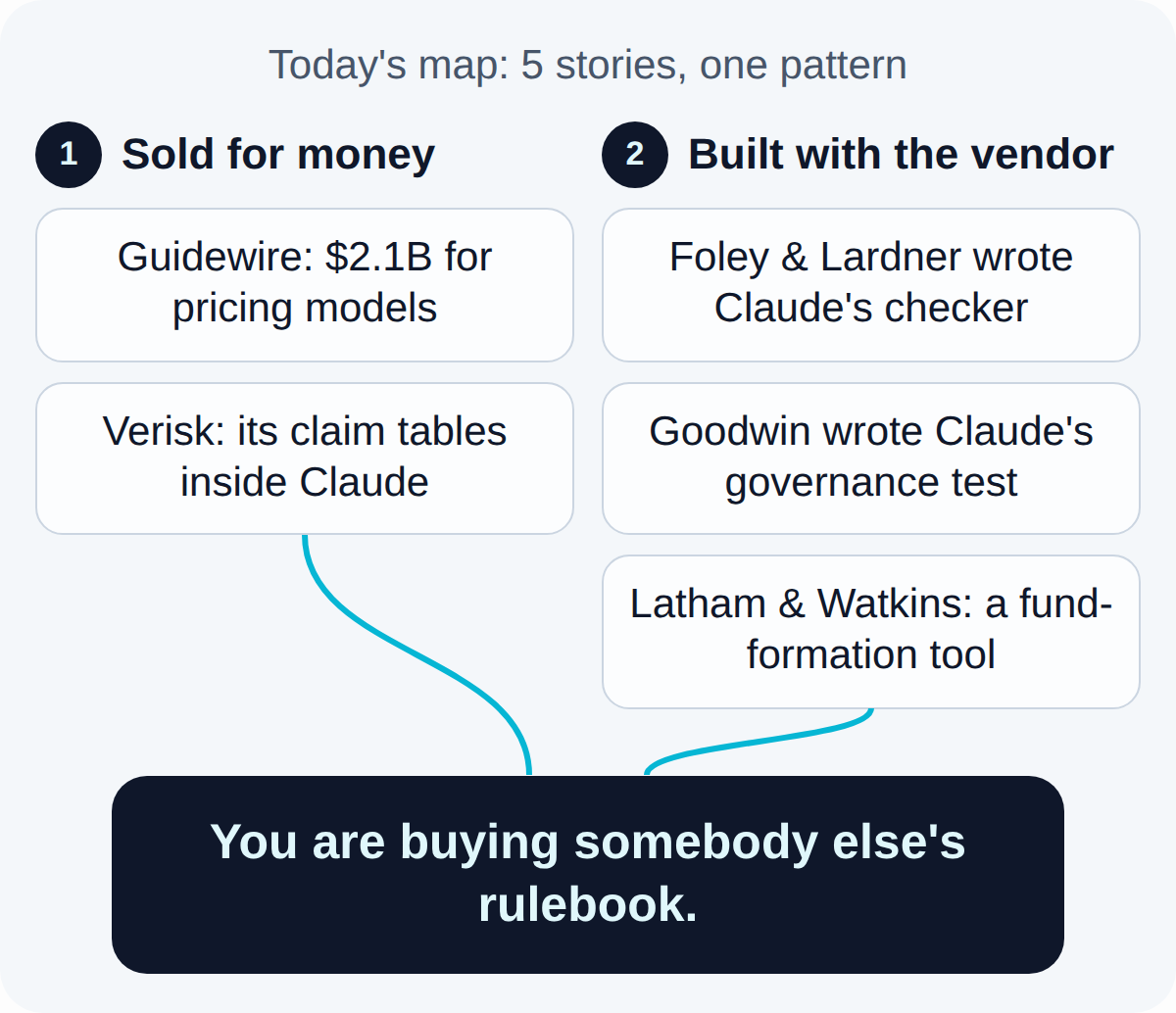
1. Guidewire put $2.1 billion on how insurers price risk
Guidewire agreed to buy hyperexponential, an insurance underwriting software company, for up to $2.1 billion. Chief executive Mike Rosenbaum put agentic underwriting at the centre of the deal.
Underwriting is an insurer putting a price on a risk and then eating the loss when that price was wrong.
Eight days earlier, on 20 October, Guidewire had already shown its own agent work: at its Connections conference it introduced the Qusar release, an agentic framework with assistants for claims, policy servicing and development tasks. So the framework came out of its own shop and the pricing judgement came off the market.
I read the $2.1 billion as the price of judgement that is already running at insurers who trust it. Guidewire can ship an assistant in a quarter; it cannot ship rate decisions an actuary will sign, and an agent that proposes a premium nobody can trace back to a method is an agent no insurance regulator waves through. Which makes the audit trail on the acquired models the real asset in this deal, not the agents. If I ran a carrier on Guidewire, I would want it in writing which of my own rating rules survive the migration, and who signs for the ones that arrive with the models.
2. Verisk moved its claim-cost tables into other people's AI
Verisk did two of these on one day. It opened an integration with Amazon Quick that gives insurers its ISO Loss Costs and Premium Audit Advisory Service content, and it expanded its Underwriting Intelligence offering inside Anthropic's Claude, with extra resources and a Benchmark connector.
Loss costs are the reference numbers for what a type of claim tends to cost. A general model has no way of knowing them.
A month before, on 29 September, the traffic ran the other way: Truepic's image and video authentication went inside Verisk's own ClaimSearch workflow. Verisk now sits on both sides of its own counter.
Verisk has the better half of this trade, and it is the half I would copy. It did not build a chatbot and ask insurers to come to it. It put numbers insurers already pay for in front of whatever tool they happen to have open, so the content gets used in three places and owned in one. The exposure moves to the buyer: once a model answers out of somebody else's licensed tables, the provenance of the figure in your filing is a contract term rather than an engineering choice, and most procurement teams are not reading it that way yet.
Advertisement
Your Boss Will Think You’re an Ecom Genius

Optimizing for growth? Go-to-Millions is Ari Murray’s ecommerce newsletter packed with proven tactics, creative that converts, and real operator insights—from product strategy to paid media. No mushy strategy. Just what’s working. Subscribe free for weekly ideas that drive revenue.
3. Two law firms built the tools Anthropic shipped
Anthropic released more Claude tools for lawyers, and it did not write all of them. An Obligations Checker came from Foley & Lardner and an AI Governance Benchmark from Goodwin, both law firms, alongside work with legal technology companies.
The same day, Latham & Watkins agreed to develop fund-formation tools with Harvey, the legal AI company. Two days before that, on 26 October, OpenAI launched Astra for Law.
What bothers me here is whose name ends up on the answer. A checker built by Foley & Lardner is not Foley & Lardner advising you. It is a tool with a serious firm's reputation on the box, and your signature sits under whatever comes out of it. The EU AI Act (2024) already sorts that out in the direction nobody enjoys, by putting the obligations of use on the deployer, which is you and not the lab. Before I let one of these near a live contract I would ask the vendor a single question: when it flags nothing, who answers for that.
Your Turn
Which of today's three reads matters most to your work?
Advertisement
Your workflows and documentation could open a new revenue stream. AI labs pay to license useful operational data. Bezel helps established companies find a data partner.
Also today
- Alphabet's cloud revenue more than doubled to $30.71 billion, while its free cash flow came in at minus $9.07 billion against an expected minus $36 million (read it). (3 min read)
- Anthropic will hand its seven co-founders one “F share” each, together carrying 50.1% of the votes; the filing itself ran in our 27 October edition (read it). (2 min read)
- General Compute raised $100 million for inference capacity, in a write-up that also has CoreWeave's stock at a 12-month low (read it). (4 min read)
The ArgumentThe hour, and what it was holding
On a call with the project manager, a salesman from the implementation side, somebody I had known for years who always tried to put me in a bad light, said: “You never stay long.” I said: “I don't need that long to fix things, as you guys do.”
Yesterday two law firms put a piece of what they know inside somebody else's product, and a third went and built one with a legal AI company. Same argument about what a client is actually paying for, now with a vendor standing in the middle of it.
If your advisers put their judgement in a tool you can buy, I honestly do not know what you are still paying them for.
My call: by 30 June 2027, one of the firms now building these tools, or a data vendor in the same position, names a licence fee or a revenue share in public instead of calling it a collaboration. It goes on the Scoreboard.
If you have asked a vendor whose judgement is inside its AI and got an actual name back, hit reply and tell me.
Yves
Tomorrow, the Scoreboard: I grade my own calls of the past week, the misses included.
Reach data and AI leaders in this inbox: book a placement.
Ins7ghts Daily is published by 7wData.