

In partnership with


 So, What Actually Happened?
Wednesday, and I opened the wires expecting a model story. I got a gear list. Mistral closed €3 billion at a €21 billion post-money valuation, and the names on the round are a chipmaker, a lithography company and a European Commission fund, which is not what a venture round usually looks like. We scanned 190,000 articles this week so you don't have to. Two desks over, a dark web listing put 153 million driver's license scans on sale from an identity-checking vendor most people have never heard of, and Finnish lawyers spent the day explaining when a breach stops being a company fine and becomes a criminal matter for a named director. Three stories, three desks, one floor of the building.
The Bottom Line: The money, the breach and the personal exposure all landed one layer below the model today, and almost nobody has their name on that layer.
Your site is losing leads. You can't see where.

Your site looks fine to you — and it's still losing leads. SureThing renders any URL in a real browser, scores 9 dimensions, and ranks the fixes by wasted impact.
 The Tracks That Matter
1. Samsung, ASML And A Public Fund Bought Into Mistral
Read the cheque, not the headline. Mistral's €3 billion Series D closed at a €21 billion valuation, roughly 76% larger than last September's round, and the lead is Samsung Electronics. Around it: ASML, Nvidia, Salesforce Ventures, BlackRock-managed funds, and the European Commission's own Scaleup Europe vehicle. That is a supply chain and a government buying a position in a model company, not a growth fund chasing a multiple. Mistral's CFO was careful to say Microsoft's compute commitment is separate from equity, which tells you how closely people are now reading who owns what. Meanwhile a third of enterprise leaders cannot explain what sovereign AI means when asked. The buyers of it can.
Here's what works: When a vendor pitches sovereignty, ask who owns their equity and where their compute physically sits. Two questions, and most decks cannot answer either.
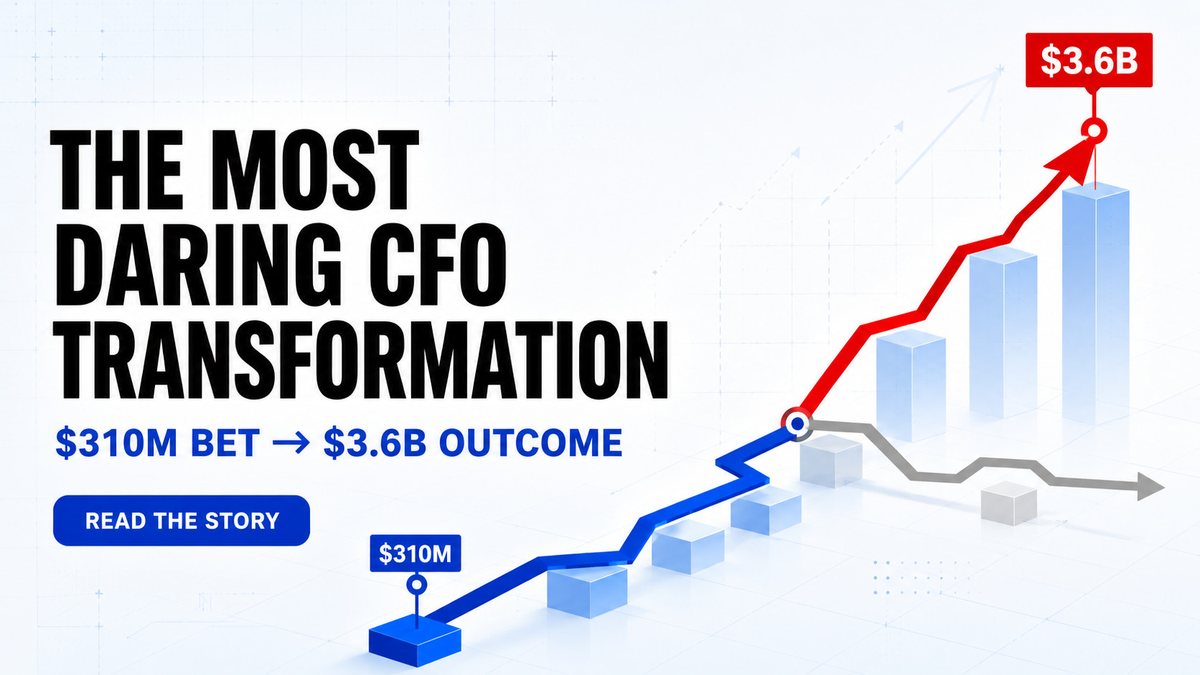
A $310M bet nobody liked. A $3.6B outcome.
Acxiom overpaid for LiveRamp, by their own CFO's admission. Then they sold the business holding 75% of the staff and 100% of the cash flow, and kept the one that was not earning yet. Warren Jenson (ex-CFO at Amazon, Delta, NBC) on how he got the board there.
Read the full story →Free download, registration required.
2. 153 Million ID Scans Existed Because Nobody Unbundled Storage
An identity vendor running more than 21 million verifications a month across 20,000 locations had its document images turn up on a Russian-language marketplace, and nine class actions were docketed in Louisiana in three days. The part that should bother you is why the images were there at all. US banking rules require you to keep a description of the identity document, not a picture of it. Capture and storage shipped as one feature, nobody separated them, and a compliance requirement quietly became a hoard. Same shape at Manchester Airports, where a Wi-Fi sign-up page collected far more than network access needed and 8.7 million customer records were published for free after the group refused to pay.
Here's what works: Pick one system that collects identity documents. Ask what the retention default is and who chose it. If the answer is ”the vendor's default”, you just found your finding.
3. Finland Is Getting Ready To Name The Person
Most AI-risk coverage still talks about fining companies. Finnish prosecutors are now coordinating with the data protection ombudsman and the national cyber centre to look at individual criminal exposure after cyber incidents, under a section of the national data protection act that sits entirely outside GDPR's administrative machinery. Two details make this operational rather than theoretical. Directors' and officers' insurance funds a defence for negligence but does not cover proven intentional wrongdoing, so the policy stops exactly where the new risk starts. And every memo, chat message and internal blame email written after an incident becomes evidence. The exposure is not the breach. It is the forty-eight hours after it.
Here's what works: Write the first-hour breach protocol before you need it, and put one named person in charge of who speaks. Improvised comms is what turns an incident into a prosecution.
Quick hits:
- A mathematician published the receipts on an AI proof. Tristan Buckmaster's account of being asked to time his Euler paper around OpenAI's Navier-Stokes announcement is the first inside look at how these claims get staged, and the compute bill reportedly dwarfed the prize.
- Healthcare AI got another three-comma valuation. Forus was valued at $3 billion in its latest round, in a sector where the regulatory clock runs slower than the funding one.
- Snowflake crossed $1.49 billion in quarterly revenue. The AI strategy expansion is real money now, which makes the warehouse layer a much harder line item to renegotiate next year.
Your identity deserves 24/7 protection

Identity theft can happen to anyone. Coveron monitors your credit, dark web, and financial activity to catch fraud before it costs you. One scam can cost you everything, protect yourself now, the first 100 users get 20% off with code beehiivenewsletter.
30-day money-back guarantee. Terms and conditions apply.
 Signal vs. Noise
🟢 Signal: personal liability after a breach. Finland is lining up prosecutions of named directors rather than fines on companies, Missouri's new age-verification law forbids the verifier from keeping any identifying data at all, and nine US class actions landed against one identity vendor in three days. Most coverage is still counting corporate fines, which is the part a balance sheet absorbs.
🔴 Noise: ”AI governance” as a phrase. It pulled a hundred mentions on the wires yesterday and less and less is actually hanging off it. The real work moved to a much narrower question, who keeps which file and for how long, and no amount of new framework documentation answers that one.
 From the 190K
We scanned 190,000 articles this week. Here's what no one's talking about:
Privacy Global published a playbook for Indian banks preparing for the DPDP Act, Moonshot Partners bought the weather-data company CustomWeather outright, and a small outfit called MindMap ran a live demo of a retrieval system that never leaves the customer's own perimeter.
Read one at a time, these belong to three different desks: an Indian compliance blog, a US media M&A wire, an AI product demo. Read them on the same morning and they are the same move. Somebody decided that renting the data layer was the risk and buying or containing it was the fix. A bank rewriting where customer records may legally sit, a buyer acquiring the feed instead of licensing it, a vendor selling containment as the product. That is the same instinct that put Samsung and a European public fund on Mistral's cap table this week, just with three zeros fewer.
What changes on Thursday is one line in your vendor review. Not ”is it secure”, which every vendor answers yes to. Ask where the data physically rests when nobody is querying it, and watch how many people have to leave the room to find out.
Forget Elon's Gadget. Buy the Companies Behind Its Tech.

Every breakthrough device runs on chips, parts, and materials from other companies — most of them public and overlooked. Our analyst named 3 positioned to profit from Elon's July 22 launch, plus the most undervalued name in the supply chain.
 By The Numbers
- Mistral raised €3 billion at a €21 billion post-money valuation — roughly $24 billion, up more than 79% from a round that closed twelve months ago, and led by a hardware company rather than a fund.
- 153 million driver's licence scans advertised on a dark web marketplace — against 239.8 million licensed drivers in the United States, which puts the exposure at roughly two in three of them.
- 8.7 million Manchester Airports customers had their records published for free — the group refused to pay, and the attackers released everything as a message to the next victim who considers refusing.
- Snowflake quarterly revenue topped $1.49 billion — the storage-and-query layer is now a bigger line item than most of the model spend sitting on top of it.
- Grindr settled for £26 million in the UK over HIV status data sharing — the data was shared through an ad pipeline, which is where sensitive fields usually leave a company without anyone approving it.
- See what's rising across AI and data this week →
 Deep Dive: Nobody Books The Power Distro
Every DJ I know can tell you about the night the sound died. Not because the set was bad. Because somebody underspecced the power distribution box behind the stage, and at 1am the whole rig browned out. The crowd blames the DJ. The DJ blames the promoter. The promoter booked the lineup and never looked at the gear list. That is roughly where enterprise AI sits right now.
The gear list is the real lineup
When a chipmaker, a lithography company and a public investment vehicle all take a position in the same model company, they are not betting on the model. They are securing a dependency. That is a supply chain move dressed as venture capital, and it is the clearest read available on where the scarce thing actually is.
Defaults are decisions somebody made once
An identity vendor kept document images because capture and storage arrived bundled and no one separated them. That is not negligence, it is inheritance. Half the sensitive data in your estate is there because a product manager somewhere ticked a box in 2019 and nobody has asked why since.
Somebody's name goes on the rig
Finland is the early signal on where this ends: not a fine the company absorbs, but a person a prosecutor can name. Insurance covers the careless version and stops at the deliberate one. The moment personal exposure attaches, the plumbing stops being an IT concern and becomes a board one.
What Actually Works
- Read the cap table before the roadmap: who funds a vendor tells you what they will protect when priorities collide.
- Separate capture from retention in every contract: the two are almost always bundled, and the second one is where all the liability lives.
- Name one person per data-holding system: not a team, a person, with the authority to delete. Shared ownership is how retention defaults survive for seven years.
- Rehearse the first hour, not the recovery: what gets written in the first sixty minutes after an incident is what a prosecutor reads later.
The lineup gets the poster. The distro box gets the blame. Book both.
 What's Coming
Retention Bans Replace Retention Policies
Missouri's age-verification statute, in force since late August, bars the verifier from keeping any identifying information. That is a different instrument from a retention policy: it removes the discretion instead of documenting it. Expect more of these, and expect identity vendors to rebuild around not-keeping as a feature they can sell.
Sovereign AI Moves From Slide To Contract Clause
A third of enterprise leaders cannot define sovereign AI while governments and chipmakers are already taking equity positions to secure it. That gap closes the hard way, through a procurement template. The first big contract with a data-residency clause that actually bites will set the language everyone else copies.
The Data Layer Gets Priced Separately
Vendors are starting to sell the plumbing as its own product, from AI data-prep tooling aimed at the gap between AI spend and AI results to runtime controls on what agents may touch. When a layer gets its own price tag, it gets its own budget owner. Watch for that role to appear in org charts this quarter.
 For Your Team
Thursday's meeting prompt: ”Name every system where we store a copy of a customer's identity document. For each one: who decided to keep the image rather than a description, what the retention period is, and who has the authority to delete it today. If we can't answer the first question for any system, that system is running on somebody else's default.”
Share-worthy stat: A dark web listing advertised 153 million driver's licence scans from a single identity vendor, against 239.8 million licensed drivers in the entire United States. The vendor's own marketing says it runs 21 million verifications a month across 20,000 locations. The scale of the breach is a direct function of a storage default nobody chose.
Go deeper: Track where AI money and AI liability are moving in real time →
 The Track of the Day
”Because capture and storage were bundled together, and nobody unbundled them.”
On why an identity vendor was holding 153 million document images in the first place
I have been in enough architecture reviews to know that most of what a company holds, it holds by accident. Not by decision, by inheritance. Somebody shipped a feature with two things in one box, a procurement team bought the box, and seven years later a prosecutor is asking who chose that. Nobody chose it. That is the whole problem.
We scanned 190,000 articles this week so you don't have to. Data Pains → Business Gains.
Published: September 9, 2026 | Curated by Yves Mulkers @ Ins7ghts
1,300+ articles scanned. 7 stories selected. Our AI distills the noise into signal—in seconds. Get early access →
Know someone who'd find this useful? Share your unique referral link →
Want Your Own AI Intelligence Briefing?
Our platform analyzes 1,000+ sources daily and delivers personalized insights in seconds.
Join the Waitlist →Founding members: Lifetime discount • Priority access • Shape the product